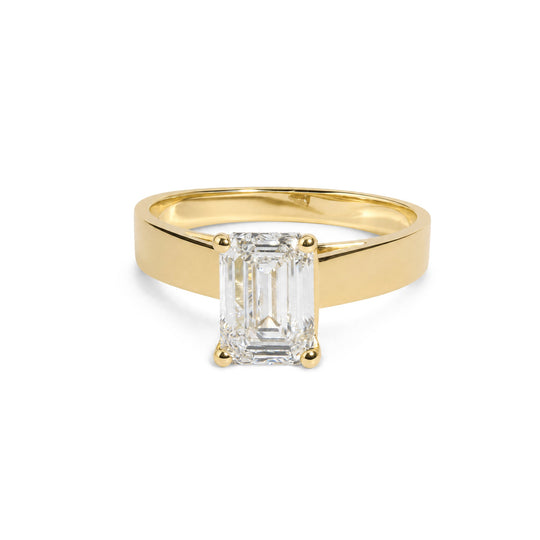
Emerald Cut Rings: Shape, Clarity, and Settings
The Emerald Cut's Step Faceting and What It Creates
The emerald cut is a rectangular step-cut shape with long, open facets that run parallel to the stone's edges. Where brilliant cuts scatter light into many points of sparkle, the emerald cut produces broad, layered reflections known as a hall-of-mirrors effect. The result is a calm, architectural character rather than the fiery display of a round brilliant. Buyers choose the emerald cut specifically for that refined depth and geometric precision over sparkle volume. For the full range of ring styles across all cuts, the rings range covers every available style.
Emerald Cut Diamond Rings and the Clarity Requirement
The emerald cut's open step facets make inclusions more visible than they would be in brilliant-cut stones, which means clarity plays a larger role in the purchase decision than in most other ring styles. VS1 or VS2 clarity is the typical starting point for a stone that appears clean to the naked eye. Color matters differently in step-cut stones too: the broad horizontal flashes reveal subtle color tones more readily than brilliant cuts, which mask warmth through scattered light. Buyers who prioritize face-up size often find the cut's efficiency compensates for the stricter clarity floor. For the full diamond range in ring settings, the diamond rings range covers the full selection.
Why Emerald Cut Rings Suit Engagement Buyers
The emerald cut's association with Art Deco design and Old Hollywood aesthetic makes it a strong choice for buyers who want an engagement ring with a distinctive character. The rectangular shape elongates the finger and has a face-up surface area larger than a round of the same carat weight, which makes it an efficient way to maximize face-up size. It reads as distinctly different from the standard round brilliant, which suits buyers who want their ring to stand apart. White gold and platinum are the most common metal choices because the cool neutral tone reinforces the cut's clean geometry. For the full engagement ring selection, the white gold engagement rings range covers every option in this metal.
Setting Styles That Complement the Emerald Cut
Four-prong solitaire settings are the most widely used with emerald cuts because the minimal metal allows the full step-cut surface to display without obstruction. Bezel settings protect the stone's four corners from everyday impact, the most structurally vulnerable aspect of the rectangular shape. Three-stone settings flanked by tapered baguette side stones reinforce the cut's geometric character and represent the most historically consistent application. East-west settings orient the stone horizontally across the finger for a more unconventional read. For the most open presentation of the emerald cut, the solitaire rings range covers the full selection. Every order ships free with a 30-day return policy.
Frequently Asked Questions
What is an emerald cut ring?
An emerald cut ring features a center stone shaped in the rectangular step-cut style originally developed for emerald gemstones, though now applied most commonly to diamonds. The cut has long, open facets running parallel to the stone's edges, creating a hall-of-mirrors depth of reflection rather than scattered sparkle. The typical emerald cut has a length-to-width ratio between 1.3 and 1.5, giving it an elongated rectangular profile. Buyers choose the shape for its understated elegance, architectural precision, and strong face-up size relative to carat weight.
Why does the emerald cut require higher clarity grades?
Emerald cut diamonds require higher clarity grades than brilliant cuts because the open step facets display inclusions more readily. In a round brilliant, the many small facets scatter light and visually minimize inclusions; in an emerald cut, the broad reflective facets reveal them clearly. VS1 or VS2 clarity is the standard recommendation for an eye-clean emerald cut diamond. This higher clarity floor means buyers pay more per carat for a comparable eye-clean result compared to most brilliant shapes.
Does an emerald cut ring look larger than a round ring of the same carat?
Emerald cut diamonds typically show a larger face-up surface area than round brilliants of the same carat weight because the step-cut shape retains more material at the top of the stone during cutting. A one-carat emerald cut measures approximately 7 by 5 mm and appears larger face-up than a round brilliant of the same weight. The elongated rectangular shape also visually lengthens the finger. These factors make the emerald cut a practical choice for buyers who want maximum visible stone for their carat weight.
How should I protect the corners of an emerald cut ring?
The emerald cut's four corners are the shape's most structurally vulnerable points during daily wear because they extend slightly beyond the central body of the stone and can chip on impact with hard surfaces. V-prong settings grip these corners without obscuring the step-cut facets. Bezel settings protect the corners entirely by surrounding the stone's perimeter with metal. Four-prong settings positioning a prong at each corner also provide protection in a more open presentation. Buyers who plan daily wear should prioritize corner-protective settings.
Is the emerald cut considered a vintage style?
The emerald cut has strong historical associations with the Art Deco period of the 1920s and 1930s, when its geometric precision and stepped lines aligned with that era's design principles. However, the cut does not read exclusively vintage in contemporary settings. In a clean four-prong or bezel setting with minimal metal detail, the emerald cut reads as modern and architectural. In an angular Art Deco setting with baguette side stones, it reads as period-specific. Whether the cut appears vintage or contemporary depends on the setting, not the cut itself.
How long do emerald cut diamond rings typically last?
Emerald cut rings are as durable as any other diamond ring because diamonds rank at 10 on the Mohs scale and will not scratch under normal wear. The setting is the key durability consideration specific to this shape: the four corners are vulnerable to chipping from direct impact with hard surfaces, and a secure corner-protective setting substantially reduces that risk. In a well-made setting with protected corners, an emerald cut ring will provide decades of reliable wear. Standard annual inspection for stone security and setting wear is recommended.
Are emerald cut rings more affordable than round brilliant rings?
Emerald cut diamonds often cost less per carat than round brilliants of comparable quality because the round brilliant commands the highest market premium due to its popularity and the significant weight loss during cutting. At the same carat weight and quality grade, an emerald cut typically costs less per carat. However, the higher clarity requirement partially offsets this advantage. Buyers who accept a VS1 or VS2 clarity floor and prioritize visible size and face-up efficiency generally find the emerald cut provides more stone for their budget than a comparable round.
How does the emerald cut compare to the princess cut?
The emerald cut and the princess cut are both rectangular to square shapes but use fundamentally different faceting. The princess cut applies brilliant faceting and produces sparkle comparable to a round brilliant. The emerald cut uses step faceting and produces broad, calm reflections rather than scattered light points. Clarity requirements are stricter for emerald cuts because inclusions read more clearly in the open step facets. Buyers choosing between them are deciding between sparkle volume and architectural depth. The princess diamonds range covers the full selection for comparison.
What metal color best suits an emerald cut ring?
White gold and platinum are the most widely paired metals with emerald cut rings because the cool, neutral tone complements the cut's geometric precision and Art Deco associations. White metal creates a seamless visual transition to a colorless diamond's body, allowing the step-cut facets to read without tonal interference. Yellow gold suits lower-color-grade diamonds well by warming the stone's tone. Rose gold produces a softer pairing for buyers who want warmth without the traditional register of yellow gold. The full range of white gold ring settings is available in the white gold rings range.
Do halo settings work with the emerald cut?
Halo settings in emerald cut rings typically use rectangular or elongated halos that follow the stone's shape rather than surrounding it in a round halo, which would look inconsistent with the step-cut's clean geometry. A rectangular halo of small round brilliants increases the stone's apparent size and adds sparkle that the emerald cut itself does not provide, creating contrast between the calm step-cut center and the active surrounding halo. Buyers who want a larger-looking ring without increasing the center stone carat weight find this a practical option. The halo rings range covers the full halo selection.
Use left/right arrows to navigate the slideshow or swipe left/right if using a mobile device