How Do You Build a Complete Garnet Jewelry Collection?
Garnet Necklaces: The Foundation of a Red Gemstone Collection
A garnet pendant necklace positions the deep red stone at close viewing distance against skin, where the color reads most richly. Garnet's natural, untreated color and its availability in deep, saturated material make it a strong choice for pendants that need to carry visual presence on their own. A solitaire or halo garnet in yellow or rose gold on an 18-inch chain is the most versatile daily format. For all garnet necklace styles across settings and metals, garnet necklaces covers the complete category.
Garnet Within the Warm-Toned Gemstone Family
Garnet's deep red sits within a warm-toned gemstone palette alongside citrine (golden yellow), Imperial Topaz (orange-yellow), and ruby (vivid red). Building across these families creates a warm-palette collection with clear visual coherence. Garnet's distinctive dark red is complemented naturally by the lighter warmth of amethyst or citrine in adjacent pieces. For the full range as a warm-palette complement, amethyst jewelry shows how the contrasting cool quartz variety spans the same formats.
Garnet vs. Topaz: Warm Stone Comparison
Garnet (red) and topaz (blue or orange) serve very different visual roles, but both are widely available colored gemstones. Topaz at Mohs 8 is harder; garnet at 6.5 to 7.5 has no cleavage. Both are practical for pendants and earrings in daily wear. For buyers comparing how topaz handles the full jewelry range as a color counterpoint to garnet, topaz jewelry provides the direct comparison.
Garnet and Citrine as a Warm Gemstone Pairing
Garnet's deep red and citrine's golden yellow are natural warm-palette companions in a fine jewelry collection. Both are widely available in large, clean stones. Both serve as birthstones for consecutive months (January for garnet, November for citrine). For buyers who want to build a warm-toned collection across two complementary stones, citrine jewelry shows how the golden complement spans the same formats. Every order ships free with a 30-day return policy.
Frequently Asked Questions
What is garnet and what makes it distinctive in fine jewelry?
Garnet is a family of related silicate minerals sharing a common crystal structure. The most common jewelry garnet is almandine, producing the deep red that most buyers associate with the name. Unlike most commercially popular colored gemstones, red garnet is typically natural and untreated — no heat treatment or irradiation is used, and the color is the stone's own. This gives garnet an authenticity that treated stones like blue topaz and citrine do not have.
Is garnet always red, or does it come in other colors?
Garnet occurs in nearly every color except blue. Almandine and pyrope produce the classic deep red. Rhodolite is pink-purple. Spessartite is orange-red. Tsavorite is vivid green and is one of the rarest and most valuable garnet varieties. Demantoid is a bright green garnet with a dispersion higher than diamond, making it exceptionally brilliant. For most garnet jewelry, the stone referred to is red almandine or pyrope.
What type of garnet jewelry is best for daily wear?
Pendants and earrings are the most practical garnet formats for daily wear because the stone faces minimal direct contact. Garnet has no cleavage planes, which means it is less prone to chipping than topaz, but its Mohs 6.5 to 7.5 hardness means surface scratching is a consideration in rings worn daily. For regular everyday garnet wear, a pendant in a bezel or secure prong setting is the most reliable format.
What occasions suit garnet jewelry as a gift?
Garnet is the January birthstone, making it the most direct choice for January birthday gifts. It is also the gem for 2nd wedding anniversaries. Beyond those formal occasions, garnet's long historical associations with love, protection, and vitality make it meaningful for Valentine's Day and romantic milestones. The deep red color is visually distinct and immediately recognizable as a deliberate choice rather than a generic gesture.
Is garnet a treated gemstone?
Most red garnet in commercial jewelry is natural and untreated. Unlike blue topaz, which requires irradiation, or most commercial amethyst, which is heat-treated, red almandine and pyrope garnet typically reach the market in their natural color without enhancement. This is relatively uncommon among popular colored gemstones and is one of garnet's distinguishing characteristics for buyers who prefer natural, unenhanced stones. For how treatments work across colored stones and why garnet's natural color stands out, read understanding gemstone treatments.
How should garnet jewelry be cleaned and stored?
Clean garnet jewelry with warm water, mild dish soap, and a soft brush. Rinse fully and dry with a lint-free cloth. Avoid ultrasonic cleaners and steam cleaners. Store in a soft pouch or lined box away from harder stones like diamonds or sapphires that can scratch the surface. Remove before exercising, swimming, and activities involving chemical exposure. Garnet's natural, untreated color is stable under normal conditions and does not require special light protection, unlike some heat-treated colored stones.
What garnet necklace styles are available?
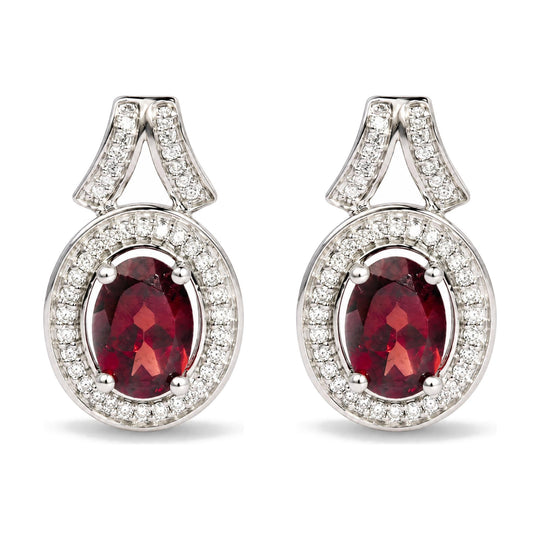
Garnet necklaces are available in solitaire pendant, halo pendant, and multi-stone formats across yellow gold, rose gold, and sterling silver. Solitaire settings let the deep red stone stand alone, which works best with well-saturated almandine material. Halo settings with small diamonds add brightness against the dark stone. Vintage-inspired settings with milgrain or filigree detailing suit garnet particularly well given its long jewelry history.
What garnet bracelet styles are available?
Garnet bracelets are available in tennis, bangle, and chain formats across yellow gold, white gold, and sterling silver settings. Tennis bracelets display garnet's deep red continuously around the wrist and are the most visually impactful format for the stone. Multi-stone bands with alternating garnet and metal links suit everyday layering. Single-stone accent bracelets use garnet as a focal point within a simpler band. Yellow gold is the most effective setting metal because the warm tone amplifies the stone's deep red. For the full range of garnet bracelet styles, see garnet bracelets.
Does garnet come with a quality certification?
Most standard red garnet in fine jewelry is sold without independent grading certificates because the stone is abundantly available and individual certification adds cost that the stone's price point does not typically justify. Certificates are more common for rare garnet varieties such as fine tsavorite or demantoid. For everyday red almandine garnet, reputable sellers disclose the stone's origin, treatment status (typically none), and approximate quality. For the full range of garnet formats at varying quality levels, the garnet pendants range illustrates how the stone presents across solitaire and halo settings.
How does garnet compare to tanzanite in fine jewelry?
Garnet and tanzanite serve opposite aesthetic roles: garnet is warm red, tanzanite is cool blue-violet. Tanzanite at 6.5 to 7 Mohs is similar in hardness to garnet. Tanzanite comes from a single source in Tanzania and is geologically finite; garnet is available globally from many deposits and is not rare. Tanzanite is more expensive due to its rarity.
Use left/right arrows to navigate the slideshow or swipe left/right if using a mobile device