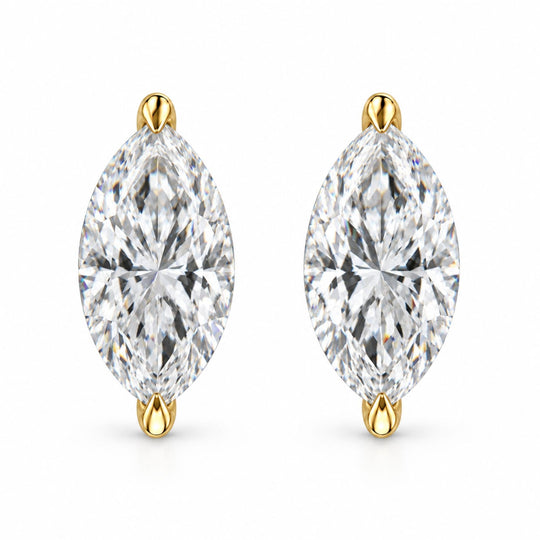
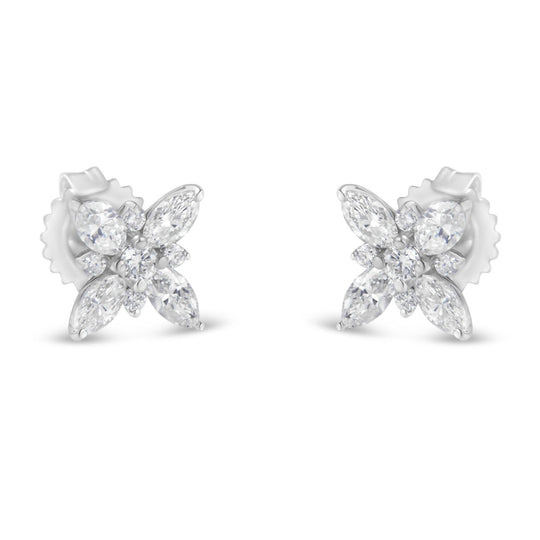
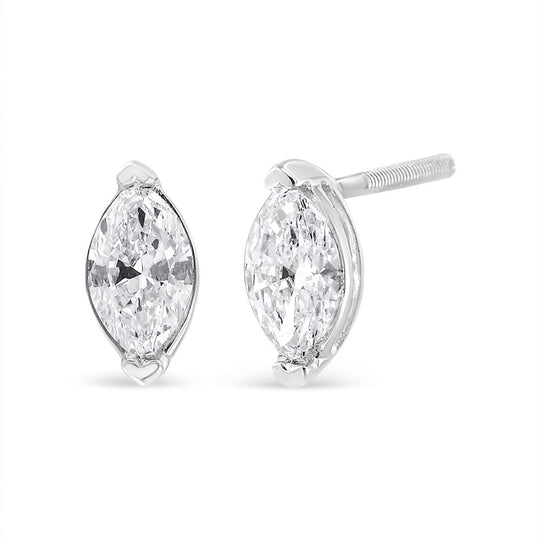
Marquise stones translate well to drop and stud earring settings — the elongated outline reads clearly at the ear and the pointed ends give the shape a distinctive character at any size. Oath's marquise earrings cover stud and drop styles in gold, white gold, rose gold, and sterling silver. Ships free on every marquise earring order, with a 30-day return policy.
Marquise Earrings Within the Full Earring Category
Marquise earrings use the marquise cut's elongated, pointed oval stone shape as their primary design element. The marquise cut produces a distinctive silhouette that differs significantly from round, oval, and cushion cuts at equivalent carat weights, and this uniqueness carries into the earring format where the stone's pointed tips and elongated form create a more directional visual statement than symmetrical cuts. Marquise earrings are available in stud, drop, and hoop configurations across gold and platinum settings. Browse the full earrings range for marquise and other earring styles.
Marquise Diamond Earrings
Marquise diamonds deliver strong light return through their 56 to 58 facet modified brilliant pattern, making diamond marquise earrings among the most brilliance-efficient elongated stone earrings available. A pair of marquise diamond studs positioned vertically at the ear creates a graphic, directional accent that differs from the symmetrical presence of a round diamond stud. Diamond marquise earrings in drop format allow the stone's elongated silhouette to read clearly as it moves. For the full diamond jewelry context across all formats, see the diamond jewelry hub.
Marquise Stud Earrings: The Everyday Configuration
Marquise stud earrings place the elongated stone directly at the ear post, where the stone's pointed tips and vertical or horizontal orientation create a more design-forward statement than a standard round stud at the same scale. A vertically oriented marquise stud reads as a more elongating format at the ear, while a horizontally oriented marquise stud emphasizes the stone's width. Both orientations suit everyday wear in 14k gold settings with secure V-prong protection at the pointed tips. Compare stud format options in the stud earrings range alongside marquise configurations.
Marquise Drop Earrings for Occasion Wear
Marquise drop earrings use the stone's elongated silhouette to maximum effect in the drop format, where the stone's length contributes to the earring's overall vertical dimension. A single marquise stone suspended from a fine chain creates a longer visual line at the ear than a round stone of equivalent carat weight because the marquise's pointed tips extend the apparent stone length. Marquise drops suit occasion and formal wear where the stone's distinctive silhouette can read clearly. Browse drop earrings for marquise and other drop format options. Every order ships free with a 30-day return policy.
Frequently Asked Questions
What are marquise earrings?
Marquise earrings are earrings whose primary stone is cut in the marquise shape: an elongated, pointed oval with a modified brilliant faceting pattern of 56 to 58 facets. The cut was developed in 18th-century France and is characterized by its boat-like profile, narrow pointed tips at both ends, and a wider curved middle. In earring form, marquise stones appear in stud, drop, and hoop configurations, each format expressing the cut's elongated silhouette differently at the ear.
What metal setting works best for marquise earrings?
Marquise diamond earrings are most commonly set in white gold or platinum because the cooler metal tones maximize contrast with the diamond's colorless brilliance. Yellow gold settings suit marquise earrings with colored gemstones or buyers who prefer a warmer metal register. 14k gold is the most practical choice for regular wear because the karat hardness maintains the V-prong integrity at the stone's pointed tips. Platinum provides maximum durability for heirloom-quality marquise earrings.
Are marquise earrings difficult to wear daily?
Marquise earrings in secure 14k gold or platinum settings are appropriate for daily wear, but the stone's pointed tips require more attentive care than round or oval stones. The prongs protecting the tips are the first points of potential wear on a marquise earring and should be inspected periodically for security. Stud-format marquise earrings with close-fitting V-prong settings at the tips are the most practical configuration for everyday use.
How does the marquise cut appear at the ear compared to a round cut?
A marquise stone creates a more directional, elongated visual statement at the ear than a round stone of equivalent carat weight because the cut's pointed tips extend the apparent stone size beyond what the actual carat measurement would suggest. A round stone of equal carat weight appears more compact and symmetrical. For buyers who want a stone that reads larger at the ear without increasing the carat weight, the marquise cut delivers a significant apparent-size advantage.
Are marquise earrings suitable as gifts?
Marquise earrings are suitable as gifts for occasions where the recipient is known to prefer distinctive or design-forward jewelry over standard round stone earrings. They suit buyers who want a fine jewelry gift with historical depth, as the marquise cut's 18th-century French court origins give it a story that round brilliant cuts lack. Browse gold earrings for marquise earring options across all three gold tones.
What is the difference between a marquise earring and an oval earring?
Marquise earrings differ from oval stone earrings primarily in the character of the stone's silhouette at the ear. The marquise has pointed tips at both ends while an oval is fully rounded at both ends, creating a more graphic, angular appearance than the oval's smooth ellipse. The marquise's pointed tips also require V-prong settings that an oval does not. For the full range of marquise cut jewelry across all formats, see marquise jewelry.
Can marquise earrings coordinate with other marquise jewelry?
Marquise earrings coordinate naturally with marquise bracelets because both use the same distinctive elongated stone shape at different wearing positions. The combination creates a thematically consistent look where the cut's pointed silhouette appears at the ear and wrist simultaneously. The scale difference between an earring stone and a bracelet stone prevents the combination from reading as identical. Browse marquise bracelets for bracelet options in the same cut configuration.
Are marquise earrings good for a minimalist look?
Marquise earrings in smaller stone sizes and stud configurations suit a minimalist aesthetic because the stone's distinctive silhouette creates visual interest without requiring elaborate metalwork or multiple stones. A pair of small marquise studs in plain 14k gold makes a deliberate design statement in a compact, wearable format. The pointed tips give even small marquise studs a more distinctive character than round studs of the same carat weight.
What is the best way to orient a marquise stud at the ear?
Marquise studs can be oriented vertically or horizontally at the ear, with each orientation creating a different visual effect. Vertical orientation aligns the stone's length from top to bottom, creating an elongating effect and making the stone appear taller. Horizontal orientation aligns the stone's width across the ear, creating a wider, more horizontal accent. Vertical orientation is the more traditional approach for marquise studs; horizontal orientation is a contemporary alternative that emphasizes the stone's breadth.
Can marquise earrings be repaired?
Marquise earrings can be repaired by a jeweler for common issues including prong tightening, re-tipping of worn V-prongs at the stone's pointed ends, and polishing of the metal settings. Because the marquise stone's pointed tips concentrate wear at the V-prong locations, periodic inspection and re-tipping is more likely to be needed than for round-stone earrings. Replacing a damaged marquise stone requires sourcing a stone that matches the original in shape and size, which can be more involved than replacing a round stone due to the variable length-to-width ratios of the cut.
Use left/right arrows to navigate the slideshow or swipe left/right if using a mobile device
choosing a selection results in a full page refresh
press the space key then arrow keys to make a selection