
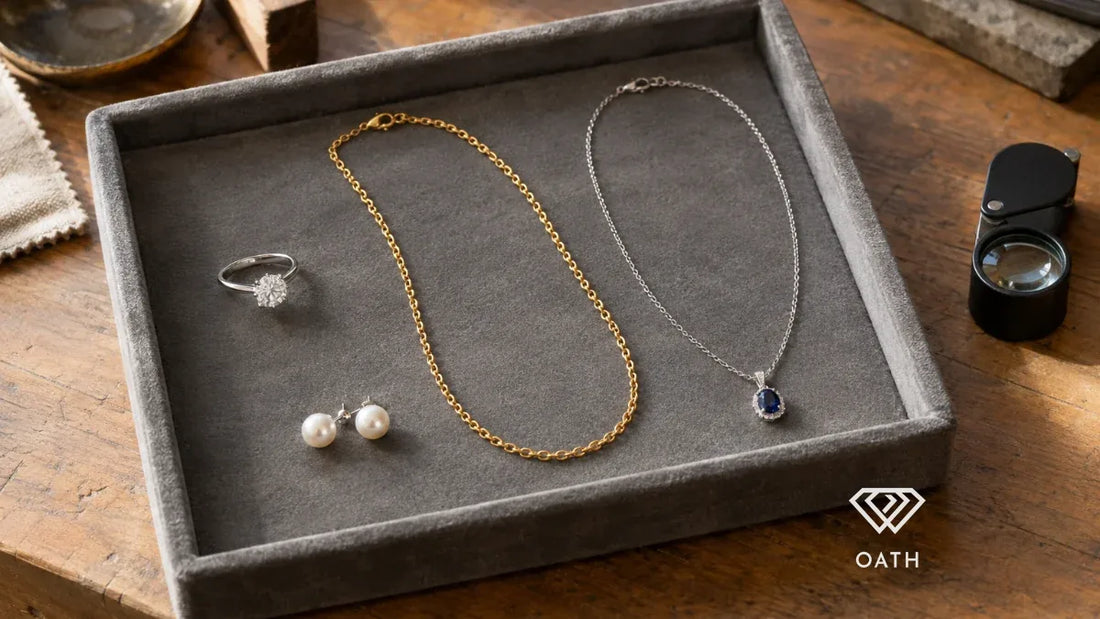
Quality fine jewelry is evaluated across four factors: metal (karat and purity), gemstone quality where applicable (color, clarity, cut, origin), setting craftsmanship, and seller credibility. A quality piece comes with clear metal hallmarks and, for significant stones, grading documentation. Any seller who cannot provide these is not worth buying from.
Jump to a section
A diamond certificate does not tell you what a diamond looks like. The GIA grading report for a one-carat stone with F color and VS1 clarity is the same format for a stone that photographs magnificently as for one that looks cold and glassy in real light. The report grades the inputs; the cut grade is the only proxy for the visual output, and even that does not capture everything the eye responds to when light moves through a stone.
This is the first and most important thing to understand about fine jewelry buying: the documentation confirms what a piece is made from, but it cannot tell you whether it is well-made, whether it will wear well for twenty years, or whether the person receiving it will love it. Those questions require a different kind of attention. This guide covers all of it: how to evaluate metal, gemstone quality, craftsmanship, and seller credibility so that every fine jewelry purchase is made with confidence rather than guesswork.
For technical standards on diamond grading and gemstone quality, GIA's 4 Cs framework is the globally recognized reference for evaluating diamonds specifically.
Step One: Choose the Metal
Metal selection is the structural decision in fine jewelry, and it should come before the stone, not after. The metal determines how the piece performs over time, whether the recipient can wear it without skin reactions, what maintenance it requires, and what it will look like in ten years. Making this choice thoughtlessly and then selecting a major stone is building a significant piece on an unconsidered foundation.
For most buyers in most situations, 14K gold is the correct starting point. It contains 58.3% pure gold, is available in yellow, white, and rose, and performs reliably for daily wear over many years. 18K gold (75% pure) is appropriate when richer color matters more than maximum scratch resistance, typically for occasional-wear pieces or for buyers purchasing European-standard fine jewelry. Sterling silver (92.5% pure, marked 925) is a genuine fine metal widely chosen for everyday pieces, with higher maintenance requirements than gold. Platinum is the most durable and dense option, requiring no rhodium plating, and being the right choice for significant diamond settings or buyers with known nickel sensitivities.
White gold requires one piece of honest explanation: it is yellow gold alloyed with palladium or nickel and plated with rhodium to achieve a white surface. That plating wears over time and requires reapplication every few years. This is normal maintenance, not a defect, but a buyer who does not know it will find themselves confused when the piece develops yellowish tones. Telling the buyer this upfront, as any credible jeweler will, is a basic quality signal.
Maintenance Note
White gold is rhodium-plated for its bright finish, and that plating wears gradually, typically needing reapplication every one to three years on daily-wear pieces. It is routine maintenance, not a defect. The Precious Metals Comparison breaks down how each metal wears over time.
Step Two: Evaluate Gemstone Quality
Diamond quality is assessed through the GIA's four Cs: cut, color, clarity, and carat weight. Of these, cut is the most important for visual impact. A well-cut diamond with mid-grade color and clarity will outperform a larger, poorly cut stone in brilliance, fire, and presence. Color grades run from D (colorless) to Z (strongly yellow); the visible difference between D through F (colorless) and near-colorless G through J is one most buyers cannot detect in a mounted setting. Clarity grades run from Flawless to Included; eye-clean stones (typically SI1 and above) are the practical target for most buyers, with truly flawless material relevant mainly to significant investment pieces.
Colored gemstone quality is assessed differently and requires more nuanced judgment. For rubies, sapphires, and emeralds, the three key factors are color (the primary driver of value), origin (Burmese ruby, Kashmir sapphire, and Colombian emerald are the most sought-after origins), and treatment disclosure. Heat treatment of rubies and sapphires is routine and accepted when disclosed; fracture filling and glass filling are more significant treatments that substantially affect value and require clear disclosure. Emeralds are routinely oiled with cedar oil or resin, which is standard practice, but must be disclosed. A credible seller provides treatment disclosure as a matter of course.
For gemstones other than the four precious stones (diamond, ruby, sapphire, emerald), color saturation and clarity are the primary quality factors for most stones. The Mohs hardness scale (scratch resistance) is a practical consideration for rings worn daily: stones below 7 are better suited to earrings and necklaces than to rings that take daily impact and abrasion.
Disclosure Note
Most colored gemstones are treated in some way, and routine treatments like heat are accepted across the trade. What matters is that the seller discloses every treatment in writing. Glass-filled rubies and undisclosed fracture filling materially change a stone's value; a seller who is vague about treatment is a seller to walk away from. The Birthstone Guide covers which treatments are standard for each stone.
Step Three: Assess Craftsmanship
A fine gemstone in a poorly made setting is a liability. Prongs that are too thin or too pointed will catch on fabric and eventually fail. A bezel that does not sit flush can trap moisture and debris. Clasps that feel loose on a new piece will not improve with wear. The signs of quality craftsmanship are consistent and learnable.
Prongs should be rounded, even in height, and secure. On a four-prong setting, each prong should be well-centered over its quadrant of the stone; on a six-prong setting, the prongs should be evenly spaced. The stone should not rock or shift when pressed lightly from the side. The metal surface should be smooth with no casting porosity (small pits or irregularities visible under magnification). Solder joints and sizing seams should be invisible or nearly so. On chain jewelry, links should be consistent in width and not kinked.
Ring sizing tells you something. A ring that fits correctly carries no sizing seam, or carries one that is invisible from the outside. A ring that has been sized multiple times may show evidence of repeated solder at the base; this is not a quality problem if done well, but visible or lumpy sizing seams indicate rough workmanship.
"Cut quality is the primary driver of a diamond's visual performance. Two diamonds with identical color, clarity, and carat weight can look entirely different because of differences in cut: proportions, symmetry, and polish together determine how efficiently the stone interacts with light. Of all the 4Cs, cut is the only factor determined entirely by human workmanship. A poorly cut diamond cannot be improved after the fact. The GIA Excellent grade is the benchmark to seek when visual performance is the priority."
Gemological Institute of America
The GIA created the modern 4Cs framework and the diamond grading report used worldwide.
Step Four: Evaluate the Seller
The seller's credibility is as important as the piece itself, because fine jewelry quality cannot always be confirmed by inspection alone. A buyer without gemological training cannot independently verify that a ruby is natural and unheated, or that a diamond's GIA certificate matches the stone it describes. That verification depends on trusting the seller's representations.
The signals of a credible fine jewelry seller: they provide documentation (GIA reports for significant diamonds, laboratory reports for significant colored stones) as a standard part of the purchase, not as an upsell. They disclose treatments clearly and proactively. They can describe the metal composition of each piece by karat and alloy. They have a clear return policy. They do not pressure customers toward larger or upgraded options or create urgency that serves the seller rather than the buyer. These are not aspirational standards; they are minimum expectations for any seller worthy of a significant purchase.
In Short
1Choose the metal before the stone; it is the structural decision that determines how the piece performs over decades.
2For diamonds, cut drives visual performance; for colored stones, color and written treatment disclosure matter most.
3A credible seller provides documentation and treatment disclosure as standard, with a clear return policy; anything less is a reason to walk away.
What Should I Look for in Fine Jewelry Quality?
Fine Jewelry Buying Checklist
A concise checklist covering what to verify before purchasing any piece of fine jewelry: metal hallmarking, documentation requirements, craftsmanship indicators, seller credibility signals, and the questions to ask at every tier. We'll email it to you.
Email Me the Guide →How Do Fine Jewelry Tiers Differ?
Fine jewelry spans several distinct tiers, and understanding what separates them helps buyers know what to expect at each level rather than guessing. The tiers below describe what each level typically includes in terms of metal, stone content, and where the quality signals concentrate. Where a piece lands within a tier depends on stone quality, metal weight, and brand positioning.
Platinum sits apart from comparable gold pieces because of its greater density and rarity, both of which scale with the weight of the piece.
Fine Jewelry at Oath


The best fine jewelry purchase is not necessarily the largest or most elaborate one. It is the one made with enough information to know exactly what you are buying, from a seller credible enough to stand behind what they represent, in a piece made well enough to be worth wearing for the next twenty years. Those standards are achievable at every tier. They just require knowing what to look for. For guidance on choosing the right piece for a specific person or occasion, the jewelry gift guide covers how to match quality to recipient and situation. Find fine jewelry at oathjewelry.com. Every order ships free with a 30-day return policy.
Frequently Asked Questions
01
What is the difference between fine jewelry and fashion jewelry?
Fine jewelry is made from precious metals (gold, platinum, silver) and, when stones are present, genuine gemstones (natural or lab-created). Fashion jewelry uses base metals (brass, copper, zinc) plated with a thin layer of precious metal, and may include synthetic stones, glass, or plastic. Fine jewelry carries hallmarks indicating metal purity; fashion jewelry typically does not. The distinction matters for durability: fashion jewelry plating wears and base metals corrode in ways that fine metals do not.
02
How do I know if a diamond is real?
The most reliable confirmation for a significant diamond is a GIA (Gemological Institute of America) grading report, which provides an independent, third-party verification of the stone's identity, weight, cut, color, clarity, and any treatments. For smaller diamonds where individual grading reports are not standard, purchasing from a credible seller who makes clear treatment and origin representations is the practical approach. A reputable seller will not be defensive about requests for documentation.
03
What does gold-filled or gold-plated mean, and is it fine jewelry?
Gold-filled and gold-plated pieces are not fine jewelry. Gold plating applies a thin layer of gold (often less than 0.5 microns) over a base metal; it will wear off in months to years with regular wear. Gold-filled has more gold content than plating (legally required to be at least 5% gold by weight) and lasts longer, but it is still a base metal core with a gold surface layer. Fine jewelry uses solid gold throughout, hallmarked by karat (10K, 14K, 18K). Any piece not marked with a karat stamp is not solid gold.
04
Should I buy jewelry online or in person?
Both channels can produce excellent results from credible sellers; the quality of the seller matters far more than the channel. Online purchasing from established fine jewelry retailers with clear documentation, return policies, and treatment disclosure is appropriate for most pieces. For significant center stones (diamonds above 0.5 carats or major colored gemstones), seeing the stone in person or requesting video of the stone in motion adds meaningful confidence. Any seller that does not offer a return period of at least 30 days for unworn pieces is a seller to avoid regardless of channel.
05
What should I look for in a ring setting for an everyday ring?
For a ring worn daily, prioritize: a stone rated 7.5 or higher on the Mohs scale; a setting style that protects the stone (bezel, half-bezel, or flush settings provide more protection than high prong settings); metal at 14K gold or platinum for durability; and prongs that are adequately thick and rounded rather than pointed or thin. Solitaire prong settings are beautiful but the most vulnerable to catching and prong wear; channel and bezel settings are more protective for active daily wear. The Birthstone Guide lists the Mohs hardness of every birthstone, useful for deciding whether a given stone suits a daily-wear ring.
06
How do I care for fine jewelry to make it last?
Store pieces separately to prevent scratching. Remove jewelry before swimming (chlorine attacks gold alloys), before applying lotions, perfumes, or cleaning chemicals, and before activities that expose the piece to hard impact. Clean gold jewelry with mild dish soap and warm water using a soft brush; rinse thoroughly. For platinum, the same approach applies. For silver, use a polishing cloth for surface tarnish and store in anti-tarnish pouches. Have prong settings checked by a jeweler every one to two years for daily-wear rings; prong tips wear gradually and periodic inspection prevents stone loss. The Precious Metals Comparison covers metal-specific care in more detail.