Skip to content
Every order ships free with a 30-day return policy  ·  Browse new arrivals

Emerald Rings

Emerald Rings Across All Settings and Metals

Emerald's deep green has made it one of the most chosen colored gemstones for rings, where color saturation and the evenness of that color across the stone are the primary quality indicators. Oath's emerald rings are set in 10K, 14K, and 18K gold and sterling silver, with genuine emeralds in styles from clean solitaires to halo and multi-stone settings. Free shipping on every emerald ring order, with returns accepted within 30 days.

  • Genuine Gemstones
  • Free Shipping
  • 30-Day Returns

Buying Emerald Rings: What the Stone's Softness Means for You

Emerald's Hardness and Why It Changes the Ring Decision

Emerald is a variety of the mineral beryl, rated 7.5 to 8 on the Mohs hardness scale. This is meaningfully softer than ruby and sapphire at 9, which has practical consequences for ring wear. Surface scratches accumulate faster on emeralds than on harder gemstones when worn in rings. Inclusions, which are extremely common in emeralds and called jardin (French for garden), mean most emeralds also have internal fractures that require protective settings. Bezel settings, which wrap the stone's entire girdle in metal, are the most appropriate choice for emerald rings worn regularly. For the full emerald jewelry range, the emerald jewelry range covers the full selection.

What Makes a Quality Emerald for Rings

Color is the dominant quality criterion in emeralds. The most prized color is a vivid, slightly bluish green with strong saturation, associated historically with Colombian emeralds from the Muzo and Chivor mines. Clarity standards for emeralds are fundamentally different from diamonds: inclusions are expected and accepted in natural stones. A completely inclusion-free natural emerald is so rare as to be practically unknown in the trade. When buying an emerald ring, prioritize color saturation and transparency over clarity. For the ring range across all gemstone types, the rings range covers the full selection across all gemstone types.

Emerald vs. Sapphire Rings: Choosing the Right Gemstone

The practical comparison between emerald and sapphire in rings comes down to hardness and durability. Sapphire at 9 Mohs is significantly more resistant to surface wear and chipping than emerald at 7.5 to 8, making it the more practical choice for daily ring wear without careful attention. Emerald's green is unique: no other stone produces the same vivid, warm green as a fine Colombian emerald. Buyers who choose emerald rings should prioritize protective settings and remove the ring during activities where it might contact hard surfaces. For the sapphire alternative at higher hardness, the sapphire rings range covers the full selection.

Emerald Ring Settings and Metal Choices

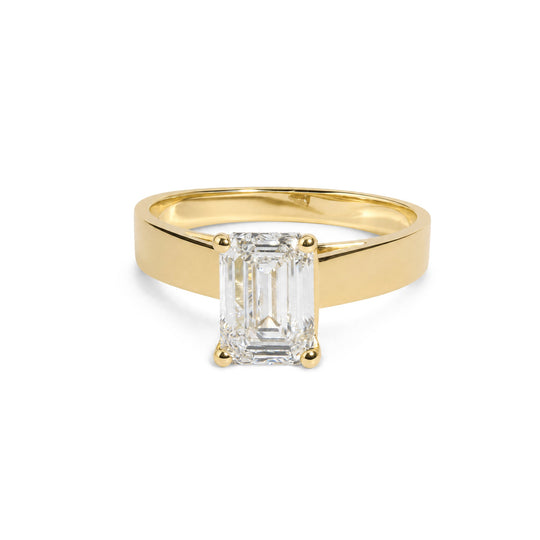
Bezel settings provide the most protection for an emerald's vulnerable edges and are strongly preferred for emerald rings intended for regular wear. Prong settings expose more of the stone's surface and are better suited for occasional wear. Yellow gold is the traditional choice for emerald settings, as the warm metal creates a rich contrast with the green stone. White gold and platinum create a cooler, more contemporary look. Emerald engagement rings have grown in popularity as a distinctive alternative, particularly in step-cut emerald cuts where the stone's clarity is showcased. The gold engagement rings range covers every gold metal option in this context. Every order ships free with a 30-day return policy.

Frequently Asked Questions

Are emeralds good for rings?

Emeralds can work well in rings with the right setting and care approach. At 7.5 to 8 on the Mohs scale, they are harder than most everyday materials but softer than sapphire, ruby, and diamond. Surface scratches accumulate faster with regular ring wear than with harder stones. Bezel settings that protect the stone's edge are strongly recommended. Emerald rings worn with care and removed during physical activities are practical; rings worn without those precautions will show wear faster than harder gemstones would. For a full guide to choosing an emerald worth buying, read how to buy emerald jewelry.

How hard are emeralds compared to sapphires?

Emeralds are rated 7.5 to 8 on the Mohs hardness scale. Sapphires and rubies are both rated 9. This means sapphires and rubies are meaningfully more scratch-resistant than emeralds, and the difference is noticeable in ring wear over time. Emeralds are also more susceptible to chipping because most natural emeralds contain many inclusions that create internal fracture points. For the same setting style, an emerald ring requires more careful daily handling than a sapphire or ruby ring.

What is jardin in emeralds?

Jardin, French for garden, is the trade term for the inclusions and internal fractures visible in most natural emeralds. Unlike diamonds, where inclusions are a negative quality factor, emerald inclusions are expected in natural stones and are not inherently disqualifying. A completely inclusion-free natural emerald is practically unknown in the fine gem trade. The jardin creates the characteristic depth of a natural emerald that distinguishes it from lab-created stones.

How do you care for an emerald ring?

Warm water, a very soft brush, and mild soap are the only recommended cleaning method. Never use ultrasonic cleaners or steam: most natural emeralds are treated with oils or resins to fill fractures, and both cleaning methods remove the treatment and can worsen existing fractures. Avoid harsh chemicals including household cleaners and chlorine. Have the setting inspected annually. Remove before any activity involving hard surface contact or chemical exposure.

Can you wear an emerald ring every day?

Emerald rings are practical for daily wear with careful habits. Remove before dishwashing, gardening, cooking, or contact with hard surfaces; remove before swimming or using cleaning products; avoid applying hand lotions directly over the stone. Buyers who want a gemstone ring for completely carefree daily wear are better served by sapphire or ruby. Buyers who love emerald's distinctive green and are willing to observe those precautions will find the stone holds up well in a protective bezel setting.

What is the best setting for an emerald ring?

Bezel settings are the strongest choice for emeralds in rings. A full bezel wraps the stone's entire girdle in metal, protecting the edges from chips and the surface from impact. The protective metal band does reduce the amount of light entering the stone, but for everyday wear rings this is the appropriate tradeoff. Half-bezel settings compromise between protection and light entry. Prong settings are better suited to emeralds in earrings or pendants where the stone experiences less contact than in a ring.

What metal is best for an emerald ring?

Yellow gold is the traditional choice for emerald rings and creates the most richly jewel-like aesthetic, with the warm gold providing a classic backdrop to the green. White gold and platinum produce a high-contrast, contemporary look. Rose gold creates a warm overall pairing, though it is less commonly used for emeralds than for pink or warm-toned stones. Yellow gold remains the most harmonious pairing for emerald's classic green.

What emerald necklaces coordinate with an emerald ring?

A simple emerald pendant in matching metal keeps the gemstone consistent across necklace and ring without overloading the look. When an emerald ring is the primary focal piece, keep the necklace stone smaller so the ring remains the center of attention. Metal consistency between ring and necklace is the most important coordination decision. The emerald necklaces range covers coordinating options.

What emerald earrings complement an emerald ring?

Emerald earrings in matching metal extend the stone's rich green from hand to ear without competing with the ring as the primary focal piece. When an emerald ring anchors the look, keep earring stone sizes modest; small emerald studs create cohesion without overloading the color. Prong and bezel settings in yellow gold maintain the warmest visual consistency with a yellow gold ring setting. The emerald earrings range covers coordinating options.

What emerald bracelets complement an emerald ring?

An emerald bracelet in matching metal adds wrist-level color that coordinates naturally with an emerald ring. Tennis-style and station bracelets work well because they distribute the green along the wrist without concentrating weight at a single point. Keep bracelet stone sizes smaller than the ring center stone to maintain the ring as the primary piece. Metal consistency across all pieces is the main coordination rule: yellow, white, or rose gold.

Your Bag
Subtotal (tax excl.) $0
 
Example
Example
Example
(0 )
Example
View detail
Example
Example
Option1
Option2
Option3
Option1
Option2
Option3
Sold out
Quantity
Add To Cart
Buy Now
Compare
Add Wishlist
Share:
0
0