
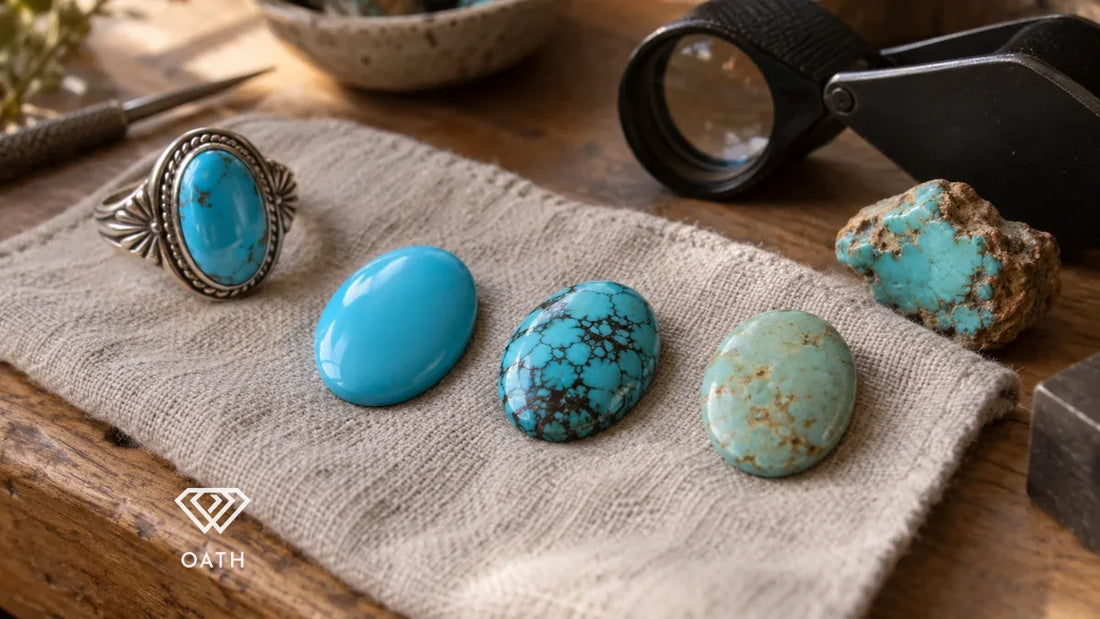
Turquoise quality is led by color, because turquoise is an opaque stone whose face-up look decides almost everything. The finest turquoise shows an even, saturated sky blue to robin's-egg blue with no chalky or washed-out patches, and matrix, the natural veining from the host rock, is judged on how even and attractive it is rather than treated as a flaw. Texture matters too: a harder, denser stone takes a better polish and wears more reliably than a soft, porous one. The honest story behind turquoise is treatment, since stabilizing, dyeing, and reconstituting are all common; what counts is clear disclosure. Turquoise rates about 5 to 6 on the Mohs scale, soft and porous enough to need gentle care.
Turquoise is a hydrated copper aluminum phosphate, an opaque blue-to-green stone that ranks among the oldest gems worked by people, from ancient Egypt and Persia to the jewelry of the American Southwest. Its color comes from copper, which gives the classic blue, with iron pushing some stones toward green. Because it is opaque, turquoise is cut as cabochons, beads, and inlay rather than faceted, and it is judged on its surface and color rather than on what light does inside it.
Two things make turquoise unusual to grade. The first is that the diamond model does not apply at all: clarity in the transparent sense is irrelevant, and the questions that matter are the evenness of the color, the character of the matrix, and how hard and well-finished the stone is. The second is that the great majority of turquoise on the market has been treated in some way, so honest disclosure is central to buying it well. This guide leads with color, then covers matrix, texture and hardness, treatment, and where turquoise sits among gemstones.
5-6
Mohs hardness
December
Birthstone
Opaque
Transparency
Stabilized
Common treatment
Why Color Leads in Turquoise
Color is the single factor that decides most of a turquoise stone's quality, and the prized look is an even, saturated medium blue, often described as sky blue or robin's-egg blue. The best stones hold that color uniformly across the whole face, with no pale streaks, no chalky areas, and no patchy fading from one edge to the other. Copper gives turquoise its blue, while iron shifts some material toward green, so blue-green and frank green stones are common and can be lovely in their own right, though an intense, even blue is the classic benchmark in most markets.
Because turquoise is opaque, this surface color is essentially the whole stone; there is no interior brilliance to fall back on, so a weak or uneven color cannot be rescued by cut. That puts turquoise in the same broad camp as other opaque gems that are read on their face rather than through them, a contrast covered in the guide to onyx quality. The practical test is simple: look at the stone in even light and ask whether the blue is deep, consistent, and clean, or pale, mottled, and gray.
Matrix, the Web That Tells the Story
Matrix is the pattern of veining left by the host rock in which the turquoise formed, ranging from fine dark lines to broad brown or black patches. Unlike inclusions in a transparent gem, matrix is not automatically a flaw; a delicate, even network, the kind sold as spiderweb turquoise, is sought after and can make a stone more desirable than a plain one. What lowers quality is matrix that is heavy, blotchy, or unevenly distributed, since it breaks up the color and can mark softer, less stable material.
At the other end, some of the most valued turquoise shows almost no matrix at all, a clean, uniform blue with a smooth face, the look associated with certain classic Southwestern mines. Neither extreme is automatically better; an even, attractive web and a clean solid blue are both prized, while a muddy, irregular pattern is not. When matrix appears across a set of beads or a pair of pieces, consistency matters, since a strand reads best when the veining and color carry a similar character from one stone to the next.
Mohs hardness, 1 (softest) to 10 (hardest). Turquoise at 5 to 6 is soft and porous, well below quartz, so it needs gentle care.
Texture, Hardness, and Polish
Turquoise varies more in hardness than almost any other gem material, and that variation drives a great deal of its quality. Gem-grade turquoise is relatively hard and dense, takes a high, waxy-to-glassy polish, and holds its color well; lower-grade material is soft, porous, and chalky, scratches easily, and can dull or shift color as it absorbs oils and moisture over time. On the Mohs scale turquoise runs about 5 to 6, softer than quartz and well below sapphire, so even good stones need more care than the hardest gems.
That porosity is also why so much turquoise is treated, since stabilizing fills the pores and hardens the stone. A naturally hard, well-finished piece with a bright, even polish is the ideal, and it is worth looking closely at the surface: a smooth, lustrous face suggests dense material, while a flat or slightly powdery look can signal a softer, more porous stone. Choosing a denser stone and protecting it in wear keeps both the color and the finish stable for the long run.
Treatment and Honest Disclosure
Most turquoise on the market has been treated, so understanding the options is the heart of buying it well. Stabilization, in which porous turquoise is impregnated with a clear resin, is by far the most common; it hardens the stone, deepens and locks the color, and is widely accepted so long as it is disclosed. Beyond that, some material is dyed to boost or even create the blue, and reconstituted or block turquoise is made by binding ground turquoise powder with resin, a low-grade product that is a long step from a solid natural stone. Natural, untreated gem-grade turquoise is comparatively rare and prized. For what genuine means and the questions to ask any seller, see your jewelry questions answered.
Disclosure also guards against outright imitations. Dyed howlite and magnesite, both naturally white and porous, are frequently colored to pass as turquoise, and plastic and ceramic fakes appear as well. Genuine turquoise feels cool, takes a characteristic waxy luster, and shows natural variation in color and matrix that uniform fakes rarely match. Asking plainly whether a stone is natural, stabilized, dyed, or reconstituted, and confirming it is turquoise rather than a substitute, settles the questions that matter most for this gem.
Where Turquoise Fits, Material and History
Turquoise is a hydrated phosphate of copper and aluminum, formed near the surface where copper-rich water seeps through aluminous rock, which is why it is found in arid mining regions such as the American Southwest, Iran, and parts of China. It has been worn for more than five thousand years, set into the funerary jewelry of ancient Egypt, the turbans and daggers of Persia, and the silverwork of the Navajo, Zuni, and other Southwestern peoples, who pair it with sterling silver in a tradition that still defines much of the market.
Turquoise is one of the birthstones for December, alongside tanzanite and zircon, and it carries long associations with protection and good fortune across many cultures, a history traced in the birthstone guide. That deep cultural record, together with its distinctive sky-blue color, is why turquoise remains a staple of both heritage and modern jewelry, especially in bold silver settings, beaded designs, and statement cabochon pieces.
Treatment and Care Note
Most turquoise is stabilized with resin to harden it and lock its color, a treatment that is accepted across the trade when disclosed; dyeing and reconstitution are also common, so the point to confirm is exactly how a stone has been treated. At about 5 to 6 on the Mohs scale turquoise is soft and porous, so it scratches easily and can absorb oils, cosmetics, and water that dull or discolor it over time. Wipe it with a soft, slightly damp cloth, keep it away from perfume, lotion, and household chemicals, and avoid ultrasonic and steam cleaners and prolonged heat, any of which can harm the stone or its color.
'The most prized turquoise color is an even, intense, medium blue.'
Gemological Institute of America
Turquoise quality factors, gia.edu
Further reading: GIA on turquoise. The GIA is the gemological body that established the modern colored-stone grading framework.
In Short
1Color leads: an even, saturated sky blue to robin's-egg blue wins, while pale, chalky, or mottled stones sit below.
2Matrix is judged on evenness, not presence; a fine web or a clean uniform blue are both prized, while heavy, blotchy veining is not, and a denser, harder stone takes a better polish.
3Most turquoise is treated, usually stabilized, so confirm exactly how a stone was treated; at about 5 to 6 on the Mohs scale it is soft and porous and needs gentle care.
Turquoise Quality Quick Reference
A one-page reference covering the even sky blue to look for, how to read matrix, why texture and hardness vary so much, the common treatments to ask about, and the care that protects a porous stone.
Email Me the Guide →A Few Turquoise Pieces from Oath


Every order ships free with a 30-day return policy.
Turquoise rates about 5 to 6 on the Mohs scale, soft and porous compared with the harder gems, so a protective setting and steady care keep both its color and its polish intact. The stone has been worn for thousands of years and remains a cornerstone of Southwestern and modern silver jewelry alike, prized for its distinctive, even sky blue. The quality that decides what a turquoise is worth comes down to color first, an even, saturated blue, then to attractive matrix, a dense and well-finished texture, and honest disclosure of any treatment. A buyer who reads the color, the matrix, the surface, and the treatment can choose turquoise with real confidence; for protecting a porous stone over the years, the fine jewelry care guide covers safe cleaning and storage, and the fine jewelry buying guide covers what to check and what to ask. Every order ships free with a 30-day return policy.
Frequently Asked Questions
01
What makes turquoise high quality?
Quality turquoise shows an even, saturated sky blue to robin's-egg blue with no chalky or washed-out areas, since color carries most of the stone's value. Matrix is judged on whether the veining is fine and even rather than heavy and blotchy, and a denser, harder stone that takes a high polish outranks a soft, porous one. Honest disclosure of any treatment completes the picture.
02
Is turquoise treated or natural?
Most turquoise sold today is treated in some way. Stabilization, in which a clear resin is added to harden the porous stone and lock its color, is by far the most common and is accepted when disclosed. Some material is dyed to enhance the blue, and reconstituted or block turquoise is made from ground powder bonded with resin. Natural, untreated gem-grade turquoise exists but is comparatively rare.
03
What is matrix in turquoise?
Matrix is the web of veining left by the host rock in which turquoise forms, showing as dark or brown lines and patches across the stone. Fine, even matrix, sometimes called spiderweb, is sought after and can add character, while heavy or blotchy veining usually lowers quality. Some prized turquoise shows almost no matrix at all, a clean, uniform blue, so evenness rather than presence is what matters.
04
How hard is turquoise and can it be worn daily?
Turquoise rates about 5 to 6 on the Mohs scale, softer and more porous than quartz or sapphire, so it needs more care than the hardest gems. Everyday wear is possible, especially in a protective setting, but the stone can scratch and can absorb oils, cosmetics, and water that dull or discolor it. Keeping it away from chemicals and cleaning it gently helps it last.
05
How can you tell real turquoise from a fake?
Genuine turquoise feels cool to the touch, shows a characteristic waxy luster, and carries natural variation in color and matrix that uniform imitations rarely match. Dyed howlite and magnesite are the most common fakes, both naturally white and porous, along with plastic and ceramic copies. A jeweler can test a suspect stone, and a reputable seller will state plainly whether a piece is natural, stabilized, dyed, or reconstituted.
06
What color of turquoise is most valuable?
Turquoise is most prized in an even, intense medium blue, the shade often called sky blue or robin's-egg blue, held uniformly across the stone. Copper produces this blue, while iron pushes some material toward green, so blue-green and green stones are common and can be attractive, though the pure, even blue is the classic benchmark in most markets. Consistency of color matters as much as the hue itself.
07
Is turquoise a birthstone?
Turquoise is one of the birthstones for December, sharing the month with tanzanite and zircon. It has been valued for more than five thousand years across Egyptian, Persian, and Native American cultures, often linked with protection and good fortune. That long history, together with its distinctive blue, keeps turquoise a favorite for both heritage silver jewelry and modern designs.