
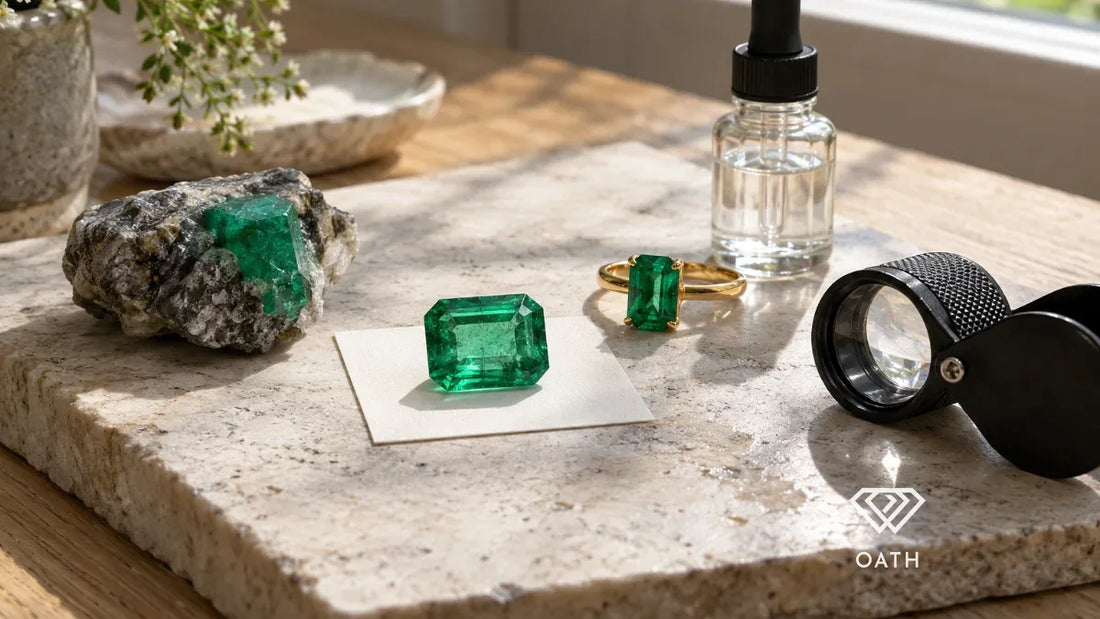
A real emerald is green beryl colored by chromium or vanadium, and it almost always carries inclusions: the tiny garden of fractures and crystals gemologists call the jardin. A flawless, glassy-clean green stone is more likely synthetic or glass. Most natural emeralds are oiled, which is normal and accepted when disclosed.
Jump to a section
What makes it realRead the jardinOiling & treatmentSynthetic & simulant tellsLab reportsValue & originEmerald is the one major gem where inclusions are a sign of authenticity rather than a defect. That single fact reframes the whole question of real versus fake. The goal here is not to leave you wary of every green stone; it is to teach you what natural emerald looks like, why oiling is routine, and when a quick read by hand should give way to a formal report.
What Makes an Emerald Real
Emerald is the green variety of the mineral beryl, colored by traces of chromium, vanadium, or both. It sits at 7.5 to 8 on the Mohs scale, hard enough for jewelry but, because nearly every stone is threaded with fractures, more brittle and more fragile than ruby or sapphire. That internal landscape is the key to telling a genuine emerald from an imposter.
Three words frame everything that follows. A natural emerald grew in the earth over geological time. A synthetic, or lab-grown, emerald is the same mineral crystallized in a lab over weeks or months. A simulant is a different material standing in for emerald: green glass, green cubic zirconia, or a doublet assembled from lesser materials. The first two are genuine emerald by composition; the third is not emerald at all.
7.5 to 8
Mohs hardness, harder than quartz but brittle
Cr / V
Chromium and vanadium, the green-makers
99%+
Share of emeralds with treated surface fractures
Read the Jardin: Inclusions Are the Proof
Hold an emerald to a ten-power loupe and you should see a world inside. Gemologists borrow the Spanish word jardin, meaning garden, for the network of healed fractures, mineral crystals, fine needles, and fingerprint-like patterns natural to the stone. Colombian emeralds famously show three-phase inclusions, tiny cavities holding gas, liquid, and a salt crystal together. Far from lowering value, the right jardin is proof of natural origin.
This flips the usual instinct. With most gems a cleaner stone is better; with emerald, a large, vivid, perfectly clean stone offered as natural should put you on guard, because it is far more likely synthetic or glass. The jardin should look organic and irregular. Geometric, repeating, or unusually orderly internal patterns point toward a lab-grown or imitation stone.
Oiling and Treatment: Normal, but Disclose It
Here is the fact that surprises most buyers: the overwhelming majority of natural emeralds have their surface-reaching fractures filled to improve clarity. Traditional cedarwood oil matches the refractive index of beryl and makes fine fissures nearly disappear; modern resins do the same job more durably. This is routine, widely accepted, and does not make a stone fake. What it does require is honest disclosure.
Disclosure Note
Laboratories grade clarity enhancement on a scale, typically none, minor, moderate, and significant, and the degree affects both value and care. Resin fillers can show a faint blue or orange flash in a fracture when tilted under strong light. Because oil can dry out, an oiled emerald should never see an ultrasonic or steam cleaner; clean it gently with mild soap and water. The fine jewelry buying guide covers reading a treatment disclosure.
So the practical question is not whether an emerald is treated, but how much, and whether the seller says so plainly. A minor oiling is unremarkable. Heavy resin filling matters more, both for value and for how carefully the stone must be worn. A reputable seller will tell you the degree in writing, and a lab report will confirm it.
Synthetic and Simulant Tells
Lab-grown emeralds are real beryl, and they fall into two families. Flux-grown stones, such as the long-established Chatham and Gilson material, can show wispy, veil-like inclusions and small phenakite crystals. Hydrothermal stones can show a chevron or nailhead growth pattern and a faint seed plate. Both look convincingly green, so the internal growth features, read under magnification, are what give them away.
Simulants are usually an easier call. Green glass shows round bubbles, swirl, and a single uniform color with no jardin. Doublets, sometimes called soude emeralds, join a thin slice of beryl or glass to a backing, betraying a flat seam at the girdle when viewed from the side. Green cubic zirconia throws far too much fire for beryl. A loupe and, when needed, a refractometer separate all of these quickly.
When to Get a Lab Report
A loupe read is enough to enjoy everyday pieces and to rule out obvious glass. For a significant emerald, an independent laboratory is the final word. The GIA, AGL, Gubelin, and GRS confirm whether a stone is natural or synthetic, grade the degree of clarity enhancement, and for important stones assess geographic origin, which carries real weight for emerald.
"Over 99% of emeralds have surface reaching fractures that are treated with oil."
The Natural Emerald Company
Emerald enhancements guide, emeralds.com
The Natural Emerald Company is a specialist emerald dealer and educational resource. Further reading: GIA emerald overview.
Request a report when value or sentiment runs high, when origin matters to you, or when a seller cannot state plainly whether a stone is natural, how heavily it is oiled, and where it came from. A grading report is the language jewelers and insurers trust, and it travels with the piece for resale and coverage.
Is an Emerald Worth It? Value and Origin
Emerald value tracks color above all: the most coveted is a vivid, slightly bluish green with even saturation, neither too dark nor too pale. After color come clarity, cut, carat, origin, and the degree of treatment. Colombia, especially the Muzo and Chivor mines, set the historic standard, with Zambia, Brazil, and Afghanistan as important sources. A natural stone with light treatment and a documented origin sits at the top; a lab-grown emerald is valued for its color alone.
So decide what you want the stone to do. For lasting worth and a story tied to the earth, choose a natural emerald with a stated treatment level and, ideally, a report; if origin matters, ask for it in writing. For pure green at an easy reach, a disclosed lab-grown emerald is honest and lovely. And whichever you choose, treat the stone gently, since emerald rewards careful wear.
In Short
1A real emerald is green beryl colored by chromium or vanadium; lab-grown emeralds are the same mineral, and simulants like glass, cubic zirconia, and doublets are not emerald.
2Natural emeralds carry the jardin, a garden of inclusions, so a large, vivid, flawless green stone is a warning sign rather than a prize.
3Almost all emeralds are oiled to improve clarity, which is accepted when disclosed; a lab report confirms natural versus synthetic, the degree of treatment, and origin.
The Emerald Authentication Checklist
A one-page checklist of the signs of a genuine emerald, what the jardin should look like, the treatment questions to ask, and the tells of synthetics and glass. We'll email it to you.
Email Me the Guide →


Every order ships free with a 30-day return policy.
Identifying an emerald comes down to reading it: the jardin that marks natural growth, the oiling a seller should disclose, the bubbles and seams that betray glass and doublets, and the moment a report is worth requesting. Approach it that way and an emerald becomes a confident, informed choice rather than a gamble. Every order ships free with a 30-day return policy.
Frequently Asked Questions
01
How can I tell if an emerald is real?
Genuine emeralds are green beryl and almost always show a jardin under a ten-power loupe: healed fractures, mineral crystals, fine needles, and, in Colombian stones, three-phase inclusions. A large, vivid emerald that looks completely flawless is more likely synthetic or glass. The most reliable confirmation for an important stone is a GIA or comparable lab report.
02
Are emerald inclusions normal?
Inclusions are not only normal in emerald, they are expected and often welcome. The internal garden of fractures and crystals, called the jardin, is a hallmark of natural origin and helps distinguish a real emerald from a flawless synthetic or a piece of glass. The jardin should look organic and irregular rather than geometric or repeating.
03
Is an oiled emerald still a real emerald?
An oiled emerald is a genuine natural emerald. The overwhelming majority of emeralds have surface-reaching fractures filled with oil or resin to improve clarity, which is routine and accepted across the trade. What matters is disclosure: a reputable seller states the degree of treatment, and an oiled stone should be cleaned gently, never in an ultrasonic or steam cleaner.
04
What is a fake or simulant emerald?
A simulant is a different material made or chosen to look like emerald rather than beryl grown in a lab. Common examples are green glass, green cubic zirconia, and doublets that join a thin slice of beryl or glass to a backing. Simulants give themselves away through round gas bubbles, a seam at the girdle, a uniform color with no jardin, or excessive fire.
05
Is a lab-grown emerald a real emerald?
A lab-grown emerald is real beryl with the same chemistry and color as a mined emerald, so by composition it is genuine rather than fake. The difference is origin and rarity: it crystallizes in a lab over weeks or months rather than over geological time, and it shows growth features such as veils or chevron patterns. For how the quality factors are judged, see how to evaluate emerald quality.
06
Where do the finest emeralds come from, and do I need a report?
Colombia, especially the Muzo and Chivor mines, set the benchmark for fine emerald, with Zambia, Brazil, and Afghanistan as major sources, and origin can influence value meaningfully. A grading report is worth requesting whenever value, origin, or treatment level matters, since it confirms natural versus synthetic and grades enhancement. The birthstone guide places emerald in its wider context.