
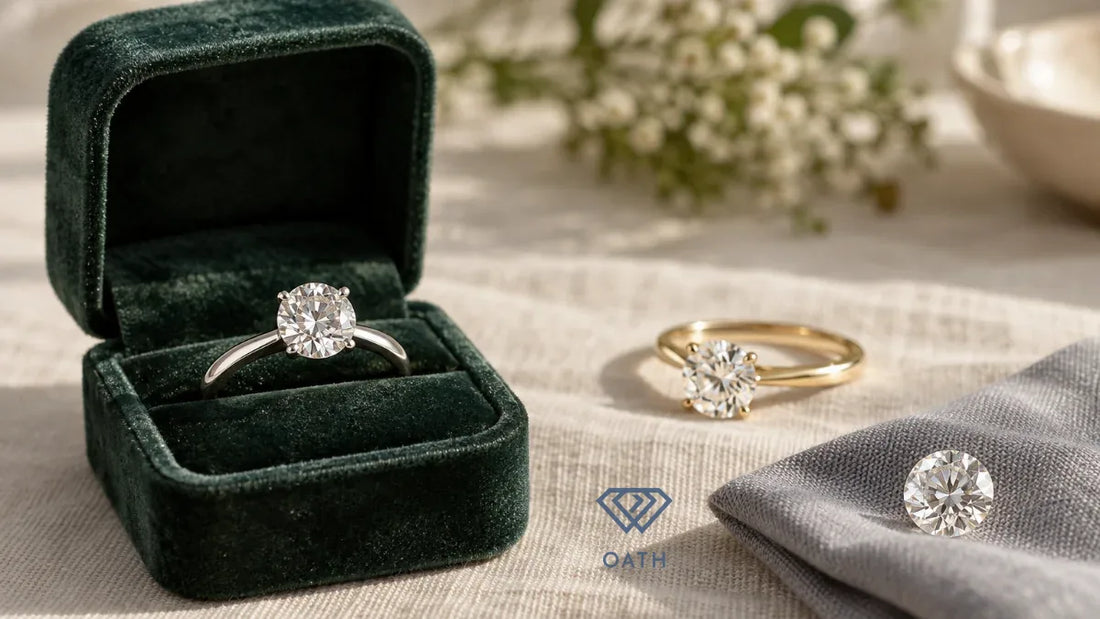
Lab-grown and natural diamonds are both real diamonds with identical physical, chemical, and optical properties, graded on the same 4Cs. The practical differences are price, resale, and origin story, which is why lab-grown now accounts for most engagement ring purchases.
The lab-grown versus natural question feels bigger than it is, because both are real diamonds that look identical and grade on the same scale. What separates them is price, long-term resale, and the story behind the stone. This guide lays out the real differences and helps you decide which fits your priorities. For the wider ring decision, see the engagement ring buying guide.
What is the same, and what is different
A lab-grown diamond is a diamond, not a simulant like cubic zirconia or moissanite. It has the same carbon structure, hardness, and sparkle as a mined stone, and a trained grader uses the same 4Cs for both. The differences are practical rather than physical.
Natural and lab-grown diamonds share the same 4Cs, look, and durability.
| Factor | Lab-grown | Natural |
|---|---|---|
| Composition | Identical carbon, same hardness | Identical carbon, same hardness |
| Grading | Same 4Cs and lab reports | Same 4Cs and lab reports |
| Price | Roughly half for a similar stone | Higher for the same specs |
| Resale | Lower resale to date | Stronger resale recognition |
| Origin | Made in weeks in a lab | Formed over billions of years |
Price and what your budget buys
Price is the headline difference. For a similar size and quality, a lab-grown diamond often costs about half of a comparable natural stone, so the same budget reaches a larger or finer diamond. Recent figures put a representative lab-grown stone near $5,188 against about $10,760 for a comparable natural (The Knot). You can compare the two side by side across the diamond rings selection.
When lab-grown wins
Choose lab-grown to get the biggest or finest stone for the budget, at a lower price, if you are comfortable with limited resale value.
When natural wins
Choose a natural diamond for rarity, the billions-of-years origin, and the strongest resale recognition in a long-term heirloom.
How to choose between them
Beyond price, the decision comes down to what the ring means to you and how you weigh resale. A short checklist makes the call concrete.
A diamond is a mineral consisting essentially of pure carbon.
U.S. Federal Trade Commission
Further reading: Britannica, Diamond. The 2018 FTC definition dropped the word natural, recognizing laboratory-grown stones as diamonds too.
In Short
1Lab-grown and natural diamonds are both real diamonds, identical in look and graded the same way.
2Lab-grown costs roughly half for a similar stone; natural holds stronger resale and a rarity story.
3Set the budget, get a grading report either way, and choose based on price, resale, and meaning.
The Lab-Grown vs Natural Cheat Sheet
A one-page comparison of price, grading, resale, and origin to help you choose between lab-grown and natural diamonds. We will email it to you.
Email Me the Guide →


Every order ships free with a 30-day return policy.
Lab-grown and natural diamonds are both real, beautiful, and graded the same way, so there is no wrong answer. Decide what matters most, price and size or rarity and resale, set the budget, and insist on a grading report, and the choice becomes simple. Every order ships free with a 30-day return policy.
Frequently Asked Questions
01
Are lab-grown diamonds real diamonds?
Lab-grown diamonds are real diamonds with the same carbon structure, hardness, and sparkle as mined stones. They are not simulants like cubic zirconia or moissanite, and gem labs grade them on the same 4Cs.
02
Do lab-grown and natural diamonds look different?
Lab-grown and natural diamonds look identical to the eye and even under a jeweler's magnification. Specialized lab equipment can tell them apart, but in a ring they are indistinguishable.
03
How much cheaper are lab-grown diamonds?
Lab-grown diamonds typically cost about half of a comparable natural stone, and sometimes less. The gap means the same budget can reach a noticeably larger or higher-grade lab-grown diamond.
04
Do lab-grown diamonds hold their value?
Lab-grown diamonds have weaker resale value than natural diamonds so far, since supply is growing and prices have fallen. Most diamonds of either kind resell below retail, so neither is a reliable investment. The engagement ring buying guide covers budgeting around this.
05
Should I choose lab-grown or natural for an engagement ring?
Lab-grown suits buyers who want maximum size and quality for the price, while natural suits those who value rarity, origin, and resale recognition. Both are graded the same, so compare reports. See how to choose a diamond engagement ring.
06
Are lab-grown diamonds graded like natural ones?
Lab-grown diamonds are graded on the same 4Cs of cut, color, clarity, and carat, by the same labs that grade natural stones. A report lets you compare two stones directly. See how to evaluate diamond quality to read one.