
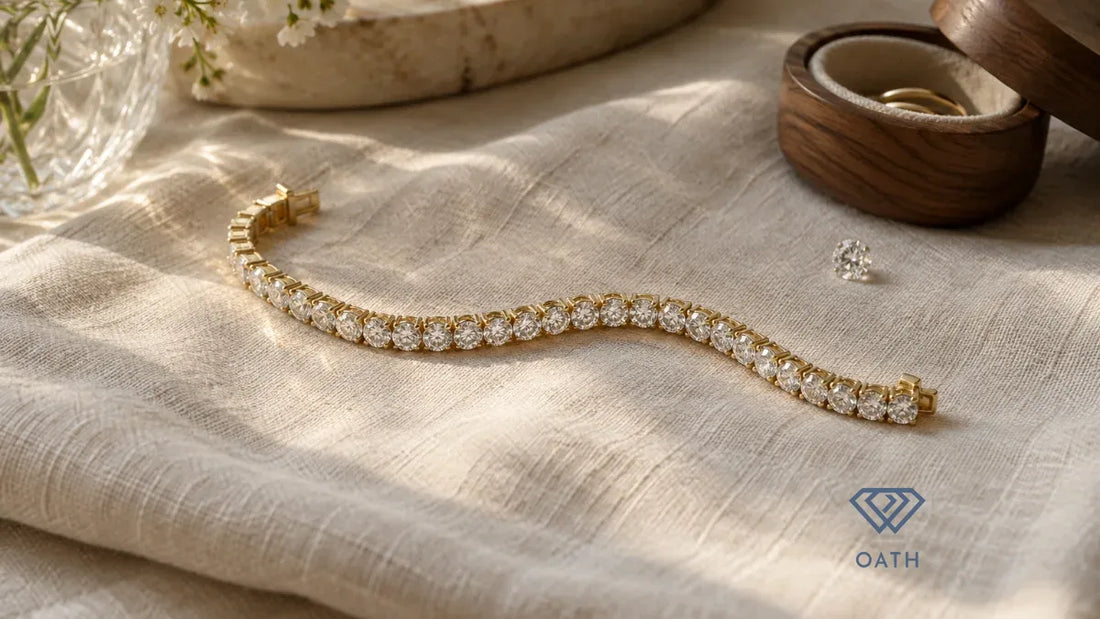
A tennis bracelet is a slim, flexible bracelet set with a single continuous line of matched stones, almost always diamonds, held in identical settings so the row reads as one unbroken band of light. The style existed as the line or eternity bracelet long before it was renamed after an on-court incident involving Chris Evert.
The tennis bracelet is one of the few pieces of fine jewelry named after an accident. It is also one of the most misdated stories in jewelry writing: the year you will find repeated across most pages is wrong. Here is what the piece actually is, where the name really came from, and what separates a bracelet that lasts decades from one that does not.
Where the name actually came from
The style is older than its name. A slim line of identically cut stones set end to end has been made since the 1920s, when it was sold as a line bracelet or an eternity bracelet. Nothing about the construction is related to tennis.
The name arrived at the United States Open, when Chris Evert was wearing a diamond and gold bracelet during an early round and the clasp gave way. Play was halted while the bracelet was recovered. Evert referred to it afterward as her tennis bracelet, and the phrase attached itself to the entire category.
The date is where almost every account goes wrong. The year is very widely reported as 1987. It was 1978. Jewelry historian Marion Fasel went to Evert's publicist to settle it, and Evert placed the incident in the year the Open moved from Forest Hills to Flushing Meadows, which was 1978. The likely explanation for the error is simple digit transposition that then propagated across the web. If you are checking a jeweler's expertise, this is a useful tell.
What actually defines a tennis bracelet
Four characteristics have to be present. Remove any one of them and the piece belongs to a different category, even if it is still a bracelet set with stones.
1 row
A single continuous line, not clustered or layered
Matched
Stones cut and sized to read as identical
Flexible
Individually linked segments, not a rigid bangle
Symmetrical
Uniform spacing around the full circumference
The flexibility point is the one most often missed. Each stone sits in its own small setting, and those settings are linked to one another. That is what lets the bracelet drape around the wrist rather than sit on it as a fixed circle. A rigid diamond bangle is not a tennis bracelet regardless of how the stones are arranged.
Total stone weight is quoted as a combined figure across the whole row, so a bracelet described at three carats total is not carrying three carat stones; it is carrying perhaps fifty small ones adding to that weight. This trips up a lot of first-time buyers.
The four settings and what each one costs you
Setting style is the single largest variable in how a tennis bracelet looks and how it survives being worn. It affects brilliance, security, and how often you will be at a jeweler having it checked.
| Setting | How it holds the stone | Brilliance | Best suited to |
|---|---|---|---|
| Prong | Small metal claws grip each stone at the corners or sides | Highest, light enters from all angles | Occasion wear and anyone prioritizing sparkle |
| Channel | Stones sit in a recessed groove between two metal walls | Moderate, light enters from above only | Daily wear, active hands, anything worn under sleeves |
| Bezel | A continuous metal rim wraps the full edge of each stone | Lowest, the rim covers the stone girdle | Maximum protection and a cleaner modern line |
| Miracle set | A reflective faceted plate frames a smaller stone | Varies, the plate amplifies apparent size | Getting visual breadth from a lighter stone weight |
The practical guidance is straightforward. If the bracelet will be worn most days, channel or bezel will save you repair visits. If it comes out for occasions, prong will out-sparkle both by a visible margin. Miracle setting is a legitimate choice rather than a shortcut, but it should be recognized for what it is: the frame is doing part of the work the stone would otherwise do alone.
How to judge one before you commit
Four checks separate a bracelet that holds up from one that disappoints, and none of them require a loupe.
Start with the clasp, because that is the failure point in the story that named the category. A box clasp with a hinged safety catch, or better a figure-eight safety, is the standard worth insisting on. A simple lobster clasp on a heavy line bracelet is under-specified. This is the component that decides whether the piece survives the decade.
Next, look at consistency across the row rather than at any single stone. The stones should read as one continuous band. Variation in size, tone, or spacing is immediately visible on the wrist in a way it never is on a product page, because the eye compares neighbors.
Third, check the length against the wrist. A tennis bracelet should move but not spin freely, roughly a finger's width of play. Too loose and the row rotates so the stones face your palm; too tight and the linking segments are under constant tension.
Finally, understand the color and clarity grades quoted in the description. Because the stones are small and set in a row, clarity characteristics that would be visible in a solitaire are effectively invisible here, which is why lower clarity grades are entirely reasonable in this style. Color consistency matters more than the grade itself. The diamond quality standards explained here apply, but their relative weighting shifts in a line setting.
Wearing it and keeping it right
A tennis bracelet sits on the most mobile joint you own and takes more knocks than any ring. Two habits cover most of the risk.
Have the settings and clasp checked roughly once a year, more often if you wear it daily. A jeweler runs a fingernail along the row and listens; a loose stone announces itself before it leaves. This single habit prevents the overwhelming majority of losses.
Put it on last and take it off first. Lotions, hairspray and cleaning products build a film across the underside of the stones that dulls the row from below, where you cannot see it happening. Warm water, a drop of dish soap and a soft brush restores it. Full guidance lives in the fine jewelry care guide.
On styling, the tennis bracelet works stacked or alone. Worn alone on the non-dominant wrist it reads as deliberate. Stacked, it pairs most naturally with a plain bangle or a watch, where the contrast in texture gives the stone row something to sit against.
It broke and fell onto the court in an early round.
Tami Starr, publicist to Chris Evert
The Adventurine, on the origin of the tennis bracelet
Further reading: Natural Diamond Council on the tennis bracelet. Evert placed the incident in the year the Open moved to Flushing Meadows, which fixes the date at 1978 rather than the widely repeated 1987.
In Short
1A tennis bracelet is a flexible bracelet carrying one continuous row of matched stones in identical settings; the style predates the name by roughly fifty years.
2The name comes from Chris Evert halting play at the 1978 United States Open to recover a broken bracelet, not 1987 as most sources state.
3Setting style is the decision that matters most: prong for brilliance, channel or bezel for daily wear, and a safety-catch clasp regardless of which you choose.
Not sure what to check before you buy?
Our jewelry buying checklist walks through clasps, settings, stone consistency and sizing, in plain language. We will email it to you.
Email Me the Guide →


Every order ships free with a 30-day return policy.
The tennis bracelet earned its place because it does something very few pieces manage: it reads as formal on a dressed wrist and as effortless on a bare one, without changing anything about itself. Choose the setting for the life the bracelet will actually have, insist on a proper safety clasp, and it will outlast the trends that periodically rediscover it. Every order ships free with a 30-day return policy.
Frequently Asked Questions
01
Why is it called a tennis bracelet?
The name traces to Chris Evert, who was wearing a diamond and gold line bracelet at the 1978 United States Open when the clasp broke mid-match. Play was paused so it could be recovered, and Evert's own description of it as her tennis bracelet became the term for the whole style. Most accounts misdate this to 1987.
02
What is a tennis bracelet made of?
Precious metal and a matched row of stones. The metal is typically 14K or 18K gold in yellow, white or rose, platinum at the higher end, or sterling silver. The stones are most often diamonds, though sapphires, rubies and emeralds are all made in the same construction.
03
What is the difference between a tennis bracelet and a regular bracelet?
Continuity and flexibility. A tennis bracelet carries one unbroken row of matched stones in identical settings, with every segment individually linked so the piece drapes. A regular bracelet may be solid, chain-linked, charm-hung, or set with stones in clusters or at intervals rather than in a single continuous line.
04
How do you wear a tennis bracelet?
Comfortably loose on the non-dominant wrist, with roughly a finger's width of movement. It should rotate slightly but not spin. It works worn alone as a single deliberate piece, or stacked against a plain bangle or a watch, where the contrast in texture flatters the stone row.
05
Does a tennis bracelet have to have diamonds?
Diamonds are the default but not a requirement. The defining feature is the construction: one continuous row of matched, identically set stones on a flexible linked band. Sapphire, ruby, emerald and moissanite versions are all correctly called tennis bracelets.
06
How often should a tennis bracelet be checked?
Annual inspection is the working standard, and every six months for a bracelet worn daily. A jeweler checks each setting for movement and tests the clasp and safety catch. Because the piece sits on a highly mobile joint and takes frequent knocks, this is the habit that prevents almost all stone loss.