
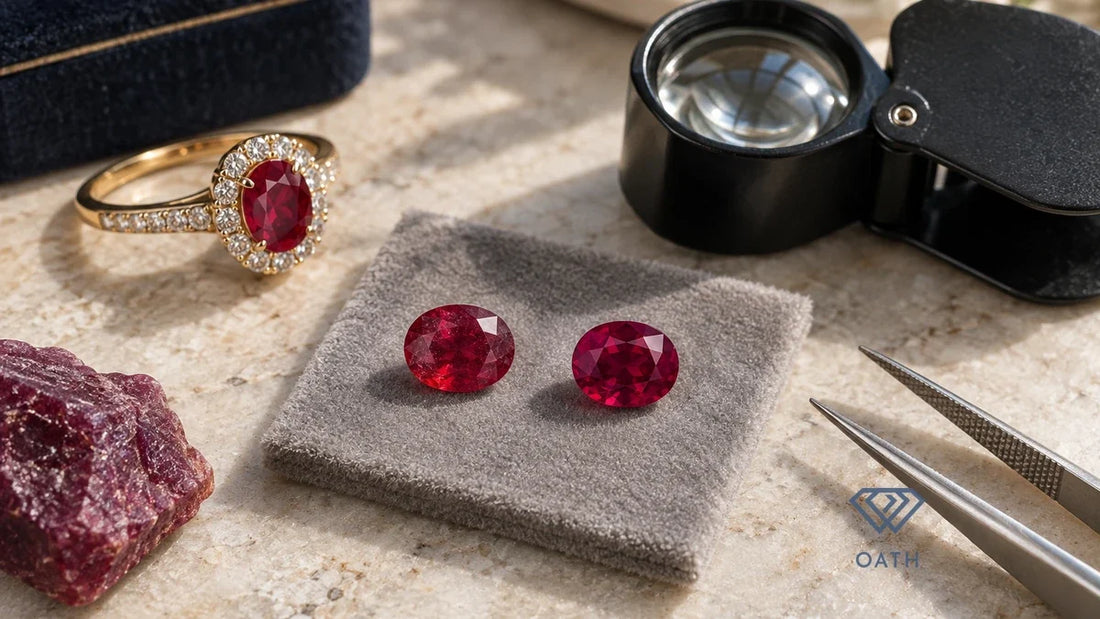
Natural and lab-grown ruby are the same mineral, corundum colored red by chromium, and both are genuine ruby. The difference is origin: natural ruby forms in the earth over millions of years, while lab-grown ruby is created in a laboratory in days or weeks. Inclusions, growth patterns, and disclosure set them apart.
Lab-grown ruby has the same chemistry, color, and hardness as mined ruby, which is exactly why it cannot be told apart by looks alone. Both are genuine ruby. This guide shows what ruby is, why a lab-grown stone is still real, and how inclusions and growth structure reveal whether a ruby was mined or made.
What Is Ruby?
9
Mohs hardness
Chromium
Source of the red
July
Birthstone
Corundum
Same species as sapphire
Ruby is the red variety of corundum, the same mineral species as sapphire. Pure corundum is colorless; trace chromium is what turns it red, from orangey to purplish tones. At 9 on the Mohs scale, ruby is among the most durable gems, well suited to rings and daily wear.
Both natural and lab-grown ruby are this same corundum. The distinction is not real versus fake but mined versus made: one forms in the earth over millions of years, the other in a laboratory over days or weeks. Ruby is the birthstone for July, and the ultimate birthstone guide places it among the other summer stones.
Natural vs Lab-Grown Ruby at a Glance
Because natural and lab-grown ruby share the same chemistry and optics, origin shows up in the inclusions and growth structure, not the color. The table lines up mined ruby against the main synthetic growth methods.
| Type | How it forms | Inclusions | Tell |
|---|---|---|---|
| Natural ruby | Forms in the earth over ages | Silk (rutile needles), crystals, fingerprints | Angular color zoning, irregular natural features |
| Flame-fusion synthetic | Melted powder, fast and common | Curved growth striae, round gas bubbles | Curved color banding under magnification |
| Flux-grown synthetic | Crystallized from molten flux, slowly | Flux fingerprints, metallic platelets | Wispy flux veils and residue |
| Hydrothermal synthetic | Grown from hot solution on a seed | Chevron growth, seed plane, breadcrumbs | Distinct growth structure near the seed |
A useful rule of thumb: a large, flawless, intensely even red stone is more often synthetic than a fine natural ruby, which almost always carries some inclusions. Even so, only magnification and, when it matters, a laboratory confirm origin.
Is Lab-Grown Ruby Real?
Yes. Lab-grown ruby is real ruby. It shares the exact chemistry, hardness, and optical properties of mined stone, because it is the same corundum. The first synthetic rubies were produced commercially in 1902 by the flame-fusion method, and the technology has only improved since.
The difference is origin and rarity. Natural ruby is finite and forms over geologic time, which is why mined stones command higher value. Lab-grown ruby offers the same look at a different point on the spectrum. United States trade rules require that synthetic stones be disclosed as lab-grown, lab-created, or synthetic.
Disclosure Note
Lab-grown ruby is genuine ruby, not an imitation; the imitations are simulants like red garnet, glass, and red spinel, which are not corundum at all. Reputable sellers state plainly when a stone is lab-grown, and the fine jewelry buying guide covers the disclosure to expect.
How to Tell Natural from Lab-Grown
Color and hardness cannot separate natural from lab-grown, since both share them exactly. The answer lives under magnification, in the inclusions and growth structure.
For the color, clarity, and cut factors that drive ruby grading, see the guide to evaluating ruby quality, and for spotting outright imitations, how to tell a real ruby from a fake.
Ruby Simulants vs Synthetics
Synthetic and simulant are not the same thing. A synthetic ruby is real ruby grown in a lab; a simulant only looks like ruby and is a different material entirely.
Flame-fusion synthetic
Real ruby grown by melting powdered feed. Fast and widely available, it betrays itself with curved growth striae and round gas bubbles.
Flux and hydrothermal synthetic
Slower lab methods that produce convincing ruby. Flux veils, metallic platelets, or seed-related growth structure reveal the laboratory origin.
Red garnet
A natural but unrelated gem often passed off as ruby. It is singly refractive and softer, lacking ruby's corundum hardness.
Red glass
A simulant with gas bubbles, mold marks, and low hardness. It warms quickly in the hand and scratches far more easily than corundum.
Glass-filled composite
Low-grade natural ruby with fractures filled by lead glass. It is fragile, sensitive to heat and acids, and sits well below untreated ruby in value.
Caring for Ruby
Ruby is one of the most durable gems at Mohs 9, second only to diamond and moissanite, so a natural or lab-grown ruby handles daily wear with ease. Warm soapy water and a soft brush keep it bright.
Care Note
Glass-filled composite rubies are the exception: avoid heat, acids, ultrasonic and steam cleaners, which can damage the glass. If you are unsure whether a ruby is glass-filled, clean it gently and ask a jeweler.
Stored away from softer stones it might scratch, a ruby of either origin keeps its fire for generations.
'Ruby is the red variety of corundum.'
International Gem Society (IGS)
International Gem Society, Corundum
Further reading: GIA, Ruby Description. IGS and GIA both define ruby as the red, chromium-colored variety of corundum; every other corundum color is sapphire.
In Short
1Natural and lab-grown ruby are both genuine corundum colored by chromium, so color and hardness cannot separate them.
2Origin shows in the inclusions: natural ruby carries silk and angular zoning, while flame-fusion synthetic shows curved striae and round bubbles.
3Lab-grown ruby must be disclosed as such; simulants like garnet and glass are the true fakes, since they are not corundum at all.
The Ruby Origin Checklist
A one-page guide to telling natural from lab-grown ruby, from inclusions and growth lines to when a lab report is worth it. We will email it to you.
Email Me the Guide →


Every order ships free with a 30-day return policy.
Whether mined or made, ruby is genuine corundum and a joy to wear. Judge origin by inclusions and growth structure rather than color, expect lab-grown stones to be disclosed, and lean on an independent report when it counts. Every order ships free with a 30-day return policy.
Frequently Asked Questions
01
How can I tell natural ruby from lab-grown?
Natural ruby carries silk, crystals, and angular color zoning, while a flame-fusion synthetic shows curved growth striae and round gas bubbles. Because both are corundum, magnification, not color or hardness, reveals the origin.
02
Is lab-grown ruby real ruby?
Lab-grown ruby is real ruby. It is the same corundum with the same chemistry, hardness, and optics as mined stone, simply grown in a laboratory rather than the earth, and trade rules require it to be disclosed as lab-grown.
03
What is the difference between a synthetic and a simulant ruby?
A synthetic ruby is genuine corundum grown in a lab, while a simulant only imitates the look. Red garnet, red glass, and red spinel are simulants because they are different materials, not corundum.
04
Is lab-grown ruby worth less than natural?
Lab-grown ruby generally carries lower value than a comparable natural stone, because mined ruby is finite and forms over geologic time. For spotting outright imitations rather than synthetics, see how to tell a real ruby from a fake.
05
What is a glass-filled ruby?
A glass-filled ruby is low-grade natural ruby whose fractures have been filled with lead glass to improve appearance. It is fragile and sensitive to heat and acids, which the guide to evaluating ruby quality weighs as a quality factor.
06
How do I care for a ruby?
Ruby is very durable at Mohs 9 and takes warm soapy water and a soft brush well. The exception is a glass-filled composite, which should avoid heat, acids, and ultrasonic cleaners that can damage the filler.