
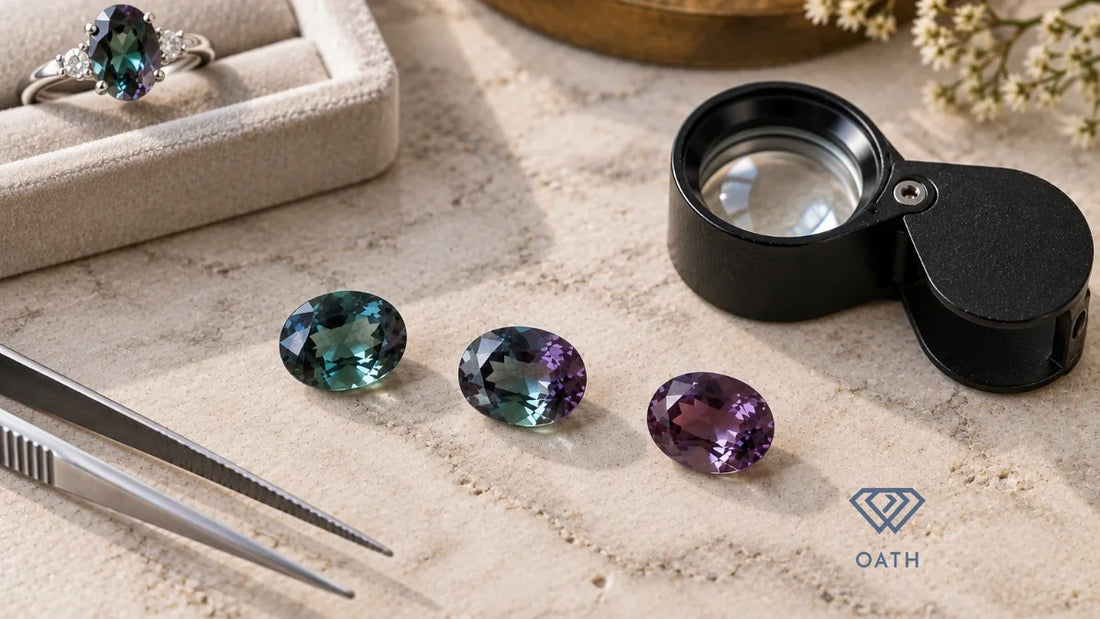
Natural alexandrite is the rare color-change variety of chrysoberyl, shifting green in daylight to red under incandescent light through trace chromium. True synthetic alexandrite is the same chrysoberyl grown in a lab, while most mass-market alexandrite is actually color-change corundum, a simulant that is not chrysoberyl at all.
Alexandrite is famous for changing color from green to red, and that drama is exactly why the market is full of substitutes. Some are honest lab-grown chrysoberyl; many more are color-change corundum sold under alexandrite's name. This guide explains what alexandrite is, how the color change works, and how to tell natural stones from synthetics and simulants.
What Is Alexandrite?
BeAl2O4
Chrysoberyl
8.5
Mohs hardness
June
Birthstone
Chromium
Color-change cause
Alexandrite is the rare color-change variety of the mineral chrysoberyl, a beryllium aluminum oxide. Trace chromium gives it a chameleon trick: green to bluish-green in daylight, shifting to red or purplish-red under incandescent light, an effect often described as emerald by day, ruby by night.
At 8.5 on the Mohs scale, chrysoberyl is hard and tough enough for daily wear. Alexandrite was discovered in Russia's Ural Mountains in the 1830s and named for the future Tsar Alexander II; today it also comes from Brazil, Sri Lanka, and East Africa. It is a June birthstone, and the ultimate birthstone guide lists it alongside pearl and moonstone.
The Color-Change Effect
The color change is the whole point of alexandrite, and understanding it is the key to spotting the fakes. It is not a trick of the setting or a coating. It is how the chromium inside the chrysoberyl absorbs light.
Chromium absorbs light in the yellow band of the spectrum, leaving green and red to pass through. Daylight and fluorescent light are rich in blue-green, so the stone reads green; incandescent bulbs and candlelight are rich in red, so the same stone reads red. The shift is so distinctive that gemologists call it the alexandrite effect.
Natural alexandrite is also strongly pleochroic, showing green, orange, and red-purple from different crystal directions. A fine natural stone usually shows a clear but not cartoonish green-to-red change; a change that looks too clean and too dramatic, often blue to purple, is a warning sign discussed below.
Natural, Synthetic, and Simulant at a Glance
Three different things get sold as alexandrite: natural chrysoberyl, true synthetic chrysoberyl, and simulants that are entirely different materials. The table separates them. The biggest consumer trap is color-change corundum sold as alexandrite.
| Type | What it is | The tell |
|---|---|---|
| Natural alexandrite | Mined color-change chrysoberyl | Subtler green-to-red change, natural inclusions, strong pleochroism |
| Synthetic alexandrite | Lab-grown chrysoberyl, same material | Genuine change, but curved striae, bubbles, or flux veils inside |
| Color-change corundum | Synthetic sapphire, a simulant | Dramatic blue-to-purple change, too clean, not chrysoberyl |
| Color-change spinel or garnet | Other materials that shift hue | Different change and optics, confirmed by a lab |
How to Tell Them Apart
Telling alexandrite apart starts with the exact colors of the change, then moves to a loupe. The hue of the shift and the inclusions inside carry most of the answer.
For the color-change strength, clarity, and cut factors behind a fine stone, see the guide to evaluating alexandrite quality.
The Simulant Trap
Naming the substitutes makes the market clearer, because the word alexandrite gets stretched to cover several very different stones.
Synthetic alexandrite
Genuine lab-grown chrysoberyl with a real green-to-red change. Honest and durable, it reveals its lab origin through curved striae, gas bubbles, or flux veils under magnification.
Color-change sapphire (corundum)
The most common alexandrite simulant, this synthetic corundum is not chrysoberyl at all. Its change is usually a bold, too-clean blue to purple rather than alexandrite's green to red.
Color-change spinel
A synthetic spinel that shifts hue and stands in for alexandrite. It is a different material with different optics, separated reliably by a gem lab.
Color-change garnet
A natural but unrelated gem that changes color. It is genuinely rare and collectible in its own right, but it is garnet, not alexandrite.
Glass
Simple colored or color-change glass mimics the effect crudely. It is soft, often shows gas bubbles, and feels warm and light next to true chrysoberyl.
Caring for Alexandrite
Durability is the good news with alexandrite. At Mohs 8.5 with excellent toughness and no cleavage, chrysoberyl handles daily wear in rings and bracelets with ease, whether the stone is natural or a true synthetic.
Care Note
Clean alexandrite with warm soapy water and a soft brush; it is hard enough that warm soapy water is always safe. Natural untreated alexandrite generally tolerates ultrasonic cleaners well, but if a stone might be fracture-filled or you are unsure, stay with the gentle method and ask a jeweler. Store it apart from softer stones it could scratch.
Hard, tough, and quietly magical under changing light, an alexandrite of either origin is built to last for generations.
Alexandrite is the very rare color-change variety of the mineral chrysoberyl.
Gemological Institute of America (GIA)
Further reading: GIA, Alexandrite Description. GIA defines alexandrite as the color-change variety of chrysoberyl, BeAl2O4, colored by chromium; every imitation either copies that effect in a different material or is grown in a lab from the same chrysoberyl.
In Short
1Natural alexandrite is the rare color-change variety of chrysoberyl, shifting green to red through trace chromium, and is hard and durable at Mohs 8.5.
2True synthetic alexandrite is the same chrysoberyl grown in a lab, with a genuine color change but lab inclusions like curved striae, bubbles, or flux veils.
3Most mass-market alexandrite is actually synthetic color-change corundum, a simulant whose bold blue-to-purple shift differs from chrysoberyl's subtler green-to-red change.
The Alexandrite Identity Checklist
A one-page guide to telling natural alexandrite from synthetic chrysoberyl and corundum simulants, from the exact color change to the inclusions inside. We will email it to you.
Email Me the Guide →Every order ships free with a 30-day return policy.
Whether mined or lab-grown, true alexandrite is color-change chrysoberyl, and the stone to walk away from is the corundum simulant with the too-perfect blue-to-purple flip. Judge the exact hue of the change, loupe for growth marks, and confirm anything important with a gem lab. Every order ships free with a 30-day return policy.
Frequently Asked Questions
01
How can I tell natural alexandrite from synthetic?
Both natural and true synthetic alexandrite are chrysoberyl with a real green-to-red change, so origin shows under magnification. Synthetic stones reveal curved striae and gas bubbles from Czochralski growth or wispy flux veils, while natural ones show fingerprints, needles, and small crystals.
02
Is most alexandrite jewelry real alexandrite?
Much mass-market alexandrite is not chrysoberyl at all but synthetic color-change corundum, a simulant. Its giveaway is a bold, too-clean blue-to-purple change, unlike the subtler green-to-red shift of genuine alexandrite.
03
What causes alexandrite to change color?
Trace chromium in the chrysoberyl absorbs light in the yellow part of the spectrum, letting green and red pass. Under blue-green daylight the stone looks green, and under red-rich incandescent light the same stone looks red, the effect gemologists call the alexandrite effect.
04
Is synthetic alexandrite worth less than natural?
True synthetic alexandrite generally carries lower value than fine natural material, which is among the rarest of gems. For the color-change strength and clarity factors that drive quality, see the guide to evaluating alexandrite quality.
05
Is alexandrite durable enough for daily wear?
Yes. Alexandrite is chrysoberyl at 8.5 on the Mohs scale with excellent toughness and no cleavage, so it stands up well to rings and bracelets. Warm soapy water and a soft brush keep it clean.
06
Where does natural alexandrite come from?
It was first found in Russia's Ural Mountains in the 1830s and named for the future Tsar Alexander II. Those deposits were largely worked out, and today natural alexandrite comes mainly from Brazil, Sri Lanka, and East Africa.