
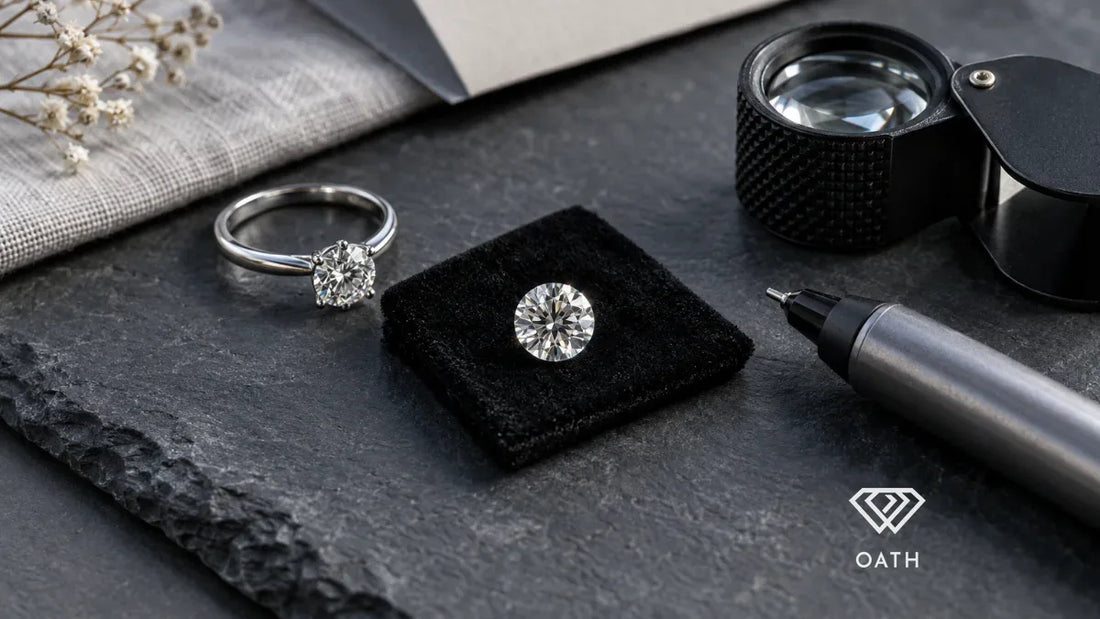
A real diamond is pure crystallized carbon, the hardest natural material, and it handles heat and light in ways imitations cannot match. A quick fog test and a thermal probe rule out most fakes, though moissanite needs one extra check. Lab-grown diamonds are real diamonds; only a laboratory can confirm a stone's origin for certain.
Jump to a section
What makes it realTests that workCZ, moissanite, glassLab-grown vs naturalLab reportsThe 4Cs & valueDiamond attracts more imitations than any other gem, so the questions come up constantly: is it glass, is it cubic zirconia, is it moissanite, is it lab-grown, is it real? The good news is that a few reliable habits separate a genuine diamond from nearly every imitation, and the one tricky lookalike has a known workaround. Here is how to read a diamond with confidence, and when to let a laboratory have the final say.
What Makes a Diamond Real
A diamond is pure carbon crystallized under enormous pressure into the hardest natural material known, a 10 on the Mohs scale. That structure gives it two signature behaviors. It conducts heat exceptionally well, which is what most testers measure, and it bends and returns light with a high refractive index, producing the crisp white brilliance and flashes of colored fire that define a fine stone.
Three categories matter. A natural diamond formed in the earth over millions to billions of years. A lab-grown diamond is the same carbon crystal, made in a lab in weeks by CVD or HPHT methods, and it is a real diamond in every physical sense. A simulant, such as cubic zirconia, moissanite, or glass, only looks like diamond and is a different material entirely. The first two are diamond; the third is not.
10
Mohs hardness, the hardest natural material
Carbon
Pure crystallized carbon, nothing else
Insulator
A diamond carries heat well but resists electricity
At-Home Tests That Actually Work
Start with the fog test. Breathe on the stone as you would a mirror: a diamond pulls heat away so fast that the fog clears almost instantly, while most simulants stay fogged for a second or two. It is a quick, free first filter. Next, look at how the stone sparkles. A diamond returns a balance of bright white light with measured flashes of color; a stone that throws an intense, almost gaudy rainbow is more likely cubic zirconia or moissanite.
A handheld thermal tester, the pen-style diamond tester, is the most useful home tool, because diamond's heat conductivity is hard to fake. It will clear out glass and cubic zirconia immediately. Its one blind spot is moissanite, which conducts heat much like diamond and can read as diamond on a basic probe. The fix is a multi-tester that also checks electrical conductivity: diamond resists electricity while moissanite conducts it, so the combined tool separates them.
Two old tricks deserve caution. The newspaper read-through test and the water float test are unreliable, especially for mounted stones and for modern simulants that mimic diamond's density and clarity. Treat them as curiosities. The mounting itself is a better clue: a genuine diamond is rarely set in low-grade base metal, so a hallmark for gold or platinum is a quiet vote of confidence.
The Lookalikes: Cubic Zirconia, Moissanite, and Glass
Cubic zirconia is the most common stand-in. It is denser than diamond, so it feels heavy for its size, throws far more rainbow fire, lacks diamond's heat conductivity, and softens at the facet edges with wear. A thermal tester catches it at once. Glass and rhinestone are easier still: warm, soft, and lifeless next to a diamond, often with round bubbles inside.
Moissanite is the convincing one. Nearly as hard as diamond and a strong heat conductor, it passes a basic thermal tester. Two things give it away. It is doubly refractive, so under a loupe the back facet edges look doubled or fuzzy, where a diamond's stay crisp. And it conducts electricity, so a multi-tester flags it. One honest caveat: a few diamonds that contain boron, including some natural blue and certain lab-grown stones, can also read as conductive, which is exactly why a laboratory is the final authority.
Lab-Grown vs Natural: Both Are Real Diamonds
This is the point that trips up even careful buyers: a lab-grown diamond is a real diamond. Grown by CVD or HPHT, it has the same carbon crystal structure and the same hardness, brilliance, and fire as a mined stone. A home tester cannot separate the two, because there is no physical difference to detect; both simply read as diamond. The distinction is origin, not authenticity.
Disclosure Note
Because the difference is origin rather than substance, lab-grown and natural diamonds must be told apart by a laboratory using advanced instruments, never by a pen tester. Reputable lab-grown stones carry a laser inscription on the girdle and a report from GIA, IGI, or GCAL stating clearly that they are laboratory-grown. When buying, ask for that report in writing; the fine jewelry buying guide covers what disclosure should include.
Neither choice is more real than the other. A natural diamond carries the rarity and the long geological story; a lab-grown diamond offers the same look with a different origin and a younger history. What matters is that the seller states plainly which one you are buying, backed by a report, so the choice is yours to make on full information.
When to Get a Lab Report
Home tests are perfect for ruling out glass and cubic zirconia and for a quick gut check. For a stone of real value or sentiment, a grading report from GIA, IGI, or GCAL is the final word. A laboratory confirms whether a stone is a diamond, whether it is natural or lab-grown, and grades it on the 4Cs, often matching it to a laser inscription on the girdle.
"This results in nearly the same chemical, optical and physical properties as natural diamonds."
Gemological Institute of America (GIA)
On laboratory-grown diamonds, 4cs.gia.edu
GIA created the 4Cs and the modern diamond grading standard. Further reading: GIA diamond overview.
Request a report when value or sentiment runs high, when origin matters to you, or when a seller cannot tell you plainly whether a stone is natural, lab-grown, or a simulant. A grading report is the language jewelers and insurers trust, and it travels with the piece for resale and coverage.
Is a Diamond Worth It? The 4Cs and Value
Diamond value rests on the 4Cs: cut, color, clarity, and carat. Cut matters most, because it governs how much light the stone returns and therefore how alive it looks. Color is graded from colorless down through faint tints, clarity from flawless through visible inclusions, and carat measures weight. A natural diamond is valued for rarity and origin; a lab-grown diamond, graded on the very same scale, is valued for the look at an easier reach.
So decide what you want the stone to be. For rarity and a story written over geological time, choose a natural diamond with a report. For the same brilliance with a different origin, a certified lab-grown diamond is honest and beautiful. And to rule out a simulant, let the fog test and a tester do the quick work, then lean on a laboratory whenever the stone truly matters.
In Short
1A real diamond is pure crystallized carbon, the hardest natural material; it clears fog instantly, returns balanced brilliance and fire, and resists electricity.
2A thermal tester rules out glass and cubic zirconia, but moissanite passes it, so use a multi-tester that also checks electrical conductivity, or look for doubled facet edges.
3Lab-grown diamonds are real diamonds, separated from natural only by a laboratory; a GIA, IGI, or GCAL report confirms identity, origin, and the 4Cs.
The Diamond Authentication Checklist
A one-page checklist of the at-home tests that actually work, how to catch moissanite and cubic zirconia, and the questions to ask before you buy. We'll email it to you.
Email Me the Guide →


Every order ships free with a 30-day return policy.
Telling a real diamond from an imitation comes down to a handful of reliable moves: the fog test, a thermal tester with the moissanite caveat in mind, a look at how the stone handles light, and a laboratory report when it counts. Master those and the most imitated gem in the world becomes one you can read with confidence. Every order ships free with a 30-day return policy.
Frequently Asked Questions
01
How can I tell if a diamond is real?
Start with the fog test: a real diamond clears your breath almost instantly because it disperses heat so quickly. Then check the sparkle, which should balance white brilliance with restrained fire rather than a constant rainbow, and use a handheld thermal tester to rule out glass and cubic zirconia. For a valuable stone, a GIA, IGI, or GCAL report is the only definitive confirmation.
02
Does the diamond fog test really work?
The fog test is a useful first filter rather than proof. Because diamond conducts heat away rapidly, the fog from your breath clears almost at once, while most simulants stay misted for a moment longer. It reliably flags obvious fakes, but it cannot separate diamond from moissanite or tell a natural diamond from a lab-grown one, so pair it with a tester and, when it matters, a lab report.
03
Can a diamond tester tell a diamond from moissanite?
A basic thermal tester often cannot, because moissanite conducts heat much like diamond and can read as diamond. The reliable fix is a multi-tester that also measures electrical conductivity: diamond resists electricity while moissanite conducts it. Under a loupe, moissanite also shows doubled facet edges. A few boron-bearing diamonds can read as conductive too, which is why a laboratory is the final authority.
04
Is cubic zirconia a real diamond?
No. Cubic zirconia is a diamond simulant, a different material made from zirconium dioxide. It is denser than diamond, so it feels heavy for its size, throws far more rainbow fire, lacks diamond's heat conductivity, and softens at the facet edges with wear. A thermal tester identifies it almost instantly, and to the trained eye its excess fire gives it away.
05
Is a lab-grown diamond a real diamond?
Yes. A lab-grown diamond is genuine diamond with the same carbon crystal structure and the same hardness, brilliance, and fire as a mined stone, grown by CVD or HPHT methods. A home tester cannot tell it from a natural diamond because there is no physical difference; only a laboratory can separate them by origin. For how the 4Cs are judged, see how to evaluate diamond quality.
06
Do I need a diamond grading report?
A report is worth requesting whenever value, origin, or sentiment runs high, since it is the only way to confirm with certainty whether a stone is natural, lab-grown, or a simulant, and to grade it on the 4Cs. GIA, IGI, and GCAL are the widely trusted laboratories, and many stones carry a matching laser inscription on the girdle. The birthstone guide places diamond in its wider context.