
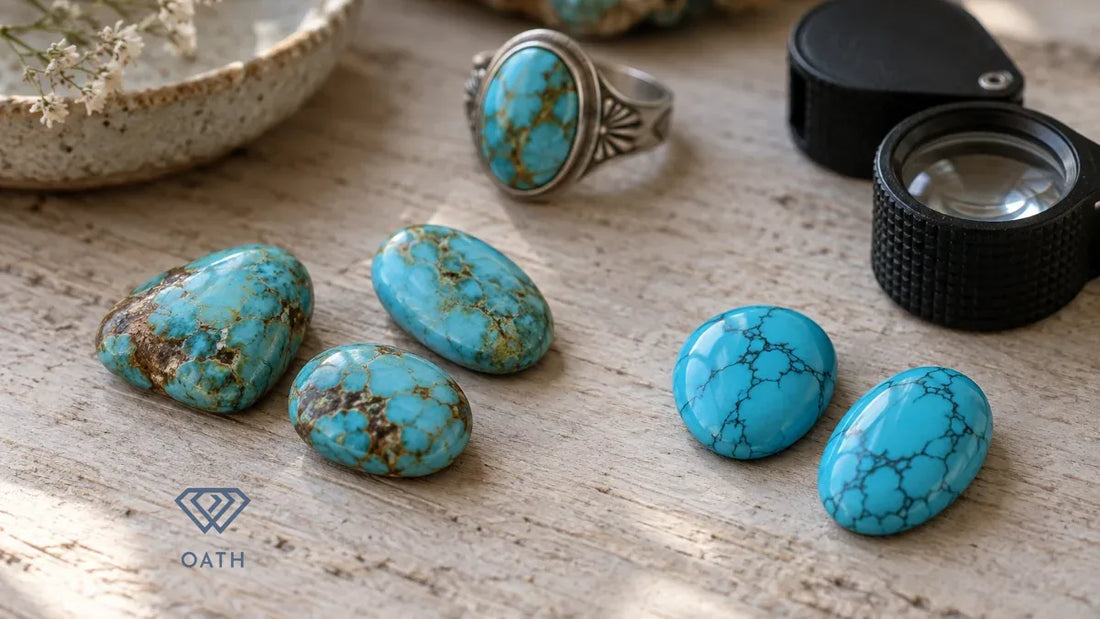
Genuine turquoise is a porous, blue-to-green copper-aluminum phosphate, and most pieces sold today are stabilized with resin to harden them. The common fakes are dyed howlite or magnesite, reconstituted composite, and dyed plastic or block. Matrix character, hardness, and a few quick tests are the fastest tells.
Turquoise has been treasured for thousands of years, and for almost as long it has been imitated. The good news: genuine turquoise behaves in ways dyed howlite and plastic cannot fully copy. This guide shows what real turquoise is, how stabilization differs from imitation, and how to separate the true stone from its look-alikes before you buy.
What Is Real Turquoise?
5 to 6
Mohs hardness
December
Birthstone
Cu + Al
Copper-aluminum phosphate
Porous
Absorbs oils and dye
Turquoise is a porous, blue-to-green copper-aluminum phosphate that forms where copper-rich water seeps through aluminum-bearing rock in dry regions. Copper drives the sky-blue tones, while iron pushes the color toward green. The web of host rock left behind, called matrix, is part of the stone's character.
Because it is soft and porous, sitting at 5 to 6 on the Mohs scale, turquoise readily absorbs oils, dye, and resin. That porosity is exactly what makes both honest treatment and outright imitation possible, so knowing the material is the first step to spotting a fake.
Turquoise is the traditional birthstone for December, prized for millennia from the Sinai and Persia to the mines of Arizona and Nevada. For where it sits among the other December stones, the ultimate birthstone guide sets them side by side.
Real vs Fake Turquoise at a Glance
Most turquoise fakes are lesser minerals dyed blue, or material that is not solid turquoise at all. The table lines up genuine turquoise against the stand-ins sellers pass off most often.
| Material | Hardness (Mohs) | Tell | Giveaway |
|---|---|---|---|
| Genuine turquoise | 5 to 6 | Irregular natural matrix, waxy to dull luster | Random matrix, cool and stone-like in the hand |
| Dyed howlite | 3.5 | White mineral with gray-black webbing, dyed blue | Dye lifts on an acetone swab, softer than turquoise |
| Dyed magnesite | 3.5 to 4 | Very white base taking dye evenly | Identical beads, blue dye pooled in cracks |
| Reconstituted composite | Varies | Ground turquoise powder bonded with resin | Color too uniform, visible binder between grains |
| Block (plastic or resin) | 2 to 3 | Flat color, painted-on or absent matrix | Light, warms fast, no natural variation |
No single check settles it alone, but agreement across a few tells makes a confident call. For an important stone, an independent laboratory report removes the doubt.
Stabilized, Dyed, or Natural?
Turquoise reaches the market across a spectrum of treatment. Natural untreated stone of high grade is genuine and rare. Stabilized turquoise is natural stone impregnated with resin to harden it and deepen color, the most common form sold today, and still genuine turquoise.
Below that, dyed or color-enhanced material stretches lower-grade stone, while reconstituted composite is ground turquoise bonded into a block. Imitation, such as dyed howlite or plastic, is not turquoise at all. The line that matters is whether the piece is turquoise or merely turquoise-colored.
Disclosure Note
Stabilized turquoise is still genuine turquoise, and reputable sellers say plainly when a stone is stabilized, dyed, or reconstituted. Clear treatment disclosure, not a vague authenticity badge, is the mark of a trustworthy source, and the fine jewelry buying guide covers the questions worth asking.
How to Spot Fake Turquoise
You can screen most pieces in a few minutes. Let agreement between the checks, not any single result, guide your conclusion.
For a closer look at color, matrix, and grading, the guide to evaluating turquoise quality walks through it factor by factor.
Turquoise Imitations and Look-Alikes
Knowing the usual stand-ins makes them easier to catch. Each behaves differently from genuine turquoise.
Dyed howlite
A soft white mineral with natural gray-black webbing that takes blue dye convincingly. It is softer than turquoise, and the dye can lift with acetone.
Dyed magnesite
Another white mineral dyed to imitate turquoise. Beads often look identical to one another, with dye concentrated in surface cracks.
Reconstituted composite
Ground turquoise and dye bonded with resin into a block, then cut. It contains real turquoise but is not a solid natural stone.
Block (plastic or resin)
Dyed plastic or resin with flat color and painted matrix. It is light, warms fast in the hand, and shows no natural variation.
Other look-alikes
Chrysocolla, variscite, and dyed chalcedony sold as gem silica can resemble turquoise, though their texture and formation differ on close study.
Caring for Genuine Turquoise
Turquoise is soft and porous, so it asks for gentle handling. Keep it away from heat, cosmetics, lotions, and household chemicals, all of which can discolor the stone.
Care Note
Wipe turquoise with a soft, dry or barely damp cloth and store it apart from harder gems. Avoid ultrasonic and steam cleaners, perfumes, and prolonged sunlight, since porosity lets liquids and heat alter the color.
Stabilized stones tolerate daily wear better than untreated ones, but a little care keeps any turquoise looking its best for years.
'...a porous, semitranslucent to opaque compound of hydrated copper and aluminum phosphate.'
Gemological Institute of America (GIA)
Further reading: American Gem Trade Association. GIA describes turquoise as a porous copper-aluminum phosphate, and AGTA standards call for disclosing stabilization, dyeing, and reconstitution.
In Short
1Real turquoise is a porous copper-aluminum phosphate at 5 to 6 on the Mohs scale, with irregular natural matrix woven through the stone.
2Most turquoise sold today is stabilized with resin; that is genuine turquoise, not a fake, as long as it is disclosed.
3Dyed howlite and magnesite, reconstituted composite, and dyed plastic are the common imitations; matrix, hardness, and a dye test separate them from the real stone.
The Turquoise Authenticity Checklist
A one-page guide to spotting genuine turquoise at a glance, from matrix and weight to the dye test. We will email it to you.
Email Me the Guide →


Every order ships free with a 30-day return policy.
Genuine turquoise rewards a careful eye. Read the matrix, weigh it in the hand, watch for dye in the cracks, and expect stabilization as the norm rather than a flaw. Every order ships free with a 30-day return policy.
Frequently Asked Questions
01
How can I tell if my turquoise is real?
Genuine turquoise shows an irregular, woven matrix, a cool stone-like feel, and subtle color variation. Dyed howlite and plastic give themselves away with painted matrix, dye pooled in cracks, and a light, quick-warming surface.
02
Is stabilized turquoise still real turquoise?
Stabilized turquoise is genuine turquoise that has been impregnated with resin to harden it and steady the color. It is the most common form sold today and is fully authentic as long as the treatment is disclosed.
03
What is the most common fake turquoise?
Dyed howlite and dyed magnesite are the most common imitations. Both are soft white minerals that take blue dye convincingly, but their dye can lift with acetone and they scratch more easily than turquoise.
04
What is the difference between turquoise and howlite?
Turquoise is a copper-aluminum phosphate, while howlite is a softer calcium borosilicate often dyed to mimic it. For the color, matrix, and grading factors that define quality turquoise, the guide to evaluating turquoise quality breaks them down.
05
Is all turquoise treated?
Most turquoise on the market is stabilized, and lower grades may be dyed or reconstituted. Untreated high-grade stone is genuine and uncommon, so the fine jewelry buying guide explains the disclosure worth requesting.
06
How should I care for turquoise?
Turquoise responds best to a soft cloth, storage apart from harder gems, and distance from heat, cosmetics, and chemicals. Its porosity means perfumes, ultrasonic cleaners, and sunlight can alter the color over time.