
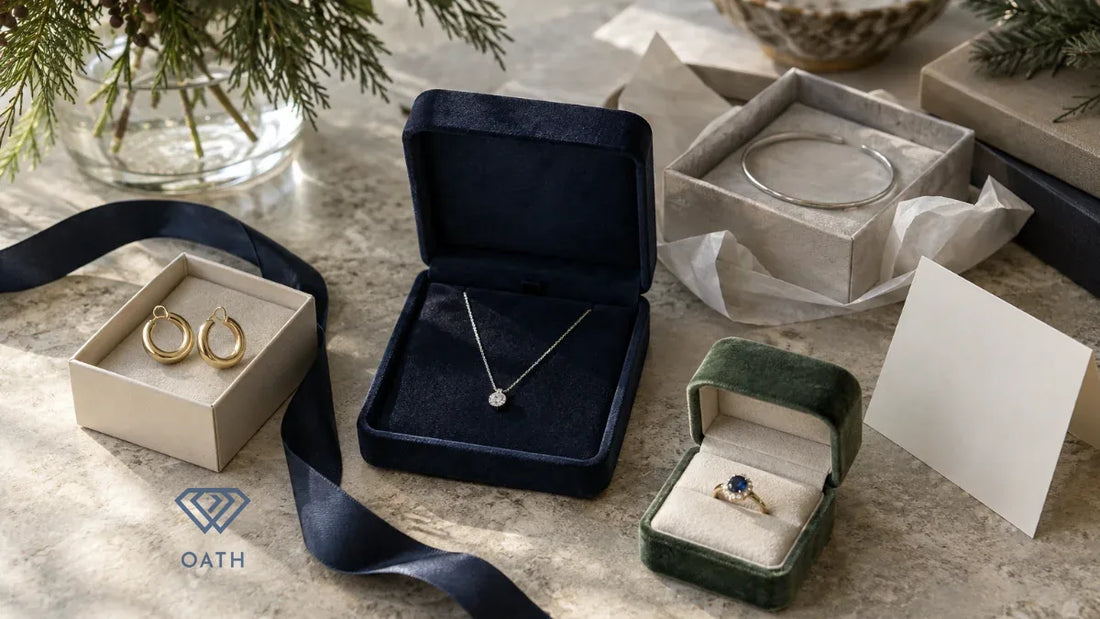
The best jewelry gifts are chosen with the recipient's existing taste in mind, not your own. Before buying, look at what they currently wear: the metal they gravitate toward, whether they prefer statement or delicate pieces, and the occasions they dress for. A piece that extends and enhances what someone already loves will be worn far more than one that reflects what you wish they wore.
Jump to a section
There is a failure mode specific to jewelry as a gift: the giver buys something they personally find beautiful, the recipient graciously accepts it, and the piece quietly lives in a drawer for years. It is not that the jewelry was poorly made or inexpensive. It is that the giver chose for themselves rather than for the person they were buying for.
Fine jewelry is a highly personal category. The metal someone gravitates toward, the weight and scale of pieces they actually wear, the occasions they dress for, the stones (if any) they find beautiful rather than just valuable: all of these vary enormously between individuals, and none of them can be guessed reliably without paying attention to what the recipient has already chosen. The giver who pays that attention before buying will give a piece that becomes part of how someone sees themselves. The giver who does not will give something beautiful that never quite fits.
This guide makes that attention systematic: how to read someone's jewelry taste, how to match it to a gift choice, how to navigate metal, stone, and occasion considerations, and how to match the scale of the gift to the moment without overreaching or undercommitting.
Step One: Read What They Already Wear
The most reliable research for a jewelry gift happens before you open any browser or walk into any store. It happens by paying attention to what the recipient wears now.
Metal preference is the highest-signal observation. Someone who consistently wears yellow gold is telling you something. Someone who wears exclusively silver is telling you something different. A person who mixes metals already has a tolerant, eclectic taste that gives you more flexibility. A person whose jewelry is exclusively one metal type is a buyer who made those choices deliberately, and adding something in a different metal risks creating a piece they cannot wear with the rest of their jewelry. Match the metal before anything else.
Scale and style tell you about personality. Someone who wears delicate, layered necklaces is not the same buyer as someone who wears a single substantial statement pendant. Someone whose earrings are small huggies or simple studs is different from someone who wears chandelier drops. These are preferences, not rules, but they are consistent signals. A delicate dresser given a bold statement piece will appreciate the gift and rarely wear it. A person who lives in statement pieces given something dainty may find it disappears against their aesthetic.
Occasion tells you about need. A person who wears jewelry to work every day has different priorities than someone who saves it for evenings and events. A person who is physically active (working with their hands, wearing latex gloves regularly, swimming) has practical durability considerations that affect which pieces actually get used. If the recipient is someone you spend time with, you have seen these patterns. Use them.
How Do I Choose the Right Metal for a Jewelry Gift?
Once you have identified the recipient's metal preference, the remaining metal decision is karat and color. For gold wearers, 14K yellow, white, or rose gold covers the vast majority of everyday fine jewelry needs, and the color should match what they already wear. For someone who wears silver, sterling silver (925) is the right choice; do not assume white gold is a better version of silver (they are distinct in character, maintenance, and price, and a silver wearer may not want to deal with the replating requirement of white gold). For someone whose existing jewelry is platinum, giving them gold creates a mismatch they will notice; platinum or white gold is the safer choice.
If you genuinely do not know their metal preference and cannot find out, yellow gold or sterling silver are the two defaults with the broadest cross-demographic appeal. Rose gold has strong contemporary appeal but is more polarizing: people who love it tend to love it specifically, and people who do not love it typically have made that decision.
Before You Choose
If the recipient wears white metals and you are weighing white gold against silver or platinum, the differences in maintenance and cost are real. The Precious Metals Comparison lays out how each one wears and what upkeep it needs.
Should a Jewelry Gift Include a Gemstone?
Not every fine jewelry gift needs a gemstone. A solid gold chain, a well-made bangle, a simple gold ring: these are meaningful fine jewelry gifts that stand entirely on the quality of the metal and the craftsmanship of the piece. The case for a no-stone piece as a gift is that it removes the question of whether the recipient likes this stone in this color at this size, and it focuses the gift on something they can wear with everything they already own.
When a stone does make sense as a gift: birthstones are among the most personal and personalized choices available, connecting the piece to the specific person in a way a neutral piece cannot. Diamonds carry universal recognition as a gift of significance. For diamonds specifically, the GIA's 4Cs framework explains what separates a stone that performs in real light from one that merely looks large on paper. A specific stone the recipient has mentioned or responded to visibly is always worth remembering. If none of these conditions apply, the no-stone piece is usually the safer choice.
For a complete birthstone reference by month, see the birthstone guide.
Jewelry Gifts by Occasion
Jewelry Gift Guide by Occasion
A practical reference covering the right jewelry types, gift scale, and key considerations for every major gift occasion, from birthday and anniversary to graduation and engagement. We'll email it to you.
Email Me the Guide →How Do I Buy a Ring as a Gift Without Knowing Their Size?
Rings are the most meaningful and the most logistically complicated fine jewelry gift. The size problem is real: most rings can be sized, but sizing has practical limits (typically plus or minus two to three sizes) and some settings cannot be sized at all. Buying a ring as a surprise gift without knowing the recipient's size means either asking someone who knows them, finding a ring they already own and having a jeweler measure it, or buying a size that will need to be adjusted after the gift is given. Sizing is a normal and simple service that any fine jeweler provides; building this expectation into the gift is entirely reasonable. What is not reasonable is guessing and hoping.
Most women
Size 6 to 7
Most men
Size 9 to 11
Rough averages, not reliable targets. When estimating, size slightly larger: a ring too large can be worn on another finger temporarily and is easier to size down than to size up.
If you need to guess: most women wear a size 6 to 7, and most men wear a size 9 to 11. These are rough averages, not reliable targets. Buying slightly larger than your best estimate is the better error direction, since a ring that is slightly too large can be worn on a different finger temporarily and is easier to size down than a ring too small to fit.
What Experienced Givers Know
"Selecting jewelry as a gift requires understanding the recipient's personal aesthetic before the first product is considered. The most reliable signal is their existing jewelry: the metals, scale, and styles they have already chosen for themselves reflect taste formed over years of deliberate selection. A piece that extends what someone already wears will be used. A piece chosen independently of that context may be appreciated and unworn."
Jewelers of America
Founded in 1906, Jewelers of America is the oldest fine jewelry trade association in the United States.
One practical principle worth naming directly: a fine jewelry gift does not need to be expensive to be meaningful. A well-made sterling silver piece from a credible seller that suits the recipient's taste and the occasion is a better gift than an expensive piece that misses both. The money spent is the least memorable part of a well-chosen jewelry gift. What the person carries forward is that someone knew them well enough to choose this specific piece for this specific moment.
In Short
1Match the metal the recipient already wears before any other decision; it is the highest-signal observation you can make.
2A no-stone piece is the safer choice unless a birthstone, a diamond, or a stone they have responded to clearly applies.
3A well-chosen, modestly priced piece that fits their taste beats an expensive piece that misses it.
Fine Jewelry Gifts at Oath


For guidance on the quality factors to look for in any fine jewelry piece before purchasing, see the complete fine jewelry buying guide. Find the right piece for the right person at oathjewelry.com. Every order ships free with a 30-day return policy.
Frequently Asked Questions
01
What is a good jewelry gift for someone I don't know well?
For someone whose taste you do not know well, the safest choices are simple, high-quality pieces in neutral metals: a small gold pendant, a simple pair of gold stud earrings, a classic silver chain. These are pieces that work across most personal styles rather than requiring specific taste alignment. Avoid statement pieces, bold colored stones, and highly designed pieces when buying for someone whose preferences you cannot read confidently from their existing jewelry.
02
Is it appropriate to give a ring as a gift outside of an engagement context?
Rings are excellent gifts for birthdays, anniversaries, Mother's Day, and other meaningful occasions. The considerations are knowing the recipient's ring size (see ring size guidance above) and understanding which fingers they currently wear rings on. A right-hand ring for a milestone birthday is a thoughtful and appropriate gift choice. The engagement-ring association does not limit rings as a gift category; it simply means the left ring finger carries specific cultural weight in most Western contexts.
03
What jewelry is best for a man?
Men's fine jewelry has broadened considerably in the contemporary market. Well-received categories include chain necklaces (gold or silver, in weights from subtle to substantial), wedding bands or fashion rings (particularly signet rings with personal significance), cufflinks for dressers, and bracelets (leather-and-gold combinations or solid metal bangles depending on style). As with any jewelry gift, the key is matching the piece to how the recipient actually dresses and what they already wear. A man who does not currently wear jewelry is not necessarily an impossible target, but starting with something simple and wearable is wiser than a dramatic statement piece.
04
How do I choose between a necklace, bracelet, earrings, and a ring as a gift?
The practical differences between jewelry types as gifts are: earrings require knowing whether the recipient has pierced ears (and whether they have multiple piercings, relevant for huggie or ear-cuff styles); rings require knowing the ring size; necklaces and bracelets are the most size-flexible gifts and typically the most practical surprise choices. If you are unsure, a necklace in the recipient's preferred metal is consistently the safest jewelry gift choice across most personal styles and occasions.
05
What fine jewelry holds its value best?
Fine jewelry value is determined primarily by the intrinsic value of the materials (gold weight, gemstone quality) and the resale market for those materials. Significant diamonds in high grades retain value reasonably well in the secondary market, particularly when accompanied by GIA documentation. High-quality colored gemstones with laboratory certification (ruby, sapphire, emerald of fine origin) also retain value. Fashion fine jewelry, regardless of the quality of the metal, typically does not retain significant resale value because secondary market pricing is driven by material content rather than design. Buying fine jewelry as an investment is a secondary consideration; buying it because it is beautiful and will be worn is the primary one.
06
What should I avoid when buying jewelry as a gift?
The practical avoidance list: do not buy jewelry in a metal that does not match what the recipient wears. Do not buy a ring without at least a best estimate of size. Do not buy a statement piece for someone who consistently wears delicate jewelry, or vice versa. Do not buy from a seller that cannot or will not provide metal hallmarking, treatment disclosure, and a return policy. And do not spend significantly more than the occasion warrants, since the pressure a very expensive gift creates can itself complicate the experience of receiving it.