
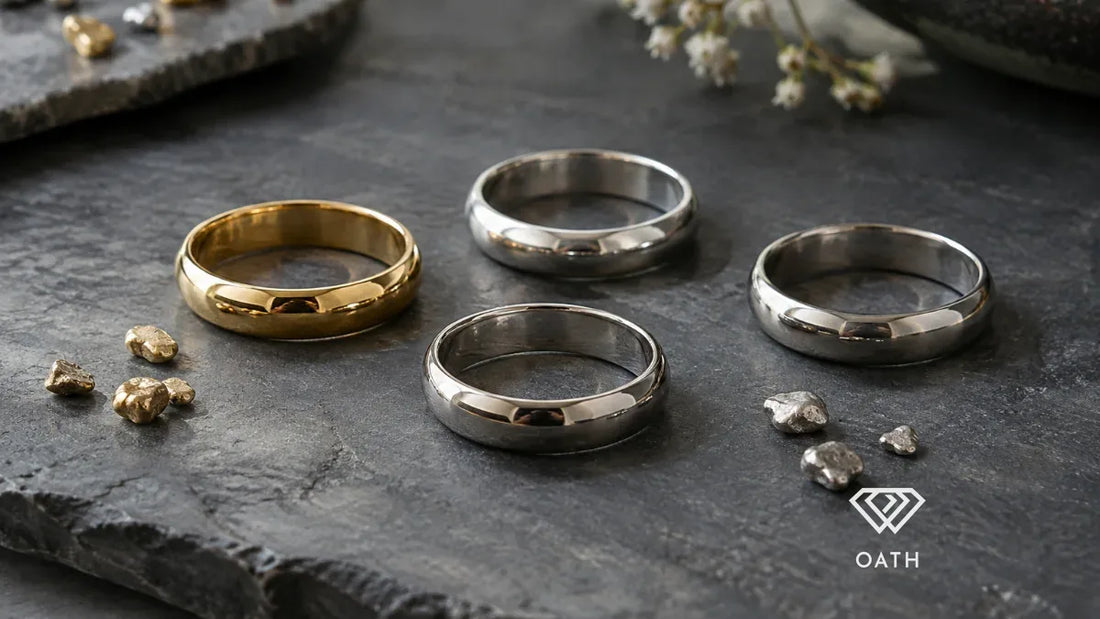
Gold (10K to 18K) offers warmth and versatility across colors; sterling silver is bright but tarnishes; platinum is the most durable, developing a patina rather than wearing away; palladium delivers platinum-like performance at lower weight and cost. The right metal depends on durability needs, skin sensitivity, and how the piece will be worn.
Jump to a metal
When ancient traders in the Mediterranean needed a consistent unit of weight for precious goods, they settled on the carob seed: one of the most dimensionally uniform small seeds in nature. Those seeds became the basis for the carat, the unit of gemstone weight still used today, and for the word "karat" used to express gold purity. A 24-karat item is 24 parts gold out of 24. Pure gold. It is also, as anyone who has worn it discovers quickly, far too soft to survive intact on a hand.
Pure 24K gold scratches under fingernail pressure. It deforms out of shape with normal handling. It cannot hold a gemstone securely in a prong setting. This is why no fine jeweler in the world makes everyday wearable pieces from 24K gold, and why the karat system exists: not to measure gold content as an abstraction, but to document exactly how much the gold has been strengthened by combining it with other metals.
That trade-off between purity and performance is the central tension of every metal decision in fine jewelry. This guide resolves it clearly, covering gold in its three practical forms, sterling silver, platinum, and palladium: what each metal is, how it actually wears, and how to choose the right one for the way you live. For further reference, the World Gold Council's guidance on gold alloys covers purity and manufacturing standards in technical depth.
What Makes a Metal Precious?
Three criteria define a precious metal in the fine jewelry context: rarity in the earth, resistance to corrosion over time, and practical workability into fine objects. Gold, silver, platinum, and palladium all satisfy these criteria in different proportions. What separates precious metals from base metals in practical terms is behavior over a lifetime of wear. A piece made from a precious metal will, with appropriate care, outlast the person who buys it. A piece made from base metals (copper, nickel, zinc) will corrode, tarnish, and degrade in ways that cannot be fully reversed. The premium for precious metals is, in large part, a premium for permanence.
Gold: The Standard in Fine Jewelry
Gold has been used in jewelry for at least 6,000 years and remains the dominant material in fine jewelry globally for reasons that are practical as well as traditional. Its resistance to corrosion is nearly absolute: it does not rust, tarnish in the way silver does, or react with most chemicals encountered in daily life. It is dense enough to feel substantial in the hand without being so heavy that wearing it becomes burdensome.
Gold comes in three distinct color variants. Yellow gold is gold in its warmest, most saturated form: a combination of pure gold with silver and copper that suits warm skin tones particularly well. White gold is gold alloyed with palladium or nickel, rhodium-plated at the factory to achieve a bright, silvery-white surface. The rhodium plating wears over time and requires reapplication every few years; this is normal maintenance, not a quality defect. Rose gold is gold alloyed with a higher copper proportion, producing a warm, pink-toned metal that photographs well and complements a wide range of skin tones.
Each gold color has its own in-depth guide: the complete guide to gold jewelry covers karat and care across all three, while the yellow gold, white gold, and rose gold guides go deep on each tone.
Maintenance Note
White gold is rhodium-plated at manufacture to achieve its bright white finish. This plating wears gradually with contact, typically requiring reapplication every one to three years for pieces worn daily. Replating is a standard service at most jewelers and fully restores the original appearance. It is a routine maintenance step, not a quality concern.
"Among all the metals used in fine jewelry, gold occupies a unique position because its properties are stable across time. It does not rust, tarnish, or corrode, and it can be worked to extraordinary fineness without becoming brittle. The karat marking system was developed to communicate precisely how the balance between pure gold content and alloying for durability has been set in any given piece; information that is essential for evaluating long-term performance and maintenance requirements."
World Gold Council
The World Gold Council sets industry standards for gold purity, hallmarking, and responsible sourcing.
Sterling Silver: Brightness and Accessibility
Sterling silver is 92.5% pure silver alloyed with copper for strength, marked "925" on any genuine piece. It produces one of the brightest, coolest metallic surfaces available in jewelry and has long served as the accessible entry point for buyers who want the feel of fine metal at a lower price than gold. Silver's main practical limitation is tarnish. Exposure to air and to the sulfur compounds in skin chemistry and household products causes sterling silver to darken over time, particularly in storage. This tarnish is reversible with a polishing cloth or mild cleaning, but it is an ongoing maintenance consideration that gold and platinum do not share. Silver is also softer than gold alloys at comparable weights, making it more prone to scratching in daily-wear settings. Any genuine sterling silver piece carries a 925 hallmark; a piece sold as silver without a purity marking deserves scrutiny.
For the full picture on 925, tarnish, and care, see the complete guide to sterling silver jewelry.
Care Note
Store sterling silver in anti-tarnish pouches or sealed bags when not being worn; exposure to air accelerates darkening. A polishing cloth handles surface tarnish in seconds. For heavier discoloration, silver polish or a mild baking soda paste applied with a soft cloth restores the surface. This maintenance is manageable with routine attention.
Platinum: The Prestige Option
Platinum is rarer than gold by a significant margin, roughly 30 times rarer by volume extracted annually, and this rarity translates directly into its price. It is also the densest metal used in fine jewelry, giving platinum pieces a distinctively weighty, substantial feel in the hand that gold at the same gauge cannot replicate. Platinum is naturally white, requiring no rhodium plating. Over time, it develops a patina: a subtle, slightly matte quality produced by the accumulation of fine surface scratches. Many buyers value this patina as part of the metal's character; those who prefer a bright, mirror finish can have the piece professionally polished to restore it. Crucially, platinum does not lose material when it scratches. The metal displaces rather than flakes away, which means a platinum piece retains virtually all of its weight and volume across decades of wear. Platinum is hypoallergenic, making it the correct choice for buyers with known metal sensitivities.
The complete guide to platinum jewelry covers purity, patina, and how it compares with white gold in full.
Palladium: The Understated Choice
Palladium belongs to the platinum group of metals, sharing platinum's naturally white color and hypoallergenic properties while being significantly lighter in weight and lower in cost. For buyers who want a platinum-like appearance and performance without platinum's weight or price, palladium is a genuine option. It is marked 950 for 95% purity. Its lower density means a palladium ring of the same dimensions as a platinum ring will feel noticeably lighter, which some buyers prefer and others find less substantial. Palladium is less widely stocked than the other metals in this guide, functioning as a niche third choice within the white metal family.
Precious Metals at a Glance
Blue bars indicate metals suited to daily-wear pieces with minimal maintenance; amber bars mark metals that require more active upkeep.
In Short
114K gold is the practical choice for most buyers; higher karats offer richer color at a slight cost to hardness for daily wear.
2Choosing between white metals is mainly a trade-off between upfront cost and long-term maintenance: white gold needs replating, platinum does not.
3Sterling silver is the most accessible precious metal; platinum is the most durable; the right choice depends on how and how often the piece will be worn.
Precious Metals Comparison Chart
A one-page reference comparing gold (10K, 14K, 18K), sterling silver, platinum, and palladium side by side: purity levels, daily wear durability, care requirements, color options, and best use cases. We'll email it to you.
Email Me the Guide →How to Choose the Right Metal for Your Lifestyle
Three questions answered honestly cover most of the decision.
How will the piece be worn?
A ring on the dominant hand encounters more abrasion daily than earrings worn to occasions. For high-contact daily wear, 14K gold or platinum are the most practical choices. For occasional wear, the full range of metals is appropriate.
Does the wearer have metal sensitivities?
Platinum and palladium are hypoallergenic. 18K gold typically contains less nickel than 14K and is generally better tolerated by sensitive skin.
What is the visual priority?
Warm tones suit yellow or rose gold. Cool, bright tones suit white gold or silver at accessible price points, and platinum for permanence. The recipient's existing jewelry is the most reliable guide to their actual preference.
Platinum's higher price reflects genuine material differences in rarity, weight, and performance. A buyer choosing between white gold and platinum is making a real trade-off between upfront cost and long-term maintenance. Both are excellent choices made for different, equally valid reasons.
How Do You Care for Each Precious Metal?
Fine Gold Jewelry at Oath


The metal a piece of jewelry is made from is not a detail to decide last. It is the foundation on which everything else rests. Gold across its karats and colors is the right choice for most buyers in most situations. Platinum is the right choice when permanence and purity matter most. Sterling silver is the right choice for buyers who want the brightness of white metal at an accessible price. Find fine jewelry in gold, silver, and platinum at oathjewelry.com. Every order ships free with a 30-day return policy.
Explore each metal in depth
Frequently Asked Questions
01
What is the difference between 14K and 18K gold?
14K gold contains 58.3% pure gold, alloyed with other metals for durability, and is the standard for daily-wear jewelry in the US market. 18K gold contains 75% pure gold and produces a richer, deeper color. 14K is more scratch-resistant for daily wear; 18K is appropriate when color quality is the priority and the piece will not be subjected to heavy daily abrasion.
02
Is white gold the same as platinum?
White gold and platinum are distinct metals with different compositions, prices, and long-term performance characteristics. White gold is yellow gold alloyed with palladium or nickel and rhodium-plated to achieve a white finish; that plating wears over time and requires periodic reapplication. Platinum is naturally white, requires no plating, and is significantly denser and rarer than gold. Both are excellent choices; the decision between them is largely one of upfront cost versus long-term maintenance.
03
Does gold tarnish over time?
Gold itself does not tarnish. It is highly resistant to oxidation and corrosion and does not react with most chemicals encountered in daily life. Some gold alloys with higher copper content can develop slight surface discoloration in specific conditions, but this cleans easily. The rhodium plating on white gold wears over time and requires reapplication, but this is a maintenance procedure rather than tarnish.
04
Is sterling silver a precious metal?
Sterling silver is a precious metal. Silver meets the three defining criteria of rarity, corrosion resistance, and workability. Sterling silver is 92.5% pure silver alloyed with copper for strength, marked 925 on genuine pieces. It tarnishes in contact with air and sulfur compounds, distinguishing it in maintenance terms from gold and platinum, but it is a genuine fine metal used in quality jewelry.
05
What metal is best for sensitive skin?
Platinum is the safest choice for buyers with confirmed metal sensitivities, as it is naturally hypoallergenic and contains no nickel or common allergens. Palladium shares this property. 18K gold contains less nickel than lower-karat formulations and is generally better tolerated by sensitive skin. Some white gold alloys and some sterling silver formulations contain nickel; if sensitivity is a known issue, confirm metal composition before purchasing. If you are pairing a metal with a birthstone, the Birthstone Guide covers metal compatibility and wearability for every birth month.
06
What precious metal lasts the longest in jewelry?
Platinum is the most durable precious metal for fine jewelry over a long period. It displaces rather than removes material when scratched, retaining its weight and volume across decades of wear. 14K gold is the most durable of the gold family for daily wear. Sterling silver is the most maintenance-intensive of the precious metals, requiring regular polishing and careful storage to maintain its appearance. Setting style also affects how long a piece holds up; the Fine Jewelry Buying Guide covers setting types and their protective trade-offs in detail.