
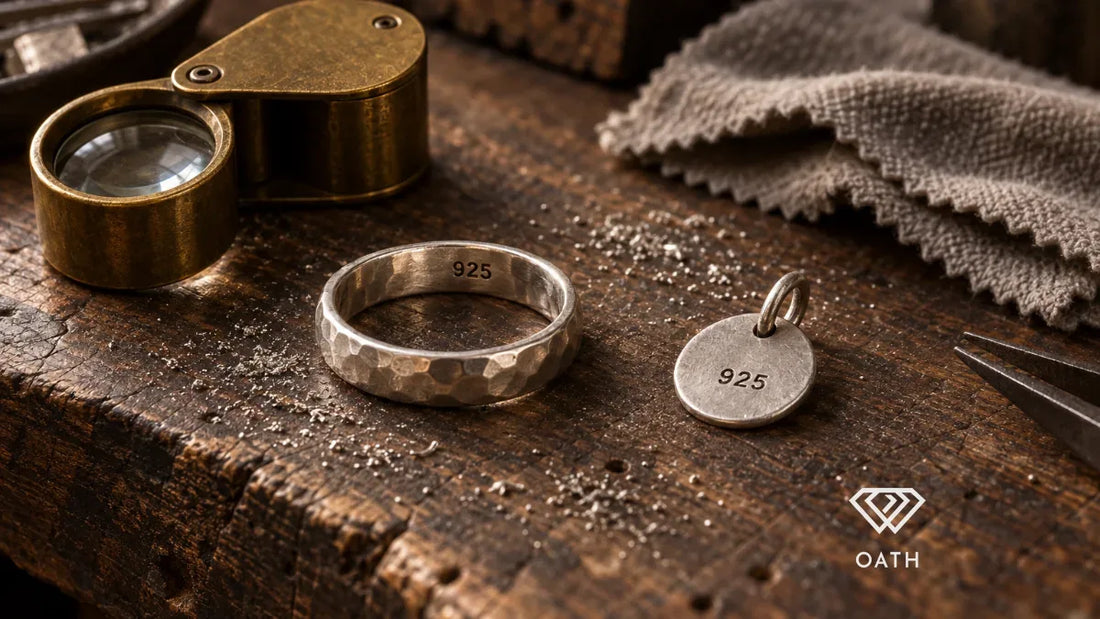
925 on jewelry means the piece is sterling silver: 92.5 percent pure silver alloyed with 7.5 percent other metals, almost always copper. The number is a millesimal fineness mark, meaning 925 parts silver per thousand. In the United States it is the legal floor for the words sterling and solid silver.
Jump to a section
What the number meansOther marksWhat it does not tell youHow to verifyLiving with sterlingFAQThe 925 stamp is the most common mark in fine jewelry and the most misunderstood. It is not a brand, not a quality grade, and not a guarantee that the whole piece is silver. It is a precise legal statement about one thing only. Here is exactly what it certifies, what it deliberately leaves out, and how to check that a piece lives up to it.
What the number actually means
925 is a millesimal fineness mark. It states that out of every thousand parts by weight, 925 are pure silver. The remaining 75 parts are other metals, and in the overwhelming majority of jewelry that means copper.
The alloy exists because pure silver is too soft to hold a shape. A ring in 999 silver would deform in ordinary wear and a prong would bend away from its stone. Adding copper gives the metal enough hardness to be worked, set and worn, at the cost of a small amount of purity and, as it turns out, most of silver's tarnish problem.
The standard is old. The sterling proportion has been the working definition of silver in England since the thirteenth century, which is why it survives as a threshold in modern law on both sides of the Atlantic rather than being replaced by something rounder.
The other marks you will encounter
925 is one point on a scale. Recognizing the neighbors tells you quickly whether a piece is understated, unusual, or misrepresented.
| Mark | Silver content | Commonly called | What it means in practice |
|---|---|---|---|
| 999 | 99.9 percent | Fine silver | Too soft for most settings; used for bullion, some chain and ear wires |
| 958 | 95.8 percent | Britannia | A British standard, softer than sterling, occasionally used in hollowware |
| 925 | 92.5 percent | Sterling | The working standard for fine silver jewelry worldwide |
| 900 | 90 percent | Coin silver | A separate legal threshold; cannot be described as sterling |
| 800 | 80 percent | Continental | Common in older European pieces; noticeably warmer in tone |
Two further points matter. Under the current United States guidance a maker may use the bare word silver for an alloy below 925, but only if an accurate parts-per-thousand figure sits immediately in front of it, as in 750 silver. And the terms coin and coin silver are reserved for 900 and above. A piece calling itself silver with no number attached and no sterling claim is telling you something by omission.
What 925 does not tell you
This is where most buyers go wrong. The mark speaks to the composition of the silver in the piece. It says nothing about three other things.
Not the surface
A 925 piece can be plated in rhodium or gold
Not the stones
Stone quality is a separate question entirely
Not the whole
Solder, clasps and pins carry their own tolerances
Plating is the most common surprise. A great deal of sterling is finished with a microscopically thin layer of rhodium, which keeps the white brightness and slows tarnish, and that layer wears through over years of contact. The piece underneath is still sterling; the finish is simply consumable. Gold over sterling is the same idea in reverse, and when the gold layer meets a defined thickness and karat it earns the name vermeil.
The distinction that actually costs people money is sterling versus plated base metal. Silver plated means a base metal core with a silver skin and no meaningful silver content by weight. Such a piece cannot legally carry a 925 mark in the United States, which is precisely why the mark is worth looking for.
How to verify a piece is really sterling
Four checks, in the order a jeweler would run them.
First, look for a maker's mark next to the number. This is the check almost nobody knows about. Under the National Stamping Act, a manufacturer or dealer who stamps a quality mark on precious metal is required to apply their own registered trademark alongside it. A 925 sitting entirely alone, with no accompanying maker's identification anywhere on the piece, is a legitimate reason for caution.
Second, understand the tolerance. The assayed content may sit up to four parts per thousand below the marked figure on a piece containing no solder, and up to ten parts per thousand on a piece that does. Sterling is a threshold with a small legal margin around it, not an exact promise of 925.000.
Third, use a magnet. Silver is not magnetic. A strong magnet that grabs the piece is detecting a ferrous core, which no sterling piece has. This test rules things out rather than confirming them, since plenty of non-magnetic base metals exist, but it is instant and it costs nothing.
Fourth, for anything of real value, ask for XRF analysis. X-ray fluorescence reads the actual fineness without damaging the piece, and most appraisers offer it. It is the only one of these four that gives you a number rather than an indication.
Living with sterling
The copper in the alloy is responsible for nearly everything people dislike about silver, and understanding that makes the care obvious.
Tarnish is not corrosion and it is not damage. Silver reacts with sulfur compounds in air, in wool, in rubber bands, in some foods and in skin, forming a thin surface layer of silver sulfide that reads as yellow, then brown, then black. Nothing has been lost. A polish removes the layer and returns the original surface.
Storage does more than polishing. Air and humidity drive the reaction, so a closed bag with the air pressed out will keep a piece bright for months. Keep sterling away from rubber and from wool in particular; both are strong sulfur sources and both are common in jewelry boxes. The fine jewelry care guide covers cleaning method by piece type.
One caution on rhodium-finished sterling: polishing compounds designed to strip tarnish will also strip the rhodium, because the tarnish sits on the plating rather than under it. Wash those pieces rather than polishing them, and have the finish renewed when it wears. Broader context on the metal sits in the full guide to silver jewelry.
Unless it is at least 925/1,000ths pure silver.
16 CFR Part 23
Guides for the Jewelry, Precious Metals, and Pewter Industries
Further reading: Federal Trade Commission, Jewelry Guides. The rule applies identically to the words solid silver, Sterling Silver, Sterling and the abbreviation Ster., which is why solid silver and sterling are the same claim rather than competing ones.
In Short
1925 means 92.5 percent pure silver alloyed with 7.5 percent other metals, usually copper, expressed as parts per thousand.
2It is the legal floor in the United States for the words sterling and solid silver; below 925 a piece cannot use either term.
3The mark describes the silver only. It says nothing about plating on the surface, the stones set into it, or the solder holding it together.
Want the marks and stamps in one place?
Our hallmarks and stamps guide decodes the numbers and symbols you will find on silver, gold and platinum. We will email it to you.
Email Me the Guide →


Every order ships free with a 30-day return policy.
925 is one of the few marks in jewelry that means exactly what it says and nothing more. Read it as a precise statement about the silver, check for the maker's mark beside it, and treat everything else about the piece, the finish, the stones and the construction, as separate questions with their own answers. Every order ships free with a 30-day return policy.
Frequently Asked Questions
01
Is 925 silver real silver?
Real silver, and the standard grade for fine silver jewelry. A 925 mark states the piece is 92.5 percent pure silver alloyed with 7.5 percent other metals. In the United States a piece cannot legally carry the mark or the word sterling unless it meets that threshold.
02
What is the difference between 925 silver and sterling silver?
The two terms describe one standard in two notations: 925 is the numeric millesimal form, sterling is the word. United States guidance treats sterling, Sterling Silver, Ster. and solid silver as equivalent claims, all requiring at least 925 parts per thousand.
03
Does 925 silver tarnish?
Tarnish is expected and is caused by the copper in the alloy reacting with sulfur compounds in air and in contact materials. The result is a surface layer of silver sulfide, not corrosion, and it polishes away without any loss of metal. Airtight storage slows it dramatically.
04
Why does 925 silver turn skin green?
Copper in the alloy is the cause. It reacts with acids in perspiration to form compounds that transfer to skin as a green mark. The reaction is harmless, varies enormously between individuals, and is more likely in humid conditions or where lotions and soaps are involved.
05
Can 925 silver be plated?
Plating over sterling is common practice. Rhodium is applied to preserve a bright white finish and slow tarnishing; gold over sterling produces a warm finish and, at a defined thickness and karat, qualifies as vermeil. The 925 mark describes the metal underneath, not the surface layer.
06
Is 925 silver worth more than silver plated?
Substantially more, because the two are not comparable materials. A 925 piece is solid precious metal throughout and carries the silver value of its full weight. A silver plated piece is base metal beneath a microscopically thin silver skin and holds essentially no precious metal value.