
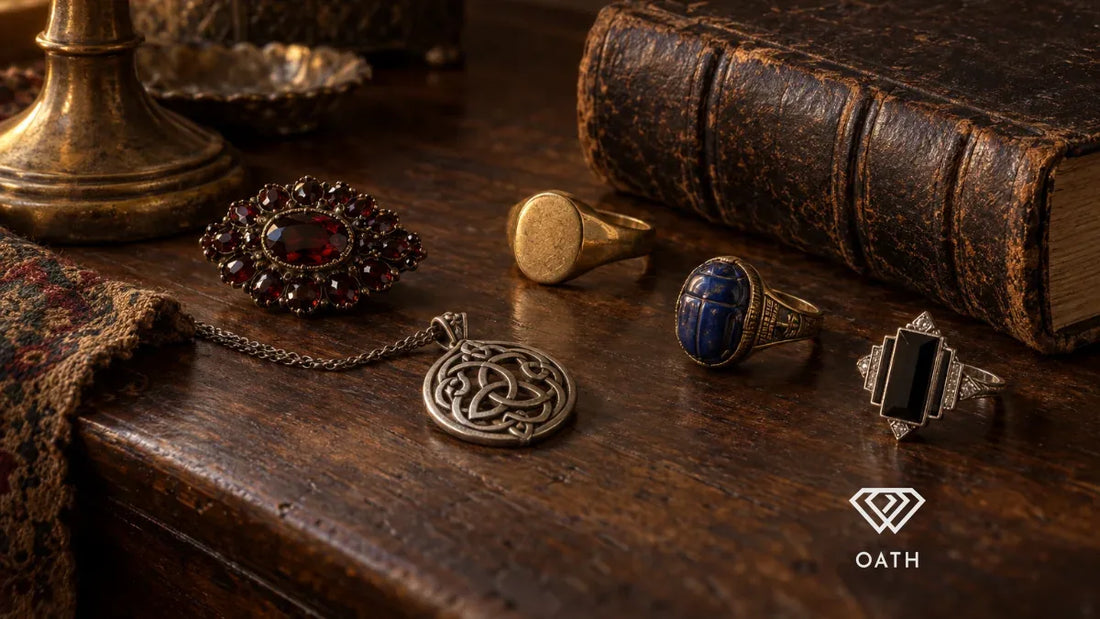
Gemstones have carried symbolic meaning across cultures for at least 6,000 years. Ruby symbolized vitality and protection in ancient Burma; sapphire represented divine favor in medieval Europe; emerald was sacred in ancient Egypt. These associations were rarely consistent across civilizations: the same gem often held different meanings in different societies. Modern birthstone symbolism is largely a 20th-century standardization built on historical traditions that were themselves more varied and contested than they are often presented.
Jump to a section
The ancient Greeks were not, as a rule, prone to poor reasoning about the physical world. They built the foundations of geometry, developed rigorous philosophical method, and made accurate observations about astronomy that held up for centuries. They were also thoroughly convinced that drinking wine from a cup carved from amethyst would prevent intoxication. The Greek word amethystos means, literally, "not drunk." Wealthy Greek households owned amethyst goblets not as decoration but as functional drinking vessels.
They were wrong about the chemistry. They were not wrong about the impulse: the human desire to believe that a beautiful, rare object carried properties beyond its appearance is at least as old as written language. Across every culture that has produced fine jewelry, the stones and metals in those pieces have always meant something beyond what the eye alone can see.
This guide traces those meanings: what specific gems and metals have symbolized across ancient Egypt, Greece and Rome, medieval Europe, and the traditions of Asia, and how those associations shaped the way we understand jewelry today. For the historical and scientific record on gem origins, the Smithsonian's National Museum of Natural History gem collection is one of the most comprehensive public resources available.
How Did Ancient Cultures Use Gemstone Symbolism?
The oldest surviving evidence of gemstone symbolism comes from ancient Egypt, where lapis lazuli held a position of extraordinary cultural importance for thousands of years. The stone's deep blue was identified with the night sky, with the Nile in flood, and with the hair of the gods themselves. Lapis lazuli was ground into powder for cosmetics, carved into amulets for the dead, and set into the gold funeral masks of pharaohs. Tutankhamun's funeral mask uses lapis lazuli extensively for exactly this reason: the stone carried the dead into the divine register.
Carnelian, a warm red-orange quartz, was equally significant in Egypt. It was associated with blood, life force, and protection in both life and death. The Book of the Dead describes specific carnelian amulets worn to protect the deceased through the afterlife judgment. In ancient Mesopotamia, the parallel tradition valued lapis lazuli for similar reasons and added cylinder seals carved from carnelian, agate, and hematite as some of the most important ritual objects.
In the Indian subcontinent, the tradition of navaratna, meaning nine gems, organized nine sacred stones around the nine planets of Hindu cosmology: ruby for the sun, pearl for the moon, red coral for Mars, emerald for Mercury, yellow sapphire for Jupiter, diamond for Venus, blue sapphire for Saturn, and two additional stones for the shadow planets Rahu and Ketu. This nine-gem system is still used in Indian jewelry today, with pieces designed to carry astrological influence as well as beauty.
Greece and Rome: When Meaning Became Philosophy
The Greeks systematized what earlier cultures had observed intuitively. The philosopher Theophrastus wrote a treatise called "On Stones" around 315 BCE, one of the earliest surviving systematic accounts of gemstones, classifying them by physical properties while also recording the symbolic and medicinal beliefs attached to them. The Romans took this further, producing extensive lapidary literature that connected gems to specific planets, deities, and bodily humors.
The amethyst-intoxication belief was among the most widely documented. The Roman scholar Pliny the Elder, writing in the first century CE, recorded it in his Natural History alongside dozens of other gem-property beliefs: that diamond could neutralize poison, that sapphire improved vision, that emerald was beneficial for the eyes and the mind. These were not fringe beliefs; they were the mainstream understanding of educated Romans.
Ruby in the Greek and Roman tradition was often grouped under the term "carbuncle" along with red garnets and red spinels, without consistent distinction between them. The red stones as a group were associated with fire, blood, and the power of Mars. A soldier wearing a red stone was thought to carry martial protection. The distinction between ruby and garnet as separate minerals with separate properties did not enter Western gemological thinking until the modern period.
Medieval and Renaissance Europe: Gems as Medicine and Morality
Medieval European gem symbolism is among the most extensively documented of any tradition. The lapidary, a book cataloging the properties and meanings of gems, was a distinct literary genre, and dozens of them survive. The most influential include the work of the 12th-century abbess Hildegard von Bingen, who wrote extensively about the healing and protective properties of specific stones in the context of Christian theology.
In the medieval framework, gems derived their power from their creation by God and from the celestial influences encoded in their colors and properties. Sapphire was the stone of heaven, associated with divine wisdom, purity, and prayer. It was worn by medieval popes and bishops for exactly this reason: the blue stone at their fingers was understood as a visible sign of their connection to the divine. Emerald was associated with hope and the Resurrection, with the green of spring renewal. Ruby maintained its ancient association with vitality, blood, and passionate love.
The belief that certain gems could physically protect the wearer was deeply held and practically expressed. Rubies were set into armor and weapons as talismans. Diamonds were believed to bring courage in battle. Pearls were associated with purity and tears simultaneously, making them appropriate both for wedding jewelry and for mourning. What changed in the Renaissance was the beginning of a scientific approach that began to separate physical properties from symbolic ones, gradually undermining the lapidary tradition's authority.
Asian Traditions: Jade, Pearl, and the Eastern Canon
Chinese gem symbolism developed largely independently of the Western lapidary tradition and reached its most distinctive expression in the treatment of jade. In Chinese culture, jade occupied a position with no close Western parallel. It was not simply beautiful or valuable; it was morally significant. Confucius catalogued eleven virtues embodied in jade, including wisdom, courage, justice, and purity. Wearing jade was understood as an aspiration to those virtues, not merely an aesthetic choice. The highest-quality jadeite, deep green and translucent, is still among the most valued gemstones in markets with strong Chinese cultural influence.
Pearl held a distinctive position across multiple Asian traditions. In Japan, the pearl was associated with the moon, with purity, and with the tears of mythological sea creatures. The Japanese cultured pearl industry, developed in the late 19th and early 20th centuries, transformed pearls from an exclusively rare material into one that could be produced deliberately, with significant implications for what "precious" means in material terms. In Indian tradition, pearl was associated with wisdom, carried by a dragon and therefore connecting the stone to one of the most powerful symbols in the culture.
Gold and Silver: Metals as Divine Materials
The symbolic history of precious metals runs parallel to that of gems and is, in many ways, even older. Gold's indestructibility, its resistance to corrosion, its warmth of color, and its relative rarity made it the material of divinity in nearly every ancient culture that encountered it. In Egypt, gold was the flesh of the gods. In Mesoamerican cultures, it was the sweat of the sun. In Greek mythology, Zeus appeared to Danaë as a shower of gold. The association of gold with solar energy, incorruptibility, and divine power is among the most consistent symbolic patterns across otherwise very different civilizations.
Silver carried complementary meanings. Where gold was the sun, silver was the moon. Where gold was masculine and solar, silver was feminine and lunar. This pairing appears in ancient Egypt, in Greek mythology's distinction between Apollo (sun/gold) and Artemis (moon/silver), in alchemy's classification of the metals according to planetary influence, and in dozens of folkloric traditions across Europe and Asia. The alchemical tradition elevated gold further as the goal of transmutation: the perfect metal toward which all baser metals were theoretically striving.
Gem Symbolism Across Civilizations
Birthstone Quick Reference Card
All 12 birthstones by month with meanings, Mohs hardness, key sources, and symbolic associations across historical traditions. A one-page reference for buyers, givers, and anyone who wants the story behind the stone. We'll email it to you.
Email Me the Guide →How These Meanings Reached Modern Jewelry
The transition from ancient and medieval gem symbolism to the symbolic language of modern jewelry was neither clean nor direct. Several distinct developments shaped what we understand gems and metals to mean today. The standardization of birthstones in 1912 imposed an official list on what had previously been a much more varied set of traditions. The modern birthstone system is a commercial standardization, not an ancient consensus, though it draws on real historical associations where they existed. What the standardization achieved was consistency: a shared cultural reference that allows the ruby to mean "July" across the English-speaking world in a way it never meant a specific month in medieval Europe or ancient India.
The diamond engagement ring tradition, now so culturally embedded that it feels ancient, is largely a 20th-century development. While diamonds appear in European betrothal rings from the 15th century among the wealthy, the widespread expectation that a diamond is the appropriate stone for an engagement ring was substantially shaped by marketing from the 1940s onward. The symbolic meaning of the diamond engagement ring is real and felt sincerely by the people who give and receive them; it is also a relatively recent construction built on older foundations.
"The belief in the magical and mystic virtues of precious stones has prevailed among all peoples and in all ages. From the most ancient times we find records of this belief, which appears to be as deeply planted in human nature as the belief in a future existence, or in the efficacy of prayer. Indeed, the gem has always been, in some sense, a symbol of all that is permanent amid the surrounding flux and change of mortal things."
George Frederick Kunz
The Curious Lore of Precious Stones (1913), available at Project Gutenberg
Kunz was the foremost American gemologist of his era and Tiffany & Co.'s longtime gem buyer; the morganite gem variety is named for his patron, J.P. Morgan.
There is something stubborn in the human relationship with precious stones: a refusal to let them be merely beautiful. Every culture that has valued gems has also needed them to mean something. The specific meanings have changed. The underlying need has not. Choosing a piece of jewelry with a specific gem is a participation in this very old tradition of meaning-making. Oath carries fine gemstone jewelry across all the major stones, chosen for quality of material and genuineness of craft.
In Short
1Gem symbolism spans at least 6,000 years, from Egyptian lapis to Chinese jade to the Indian navaratna.
2The same stone often meant different things in different cultures; these were parallel systems, not one original meaning.
3Modern birthstones (standardized in 1912) and the diamond engagement ring are recent constructions built on older traditions.
Fine Gemstone Jewelry at Oath


Find the stone that means something to you at oathjewelry.com. For the month-by-month meanings behind each modern birthstone, the birthstone guide picks up where this history leaves off. Every order ships free with a 30-day return policy.
Frequently Asked Questions
01
What do gemstones symbolize?
Gemstone symbolism varies significantly by stone, culture, and historical period. Ruby has consistently symbolized vitality, love, and protection across many traditions. Sapphire has been associated with wisdom, truth, and divine favor, particularly in European and Indian contexts. Emerald has carried associations with growth, fertility, and hope. Pearl has symbolized purity and was used in both wedding and mourning jewelry. No single symbolic meaning applies universally across all cultures for any gem, and modern associations are often simplified versions of more varied historical traditions.
02
Why do different cultures assign different meanings to the same gemstone?
Different cultures developed gem symbolism independently, based on their own cosmologies, religious frameworks, and encounters with the stones available in their region. A sapphire in medieval Christian Europe was associated with heaven because of its blue color and the cosmological framework of that tradition. The same stone in Hindu navaratna tradition is associated with Saturn and a very different set of spiritual properties. These are parallel systems, not corruptions of a single original meaning. The same stone genuinely meant different things to different people in different contexts.
03
What does it mean to wear your birthstone?
Wearing a birthstone is a participation in a cultural tradition that assigns a specific gem to each month of the year, with historical roots in several ancient systems. The modern standardized birthstone list dates to 1912 and is a US trade standardization rather than an ancient decree, though it draws on older associations. Wearing your birthstone carries whatever meaning you bring to it: personal significance, connection to tradition, or simply the pleasure of owning a stone associated with your month of birth. The birthstone guide covers each month's stone in detail.
04
What has gold symbolized historically?
Gold has been associated with the sun, with divine power, with incorruptibility, and with the highest tier of human value across nearly every culture that has encountered it. In ancient Egypt, gold was the flesh of the gods. In Greek and Roman tradition, it was connected to solar deities. In the Western alchemical tradition, it was the perfect metal, the endpoint of transmutation. The association of gold with lasting value, warmth, and prestige is among the most consistent cross-cultural symbolic patterns in the history of material culture.
05
Is the meaning of a diamond engagement ring ancient?
The diamond engagement ring is a real cultural tradition with genuine historical depth, but its widespread status is more recent than most people assume. Diamonds appeared in European aristocratic betrothal rings from the 15th century, but the broad expectation that a diamond is the correct stone for an engagement ring was substantially established through 20th-century marketing and cultural reinforcement. The meaning felt by people who give and receive diamond engagement rings is entirely sincere; the tradition itself is a relatively recent construction built on older foundations.
06
Do gemstones have healing properties?
No credible modern scientific evidence supports the claim that gemstones have healing or protective properties beyond their psychological and cultural significance. The medicinal and protective properties attributed to gems in ancient and medieval lapidary traditions were genuine beliefs held by educated people within the frameworks of those periods; they were not based on controlled observation of physical effects. The symbolic and emotional significance of gems is real and well-documented, and the psychological comfort of wearing a stone with personal meaning is a legitimate form of value, distinct from physical healing claims.