
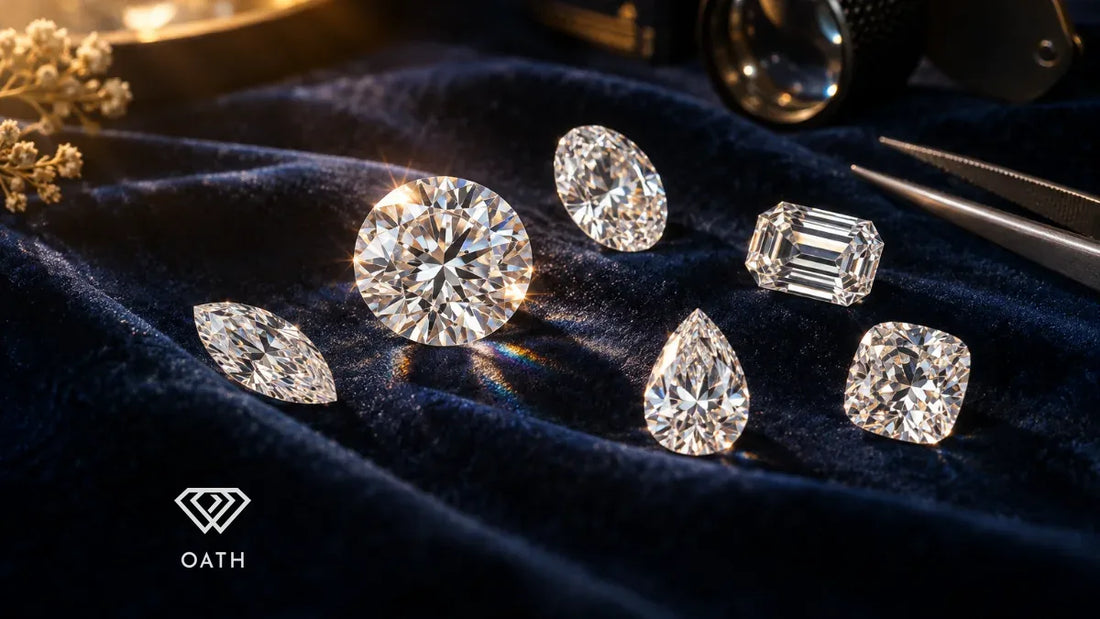
A diamond's shape is its outline seen from above, such as round, oval, cushion or emerald. Its cut is the quality of its proportions, symmetry and polish, which decides how much light it returns as brightness, fire and sparkle. Any shape can be well or poorly cut. Shape is style; cut is craftsmanship.
Jump to a section
The answerWhy they get mixed upCut qualityShapes comparedFancy shapesHow to chooseFAQAsk for an emerald cut diamond and you are describing a shape. Ask for an excellent cut diamond and you are describing quality. The same word covers two different ideas, which makes diamond shopping more confusing than it needs to be. This guide separates cut from shape and explains how to judge each.
What is the difference between cut and shape?
A diamond's shape is its outline when you look down at it from above: round, oval, cushion, princess, emerald, pear and so on. A diamond's cut is how well that shape has been crafted, meaning the proportions, symmetry and finish of its facets. Shape is a style choice. Cut quality determines how much light the diamond returns to your eye as brightness, fire and sparkle.
Two diamonds of the same shape, weight, color and clarity can look completely different because of cut. A well-cut round is lively and bright across the whole stone; a poorly cut round of the same size can look glassy, dark in the center or dull at the edges. That is why cut is often called the most important of the 4Cs for beauty.
1 of 4Cs
Cut is the only C shaped entirely by human craft
5 grades
GIA cut scale for rounds, from Excellent to Poor
57 to 58
Facets in a standard round brilliant
Why do people mix them up?
The confusion comes from the names. Jewelers routinely say emerald cut, princess cut and cushion cut when they mean the shape, so the word cut ends up doing two jobs. In everyday language, cut often means the shape and style of faceting. In grading, cut means the quality of the craftsmanship.
A useful rule: when cut appears before a shape name, as in princess cut, it describes the shape. When cut appears as a grade, as in Excellent cut or Very Good cut, it describes quality. A princess cut diamond can have an excellent or a poor cut, just as a round can.
Carat causes a similar mix-up, since it sounds like karat but measures something completely different. The guide to carat and karat separates the two.
What does diamond cut quality measure?
Cut quality measures how well a diamond's facets interact with light. When a diamond is cut to good proportions, light enters through the top, reflects off the lower facets and returns through the top to your eye. If the stone is cut too deep or too shallow, light leaks out through the bottom or sides, and the diamond looks darker and less lively.
Graders assess three visual effects. Brightness is the white light reflected back. Fire is the flashes of color as light splits into the spectrum. Scintillation is the pattern of light and dark sparkle that moves as the diamond or the viewer moves. Graders also consider the diamond's weight ratio, so a stone is not cut heavy simply to add carats, along with durability, polish and symmetry.
For standard round brilliants, GIA assigns an overall cut grade on a five-step scale: Excellent, Very Good, Good, Fair and Poor. Fancy shapes do not receive an overall GIA cut grade, though their reports still record polish and symmetry. The guide to evaluating diamond quality covers how cut fits with color, clarity and carat.
Cut Beats Size
A smaller diamond with an excellent cut often looks brighter, and sometimes larger, than a heavier stone with a poor cut. Prioritize cut quality before stretching for carat weight.
How do diamond shapes differ?
Shapes fall into two broad facet styles. Brilliant cuts, including round, oval, cushion, princess, pear, marquise and radiant, use many triangular and kite-shaped facets to maximize sparkle. Step cuts, including emerald and Asscher, use long, parallel facets arranged like steps, which produce broad flashes of light and a clear, hall-of-mirrors look rather than intense sparkle.
The round brilliant is the most refined for light return, because a century of study has refined its proportions. Ovals, pears and marquises are elongated, which makes them look larger for their weight and flatters the finger, but they can show a bow-tie: a dark band across the center caused by facets that do not return light. Cushions offer a softer, pillow-like outline. Princess cuts give a crisp square with strong sparkle, though their pointed corners need protection from the setting.
| Shape | Facet style | Popular length-to-width ratio | What to check |
|---|---|---|---|
| Round | Brilliant | 1.00 | GIA or IGI cut grade; Excellent is the top grade |
| Oval | Brilliant | 1.30 to 1.50 | Bow-tie shadow across the center |
| Cushion | Brilliant | 1.00 to 1.10 square, longer for elongated | Even facet pattern; no dark center |
| Princess | Brilliant | 1.00 to 1.05 | Corners protected by the setting |
| Emerald | Step | 1.30 to 1.50 | Clarity, since step facets show inclusions |
| Pear | Brilliant | 1.45 to 1.75 | Symmetry of the shoulders; bow-tie |
| Marquise | Brilliant | 1.75 to 2.25 | Bow-tie and protected points |
Length-to-width ratio describes how long or square a shape is, and the right ratio is personal taste rather than a quality grade. Step cuts such as emerald show inclusions more easily, so clarity matters more in those shapes. The complete diamond buying guide covers how each shape affects your other choices.
How do you judge cut in a fancy shape?
Because fancy shapes lack an overall GIA cut grade, judging them takes more of your own eye. Start with the report's polish and symmetry grades, then look at the stone itself or a magnified video. Light should spread evenly across the diamond with no large dark areas. In elongated shapes, a faint bow-tie is normal, but a heavy black band is a sign of poor cut.
Check the outline too. The two halves of an oval, pear or marquise should mirror each other, with even shoulders and a smooth curve. Table and depth percentages help, but popular ranges vary by shape, so the face-up appearance matters more than any single number. These checks apply equally to lab-grown diamonds, as the guide to evaluating lab-grown diamond quality explains.
How do you choose a shape and a cut?
Choose the shape first, because it is about personal style: classic and bright with a round, elongated and finger-flattering with an oval or pear, soft and vintage with a cushion, crisp and modern with a princess, or clean and architectural with an emerald. Try shapes on your hand if you can, since the same stone can look different in person than in photos.
Then choose the best cut quality you can within that shape. For rounds, aim for an Excellent or Very Good cut grade. For fancy shapes, favor excellent polish and symmetry, an even light pattern and a ratio you like. Once you have chosen, keep the stone clean so the cut can do its work; the guide to caring for diamond jewelry covers how.
The short version
Shape is what you like the look of. Cut is how well it was made. Pick the shape with your heart and the cut with your eyes and a grading report.
"The proportions of a diamond refer to the relationships between table size, crown angle and pavilion depth."
GIA, Diamond Cut: The 4Cs
Gemological Institute of America, gia.edu
Further reading: GIA 4Cs blog on crafting a diamond's finish. GIA grades cut on a relative scale from Excellent to Poor for standard round brilliants in the D-to-Z color range, assessing brightness, fire and scintillation along with weight ratio, durability, polish and symmetry.
In Short
1Shape is the outline seen from above; cut is how well the facets are proportioned and finished.
2Names such as princess cut describe shape; grades such as Excellent cut describe quality.
3Choose the shape you love, then the best cut quality: an Excellent or Very Good grade for rounds, strong polish, symmetry and light pattern for fancy shapes.
Want the full diamond reference?
The Oath jewelry guide covers the 4Cs, diamond shapes and how to compare stones in one place. We will email it to you.
Email Me the Guide →


Every order ships free with a 30-day return policy.
Shape and cut answer two different questions: what you want your diamond to look like, and how well it was made. Settle the first by taste and the second by grading report and a close look, and you will end up with a diamond that sparkles the way it should. Every order ships free with a 30-day return policy.
Frequently Asked Questions
01
Is a princess cut a cut or a shape?
Princess cut describes a shape: a square outline with brilliant-style faceting. The name uses the word cut, but it says nothing about cut quality. A princess-shaped diamond can be well or poorly cut, just like any other shape.
02
Which diamond shape sparkles the most?
The round brilliant generally sparkles the most, because its proportions have been refined to return the maximum amount of light. Well-cut ovals, cushions, princess and radiant shapes also sparkle strongly, while step cuts such as emerald produce broader flashes rather than intense sparkle.
03
Do fancy shape diamonds have a cut grade?
Fancy shape diamonds do not receive an overall GIA cut grade. Their reports still grade polish and symmetry, and buyers judge cut by the light pattern, outline symmetry, bow-tie and length-to-width ratio.
04
What is a bow-tie in a diamond?
A bow-tie is a dark band across the center of an elongated diamond such as an oval, pear or marquise, caused by facets that do not return light to the eye. A faint bow-tie is normal; a heavy, dark one is a sign of poor cut.
05
Which diamond shape looks biggest for its carat weight?
Elongated shapes such as oval, marquise and pear tend to look biggest for their carat weight, because more of their weight is spread across the visible surface. A shallow cut can also look larger but leaks light, so cut quality still matters.
06
Is cut more important than clarity?
Cut usually has a bigger effect on how a diamond looks than clarity, because it controls brightness and sparkle. Most inclusions in a stone graded VS2 or higher cannot be seen without magnification, while a poor cut is visible to anyone.