
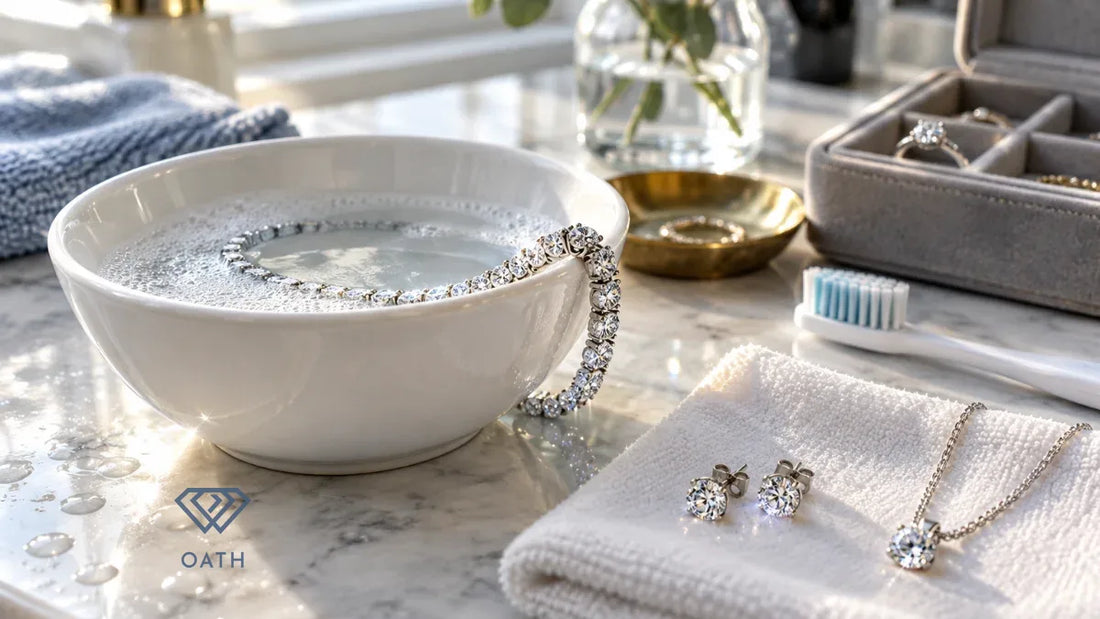
To care for diamond jewelry, soak it weekly in warm water with mild dish soap, brush gently behind the stone with a soft toothbrush, then rinse and dry. Store each piece separately so diamonds cannot scratch other jewelry, avoid chlorine and harsh cleaners, and have a jeweler check the setting every six months.
Jump to a section
The answerLost sparkleCleaning at homeUltrasonic cleanersStorageProfessional checksFAQA diamond that looked brilliant in the store can look flat within weeks, and the reason is almost never the stone. Everyday oil and residue coat the surface, and settings slowly loosen with wear. This guide covers how to clean diamond jewelry safely at home, how to store it, and when to hand it to a professional.
How do you care for diamond jewelry?
Caring for diamond jewelry comes down to three habits: clean it regularly, store it so it cannot scratch or be scratched, and have it checked by a jeweler about twice a year. A weekly soak in warm water with mild dish soap and a gentle brush keeps the diamond bright. Separate storage prevents scratches, and professional checks catch loose stones and worn prongs before anything is lost.
Diamonds are the hardest natural material, but hardness is not the same as invulnerability. A diamond can still chip from a sharp knock, and the metal holding it is far softer than the stone. Good care protects both.
10
Diamond's rating on the Mohs hardness scale, the highest
Weekly
Ideal cleaning rhythm for rings worn every day
6 months
Recommended interval for a professional check
Why do diamonds lose their sparkle?
Diamonds lose their sparkle because they attract oil. A diamond's surface readily picks up grease from skin, lotion, soap, hair products and cooking, and that film blocks light from entering and leaving the stone. A clean diamond returns light as brightness and fire; a coated one looks flat and cloudy, even though the stone itself has not changed.
The underside of the stone matters most. Light enters through the top of a diamond and reflects off the facets below, so a film on the pavilion, the pointed lower half, dulls the stone more than dirt on top. Grime also collects under prongs and inside the setting, where it is hard to see. That is why the brush in step two goes behind the stone, not just across the top.
This is true of every diamond, mined or lab-grown. The two are the same material with the same hardness and the same tendency to attract grease, as the guide is a lab-grown diamond a real diamond? explains, so the care routine is identical.
How do you clean diamond jewelry at home?
Soak. Fill a small bowl with warm water and add a few drops of mild, plain dish soap. Leave the jewelry in for 20 to 30 minutes to loosen oil and residue.
Brush. Use a soft, clean toothbrush kept only for jewelry. Brush gently around the stone, under the prongs and across the back of the setting, where grime builds up. Work over the bowl rather than an open sink.
Rinse and dry. Rinse in clean warm water with the drain plugged or in a strainer, then pat dry with a lint-free cloth or let the piece air dry. Paper towels and tissues can leave fibers caught in prongs.
Earrings and necklaces. Diamond studs collect residue on the back of the setting and around the post, so brush both and clean the earring backs as well. For necklaces, soak only the pendant where possible and lay the chain flat to dry so moisture does not sit in the links or clasp.
| Method | Best for | Avoid when | How often |
|---|---|---|---|
| Warm water and mild dish soap | All diamond jewelry | Piece also holds pearls, opal or emerald | Weekly |
| Soft toothbrush | Back of the stone and settings | Pavé with loose stones | With each soak |
| Ultrasonic cleaner | Sturdy solitaires in good condition | Treated, filled or included diamonds; loose stones | Occasionally, or leave to a jeweler |
| Professional steam cleaning | Deep cleaning built-up grime | Heat-sensitive stones set alongside | Every six months |
| Jewelry polishing cloth | Metal shine between cleans | Never on the diamond itself | As needed |
Avoid chlorine bleach, abrasive powders, toothpaste and harsh household cleaners. Chlorine attacks the gold alloy in the setting, and abrasives scratch metal. If a diamond piece also holds pearls, opal, emerald or turquoise, skip the soak and wipe it with a damp cloth instead. The metal side of the routine is covered in the guide to cleaning gold jewelry.
Are ultrasonic cleaners safe for diamonds?
Ultrasonic cleaners are effective but not risk-free. They use high-frequency vibration in a liquid to shake dirt loose, and that same vibration can loosen stones in worn settings or chip the thin edge of a diamond, called the girdle, if it already has a weakness. They are best kept for sturdy pieces in good condition, or left to a jeweler who can check the setting first.
Some diamonds should never go in an ultrasonic cleaner. Fracture-filled or otherwise treated diamonds, stones with large inclusions or feathers that reach the surface, and pavé or micro-pavé pieces with tiny stones are all at risk. The guide to gemstone treatments explains what filling and other treatments are, and the guide to evaluating diamond quality covers inclusions.
When in Doubt
If you are not sure whether a diamond is treated or a setting is secure, stick to warm soapy water and a soft brush. It is safe for every diamond and removes nearly all everyday grime.
How should you store diamond jewelry?
Store each diamond piece separately. Diamond scratches almost everything, including gold, platinum, other gemstones and even other diamonds, so pieces tossed together in a drawer or travel bag can damage each other. A fabric-lined jewelry box with individual compartments, or soft pouches, keeps every piece apart.
Fasten necklaces and bracelets before storing them so chains do not tangle, and keep earrings in pairs. When you take a ring off at home, put it in the same dish or box every time rather than on the edge of a sink. When traveling, use a padded case and carry fine jewelry with you rather than checking it in luggage.
Take diamond jewelry off for heavy work. Gardening, gym sessions, moving furniture and household cleaning expose rings to hard knocks and chemicals. The complete fine jewelry care guide covers storage for every metal and gemstone.
When should a jeweler check your diamonds?
Have diamond jewelry checked by a jeweler about every six months, and sooner if something feels different. The jeweler examines the prongs, bezels and channels under magnification to confirm every stone is secure, then cleans the piece professionally, often with steam, which removes buildup a toothbrush cannot reach.
Watch for warning signs between visits: a stone that moves or rattles, a prong that catches on clothing, a gap between the stone and its setting, or a white gold ring that has started to look warm. White gold settings are usually rhodium plated, and the guide how long rhodium plating lasts explains when to have them refinished. Keep an up-to-date appraisal and a photo of each important piece for insurance.
Six-month checklist
Prongs secure and not worn thin, no movement in any stone, clasps and earring backs firm, rhodium plating even, and a professional clean to finish.
"Diamonds are natural magnets for grease, so they're not easy to keep clean."
GIA, Secrets to Keeping Your Diamond Sparkling
Gemological Institute of America, gia.edu
Further reading: GIA tips on caring for jewelry. GIA recommends a regular soak in water with a few drops of mild dish soap and a soft, clean toothbrush, and cautions that ultrasonic cleaners can shake loose stones from their mountings or chip diamond girdles.
In Short
1Soak diamond jewelry weekly in warm water with mild dish soap, brush behind the stone, rinse and dry.
2Store pieces separately, since diamond scratches other jewelry, and remove rings for heavy work.
3Use ultrasonic cleaners with caution and have a jeweler check prongs and settings every six months.
Want the full diamond care reference?
The Oath jewelry guide covers diamonds, metals and care for every type of fine jewelry in one place. We will email it to you.
Email Me the Guide →


Every order ships free with a 30-day return policy.
Diamonds need surprisingly little to stay brilliant: a weekly soak, careful storage and a jeweler's eye twice a year. Keep that routine and your diamond jewelry will look as bright decades from now as it does today. Every order ships free with a 30-day return policy.
Frequently Asked Questions
01
How often should you clean a diamond ring?
A diamond ring worn every day looks its best with a gentle clean once or twice a week in warm water with mild dish soap. A professional clean and setting check every six months removes deeper buildup and confirms the stone is secure.
02
What is the best way to clean a diamond at home?
The best way to clean a diamond at home is a 20 to 30 minute soak in warm water with a few drops of mild dish soap, followed by gentle brushing behind the stone with a soft toothbrush, a rinse in clean water and drying with a lint-free cloth.
03
Can you use Windex or toothpaste on diamonds?
Household glass cleaners and toothpaste are not recommended for diamond jewelry. Toothpaste is abrasive and scratches gold and platinum settings, and harsh cleaners can damage metal alloys or treated stones. Mild dish soap and warm water are safer and just as effective.
04
Can a diamond scratch or chip?
A diamond can chip if it takes a hard knock at the right angle, especially along its thin girdle or at sharp points. Only another diamond can scratch it, which is why diamond pieces should be stored separately from each other.
05
Is it safe to wear diamond rings every day?
Diamond rings are made to be worn every day, but they last longest when removed for heavy work, the gym, swimming and household cleaning. Regular cleaning and a jeweler's check every six months keep everyday rings secure.
06
Do lab-grown diamonds need different care?
Lab-grown diamonds need exactly the same care as mined diamonds. They have the same hardness, structure and tendency to attract grease, so the same weekly soak, separate storage and professional checks apply.