
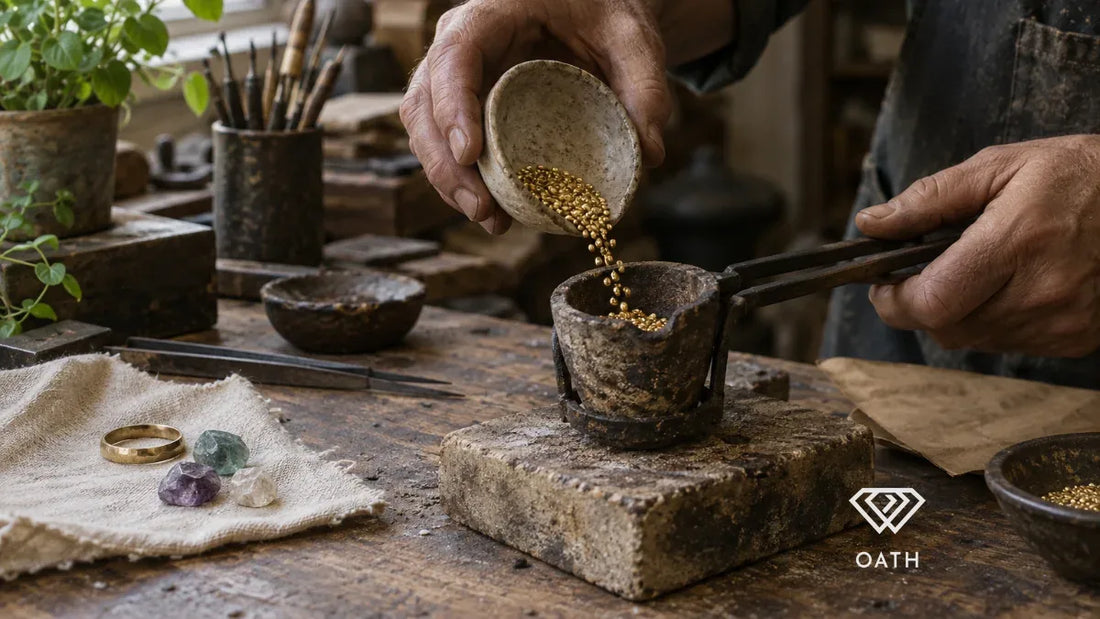
Ethical jewelry means sourcing gemstones and metals in ways that minimize harm to people and the environment. This involves responsible mining standards, fair labor practices, conflict-free diamond sourcing, and transparent supply chains. Certifications from the Responsible Jewellery Council, Fairmined, and the Kimberley Process provide independently verified standards that buyers can evaluate before purchasing.
Jump to a section
In 2000, a United Nations report estimated that rebel forces in Sierra Leone, Angola, and the Democratic Republic of Congo had funded years of civil war through the sale of rough diamonds. The stones were traded through informal channels, eventually entering the polished diamond market without trace of origin. The public response was immediate and lasting: the Kimberley Process Certification Scheme came into effect in 2003, the first internationally recognized mechanism for keeping conflict-origin rough diamonds out of mainstream commerce. It was also the first time jewelry buyers had a concrete, government-backed certification they could point to when evaluating a purchase.
Ethical jewelry sourcing has evolved considerably since then. The Kimberley Process addresses one dimension of one material. The supply chains behind fine jewelry span gold from multiple continents, colored gemstones from artisanal mines with limited oversight, and manufacturing across countries with widely varying labor standards. The Responsible Jewellery Council and similar bodies now set standards across that whole chain. Understanding what ethical sourcing means in practice, which certifications verify what, and how buyers can ask informed questions before purchasing is the purpose of this guide.
What Does Ethical Jewelry Mean in Practice?
Ethical jewelry is not a single standard or a binary category. It is a spectrum of sourcing practices, labor standards, environmental commitments, and supply chain transparency that varies by material, country of origin, and the specific choices made by each supplier and retailer. Understanding this is the foundation of making informed purchases: no piece of jewelry is produced without supply chain impact, but meaningful distinctions exist between sourcing that meets independently verified standards and sourcing with no accountability at all.
The supply chain for a piece of fine jewelry is longer than most buyers realize. A diamond ring sold in a U.S. retail store may have traveled from a mine in Botswana, through a cutting center in India, to a manufacturer in China, then to a U.S. distributor and finally a retail jewelry store. Each step in that chain has its own labor practices, environmental footprint, and record-keeping standards. A certification that covers only the mining origin does not address what happens next.
For gemstones other than diamonds, the picture is more complex. Colored stones like ruby, sapphire, and emerald often originate from artisanal and small-scale mines in Myanmar, Colombia, Zambia, or Madagascar, where thousands of individual miners work in informal operations with limited labor oversight and significant physical risk. The gemstone supply chain is the least regulated segment of the fine jewelry industry, which is why independent certification for colored gemstones remains limited compared to diamonds.
For gold and platinum, the situation is more structured but still uneven. Large-scale industrial mines often operate under national environmental and labor regulations, though the rigor of enforcement varies significantly by country. Artisanal and small-scale gold mining, which accounts for a meaningful share of global gold production, involves miners working without formal employment status, frequently exposed to mercury and other hazardous materials, in conditions that vary widely across regions.
Buyers who want to make informed choices have access to real tools: independent certification schemes that have verified specific sourcing claims through third-party audit, supplier transparency programs, and the option to choose lab-grown alternatives where the supply chain concern is origin rather than craftsmanship. None of these are perfect, and all require the buyer to ask specific questions rather than accepting vague marketing language.
What Is the Kimberley Process?
The Kimberley Process Certification Scheme, commonly called the Kimberley Process or KPCS, is an intergovernmental certification scheme that entered into force in January 2003. It was developed in response to the role conflict diamonds played in funding armed conflict in parts of sub-Saharan Africa during the 1990s. The scheme requires participating governments to certify that shipments of rough diamonds are conflict-free before they can be exported or imported between participating countries. As of 2025, 85 countries participate in the KPCS, representing virtually the entire rough diamond trade by volume.
The Kimberley Process has a specific and limited scope. It covers rough diamonds, not polished or cut diamonds. It addresses conflict diamonds, defined specifically as diamonds used by rebel movements to finance wars against legitimate governments. It does not address labor conditions in diamond mines, environmental practices, or the broader human rights record of mining operations. A diamond can be KPCS-compliant and still originate from a mine with poor labor practices, provided those practices are not connected to funding an armed rebellion.
Scope Note
Kimberley Process compliance confirms a rough diamond did not finance armed rebellion. It does not certify labor conditions, environmental practices, or human rights at the mine. Treat it as a baseline, not a complete ethical guarantee; for broader assurance, look to RJC certification of the retailer.
This limitation has been widely discussed within the industry. The Diamond Development Initiative and Global Witness, which helped establish the Kimberley Process, have both noted that the original definition of conflict diamond is too narrow to address contemporary sourcing concerns. Buyers who care specifically about conflict financing can rely on the Kimberley Process as the relevant verified standard. Buyers with broader labor or environmental concerns should look to more comprehensive certifications.
In practical terms, the Kimberley Process means that virtually all diamond jewelry sold by established retailers in participating countries carries implicit KPCS compliance through its supply chain. The certification is a baseline, not a premium claim, in the commercial diamond market today.
What Does Responsible Jewellery Council Certification Cover?
The Responsible Jewellery Council, commonly called the RJC, is an independent standards-setting and certification organization for the watch and jewellery industry. Founded in 2005, the RJC developed a Code of Practices that covers responsible business practices across the full jewelry supply chain, from mining through retail. Member companies that achieve RJC certification have been independently audited against this standard by an accredited third-party auditor and must re-certify every three years to maintain their status.
The RJC Code of Practices is more comprehensive than the Kimberley Process. It addresses human rights, labor rights including prohibitions on child labor and forced labor, occupational health and safety, environmental management, anti-corruption and anti-bribery practices, product disclosure requirements including treatment disclosure for gemstones, and supply chain due diligence. The standard applies to diamonds, gold, silver, platinum group metals, and the gemstones most commonly used in commercial jewelry.
RJC certification is available to mining companies, refiners, manufacturers, retailers, and other participants in the jewelry supply chain. A retail business with RJC certification has been audited on its own business practices and has committed to sourcing from certified suppliers where possible. RJC certification at the retail level does not guarantee that every component of every product was sourced from certified suppliers, but it does mean the business operates under audited standards and is transparent about its sourcing policies.
"The RJC Code of Practices establishes responsible business practice requirements across the full jewellery and watch supply chain. RJC Member certification provides assurance to consumers, brand owners, and other stakeholders that certified businesses have met independently audited requirements across human rights, labour rights, health and safety, environment, business ethics, and supply chain due diligence. Certification is a commitment to continuous improvement, not a static status."
Responsible Jewellery Council
Code of Practices 2019, responsiblejewellery.com
Founded in 2005, the RJC is the leading standards body for the global watch and jewellery industry. Over 1,400 businesses in 74 countries hold RJC certification, requiring independent third-party audit and renewal every three years.
What Is Fairmined Gold?
The Fairmined standard is a certification specifically designed for gold, silver, and platinum sourced from artisanal and small-scale mining operations. It is operated by the Alliance for Responsible Mining, a Colombian non-profit organization working to improve conditions for artisanal and small-scale miners globally. Fairmined certification covers the mining operation itself, verifying that it meets standards for fair wages, safe working conditions, prohibition of child labor, environmental responsibility including restrictions on mercury use, and community development practices.
Artisanal and small-scale mining is economically significant and socially complex. These operations provide livelihoods for miners who often lack access to formal employment, banking, or legal protection. They also frequently involve physical hazards, including mercury exposure in gold recovery, and limited oversight of environmental practices. The Fairmined standard is designed specifically to improve conditions in this sector rather than to replace artisanal mining with industrial alternatives.
The Fairmined label on finished jewelry means the gold in that piece was sourced from a certified artisanal mine, processed by a certified refiner, and tracked through the supply chain to the finished piece. Jewelry carrying the Fairmined mark is less common in mass market retail than in independent and artisan jewelry; the standard is more compatible with smaller-scale production than with high-volume commercial supply chains. For buyers who specifically want to support artisanal mining communities under verified conditions, the Fairmined label is the most directly relevant certification available.
Lab-grown stones offer a different supply chain entirely. Lab-created gemstones are produced in controlled industrial environments, removing the artisanal mining dimension but not the energy and manufacturing footprint of production. For buyers whose primary concern is mining origin rather than the gem itself, lab grown diamonds and lab-created colored gemstones provide an alternative. For buyers whose concern is supporting artisanal miners under fair conditions, Fairmined and similar standards address that specifically. For more on what lab-grown versus natural stones mean for quality and value, the fine jewelry buying guide covers the full picture.
How Do You Evaluate an Ethical Jewelry Claim?
Jewelry marketing frequently uses language that implies responsible sourcing without specifying any verified standard. Terms like responsibly sourced, ethically mined, sustainable jewelry, and conscious collection are common, and none of them is governed by an industry standard or subject to third-party verification unless the claim references a specific recognized certification. Buyers who want to distinguish genuine commitment from marketing language should look for specific, verifiable claims rather than general adjectives.
Watch For Vague Claims
"Responsibly sourced", "ethically mined", and "conscious collection" are not governed by any standard unless they name a specific certification. Treat an unbacked adjective as marketing, not verification. Ask which certification, who issued it, and where the material originated; a transparent seller answers all three.
Useful questions to ask a retailer: Which certification does this piece carry, and who issued it? Is the supplier RJC-certified? Can you tell me where the gold or gemstone originated? These questions do not require a hostile interaction. A retailer with genuine sourcing transparency will be able to answer them. A retailer that cannot provide specific answers to specific questions has not invested in supply chain transparency, regardless of how its products are described in marketing copy.
Certification is not the only meaningful indicator. Transparency itself, where a retailer openly describes its suppliers, sourcing policies, and the limitations of what it can verify, is more informative than a retailer that makes sweeping claims without documentation. The absence of a Fairmined mark does not mean gold was sourced irresponsibly; it may simply mean the supplier is a large industrial mine operating under national regulations rather than the artisanal mining operations Fairmined is designed for. For a deeper look at how to identify credible sellers across jewelry categories, the relevant section of the fine jewelry buying guide covers seller evaluation in detail.
Lab-grown options remove mining origin from the equation for buyers who prioritize that dimension. Lab-created diamonds and colored gemstones carry the same chemical and physical properties as their mined counterparts and eliminate concerns about conflict sourcing and artisanal mining conditions. They do not eliminate the energy and manufacturing footprint of production, and they are not inherently sustainable in every dimension, but they represent a meaningfully different supply chain for buyers for whom origin is the primary concern.
In Short
1Ethical sourcing is a spectrum across origin, labor, environment, and transparency, not a single yes-or-no label.
2Each certification has a defined scope: Kimberley Process covers conflict origin, RJC covers full business practices, Fairmined covers artisanal mining.
3Ask which certification, who issued it, and where the material came from; specific answers separate genuine sourcing from marketing language.
Ethical Jewelry Certifications at a Glance
Ethical Sourcing Guide for Jewelry Buyers
A one-page reference covering the major ethical certifications, what each verifies, the questions to ask a retailer, and how lab-grown options compare to mined alternatives. A practical tool for buyers who want specific answers rather than marketing language. We'll email it to you.
Email Me the Guide →Gemstone Jewelry at Oath


The most practical thing a buyer can do is ask specific questions and expect specific answers. Ethical sourcing is not a binary condition, and no piece of jewelry is produced without supply chain impact, but the difference between a supplier that can document its sourcing practices and one that cannot is meaningful. Certifications like RJC, Fairmined, and the Kimberley Process exist precisely to make those distinctions legible. For further reading on how to evaluate fine jewelry quality and seller credibility before purchasing, the fine jewelry buying guide covers the full range of purchasing considerations. For the gemstone-specific context behind ethical sourcing, the gem and metal symbolism guide provides historical background on how different cultures have valued these materials. Every order ships free with a 30-day return policy.
Frequently Asked Questions
01
What does conflict-free diamond mean?
Conflict-free refers to diamonds that have not been used to finance armed conflict against recognized governments. The Kimberley Process Certification Scheme, in effect since 2003, is the primary mechanism for certifying that rough diamonds are conflict-free before entering the commercial market. A conflict-free certification through the Kimberley Process addresses origin in relation to armed conflict specifically; it does not cover labor conditions, environmental practices, or other sourcing dimensions.
02
Is lab-grown jewelry more ethical than mined?
Lab-grown gemstones provide a different supply chain than mined ones, which is meaningful for buyers whose primary concern is mining origin. Lab-created diamonds and colored gemstones are produced in controlled industrial environments, eliminating concerns about conflict sourcing and artisanal mining conditions. They are not without environmental footprint, as production requires significant energy, and they do not address concerns specific to manufacturing or labor practices in jewelry production. Whether lab-grown is preferable depends on which dimension of the supply chain the buyer prioritizes.
03
How do I know if a jewelry brand is actually ethical?
Specific, verifiable claims are the distinguishing characteristic of credible ethical sourcing. A brand with genuine sourcing transparency can name its certifications, identify its suppliers, and describe what each certification covers. Broad language like responsibly sourced or ethically made without reference to a specific certification or supplier is marketing language rather than a verifiable standard. Asking direct questions, which certifications does this product carry, who certified them, where does the metal come from, produces informative responses from transparent, accountable retailers.
04
What is the Responsible Jewellery Council?
The Responsible Jewellery Council is an independent standards-setting and certification organization for the global watch and jewellery industry, founded in 2005. Its Code of Practices covers responsible business practices across the full jewelry supply chain, including human rights, labor rights, environmental management, anti-corruption, and supply chain due diligence. Member companies that achieve RJC certification have been independently audited by an accredited third-party auditor and must re-certify every three years. Detailed standards documentation is available at responsiblejewellery.com.
05
Does ethical jewelry cost more?
Certified ethical sourcing, particularly Fairmined gold, carries a premium that reflects the additional costs of certification and the fair pricing paid to artisanal miners. Fairmined-marked jewelry typically costs somewhat more than comparable pieces from uncertified supply chains, though the difference varies by piece. RJC-certified retailers do not necessarily charge more than non-certified retailers for comparable products, as RJC certification covers business practice standards rather than specific supply chain pricing. The premium, where it exists, is a direct reflection of the cost of paying suppliers fairly and maintaining independent audit standards.
06
What certifications should I look for when buying gemstone jewelry?
For diamonds, Kimberley Process compliance is the baseline conflict-free standard; RJC certification of the retailer addresses broader responsible business practices. For gold and platinum, Fairmined certification of the metal is the most direct verification of fair artisanal sourcing; RJC certification of the supplier covers large-scale operations. For colored gemstones, certification options are more limited; the most reliable signal is a retailer with documented sourcing policies, treatment disclosure practices, and ideally RJC membership. For any gemstone purchase, treatment disclosure, whether a stone has been heat-treated, filled, or enhanced, is a minimum standard of transparency that credible retailers provide as a matter of course. For treatment norms stone by stone, the birthstone guide covers what is standard for each gem.