
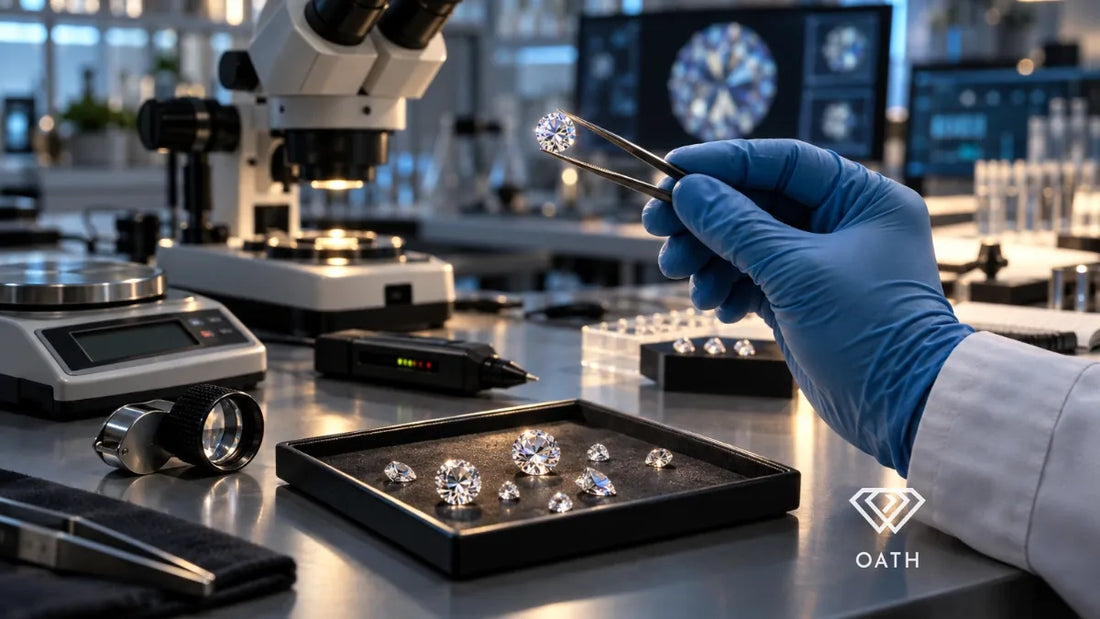
A lab-grown diamond is a diamond: pure carbon crystallized in the same cubic structure as a mined diamond, with the same hardness and brilliance. It differs only in origin. In the United States it must be sold with a qualifier such as laboratory-grown, and the words real, genuine and natural are reserved for mined stones.
Jump to a section
The answerHow they are madeTelling them apartWhy the labelWorth buying?Before you buyCareFAQThis question usually comes up at the moment of a decision: a lab-grown stone looks the same, costs less, and the buyer wants to know whether they are getting a diamond or something that merely imitates one. The short answer is that it is a diamond. The longer answer explains why it is labeled differently, how it is identified, and when that difference should change what you buy.
Is a lab-grown diamond a real diamond?
A lab-grown diamond is a diamond. It is made of the same carbon, arranged in the same cubic crystal, with the same hardness and the same brilliance as a diamond mined from the earth. The Gemological Institute of America describes laboratory-grown diamonds as essentially chemically and optically the same as their natural counterparts.
The US Federal Trade Commission reached the same conclusion in 2018, when it revised its Jewelry Guides and removed the word natural from its definition of a diamond. A diamond is now defined by what it is, not where it came from: a mineral consisting essentially of pure carbon crystallized in the isometric system.
What differs is origin, and that difference matters in two places: how the stone must be described when it is sold, and how it holds value afterward. Both are covered below.
How are lab-grown diamonds made?
Laboratory-grown diamonds are produced by one of two methods. High pressure, high temperature (HPHT) growth recreates the crushing pressure and heat of the earth's mantle in a press, crystallizing carbon around a small diamond seed. Chemical vapor deposition (CVD) builds the crystal layer by layer from a carbon-rich gas inside a vacuum chamber, again starting from a seed.
Both methods produce a crystal in weeks rather than billions of years. The rough is then cut and polished by the same methods used for mined diamonds, and graded on the same 4Cs of cut, color, clarity and carat. Some CVD diamonds are given an additional heat treatment after growth to improve their color, which a grading report will disclose.
Laboratory growth is not new. Scientists first produced diamond in a laboratory in the 1950s, initially for industrial cutting tools. Gem-quality stones in commercial quantities arrived much later, as growth techniques improved enough to produce large, clear crystals reliably.
Can you tell a lab-grown diamond from a mined one?
Not by eye, and not with a standard diamond tester. Both kinds of diamond pass the same heat and electrical tests, because they are the same material. Gemological laboratories separate them using specialized instruments that read tiny differences in growth patterns, trace elements and fluorescence.
In practice, you identify a lab-grown diamond by its paperwork and its marking. Most are laser-inscribed on the girdle and sold with a grading report that states laboratory-grown on its face. The guide to telling whether a diamond is genuine covers how to separate diamonds from simulants such as cubic zirconia and moissanite, which are different materials altogether.
| Property | Mined diamond | Laboratory-grown diamond |
|---|---|---|
| Composition | Essentially pure carbon | Essentially pure carbon |
| Crystal structure | Cubic (isometric) | Cubic (isometric) |
| Hardness | 10 on the Mohs scale | 10 on the Mohs scale |
| Refractive index | About 2.42 | About 2.42 |
| How it formed | Deep underground over billions of years | HPHT or CVD growth over weeks |
| How to tell | Only with laboratory instruments | Only with laboratory instruments |
| How it is described | Diamond, natural diamond | Laboratory-grown or laboratory-created diamond |
| Resale value | Holds a secondary market | Limited secondary market |
Why are lab-grown diamonds sold with a qualifier?
US advertising rules require it. Under the FTC Jewelry Guides, a laboratory-grown diamond must be described with a clear qualifier such as laboratory-grown, laboratory-created or a manufacturer's name followed by created. The words real, genuine and natural are reserved for mined stones and should not be used to describe a laboratory-made product.
This is a rule about honest description, not a judgment about the stone. A laboratory-grown diamond is still a diamond; the qualifier simply tells the buyer how it was formed. It is the same reason cultured pearls and lab-created sapphires carry their own labels. The guide to simulant, synthetic and natural gems explains the three categories every buyer should know.
Disclosure Note
If a seller describes a laboratory-grown diamond without saying so clearly, or describes a simulant such as cubic zirconia as a diamond, that is a disclosure failure. Look for the words laboratory-grown on the listing, the grading report and the girdle inscription.
Is a lab-grown diamond worth buying?
For many buyers, yes. A laboratory-grown diamond offers the same appearance and durability as a mined diamond, usually at a meaningfully lower cost for the same size and quality, which is why it has become a popular choice for engagement rings, studs and tennis bracelets.
The trade-off is resale. Mined diamonds have an established secondary market; laboratory-grown diamonds, which can be produced in quantity, generally do not hold value the same way. If the piece is meant to be worn and kept, that matters little. If future resale value is part of the decision, a mined diamond is the more conservative choice.
Some buyers also weigh origin itself: a mined diamond carries the story of its geological age, while a laboratory-grown diamond avoids mining altogether. The comparison of lab-grown and natural diamonds for engagement rings covers that decision in depth, and the lab-grown diamond buying guide explains how to judge quality and choose a setting.
What should you check before buying a lab-grown diamond?
Four checks cover most of the risk. First, the grading report: it should come from an independent gemological laboratory and state laboratory-grown clearly on its face, along with the stone's cut, color, clarity and carat weight. Second, the girdle inscription: most laboratory-grown diamonds carry a laser-inscribed report number or the words lab grown, which a jeweler can show you under magnification.
Third, any treatment. Some CVD stones are heat-treated after growth to improve color, and the report should say so. A treated stone is not a lesser diamond, but you should know what you are buying. Fourth, the listing itself: the description, the product title and the receipt should all carry the qualifier. If any one of them simply says diamond with no qualifier, ask before you buy.
Beyond those checks, judge a laboratory-grown diamond the way you would any diamond. Cut quality drives sparkle more than any other factor, so prioritize it over a small step up in carat weight, and choose a setting metal that suits how often the piece will be worn.
How do you care for a lab-grown diamond?
Exactly as you would a mined diamond. Clean it with warm water, mild soap and a soft brush to remove the skin oils and lotion that dull its sparkle, and have the setting checked once a year so prongs stay secure. Diamond's hardness protects the stone itself; the metal around it, whether 14K or 18K gold or platinum or white gold, is what needs the attention.
The guide to evaluating lab-grown diamond quality explains how grading reports for laboratory-grown stones differ from those for mined diamonds.
"A mineral consisting essentially of pure carbon crystallized in the isometric system."
Federal Trade Commission, Jewelry Guides, 16 CFR 23.12 (definition of diamond, revised 2018)
Federal Register, Guides for the Jewelry Industries
Further reading: GIA on natural and laboratory-grown diamonds. The 2018 revision removed the word natural from the definition, while still requiring laboratory-grown diamonds to be clearly qualified when sold.
In Short
1A lab-grown diamond is a diamond, with the same composition, crystal structure, hardness and brilliance as a mined one.
2It must be sold with a qualifier such as laboratory-grown; real, genuine and natural are reserved for mined stones.
3It offers the same look for less outlay, but holds resale value less well than a mined diamond.
Want the full diamond reference?
The Oath jewelry guide covers the 4Cs, lab-grown and mined diamonds, settings and care in one place. We will email it to you.
Email Me the Guide →


Every order ships free with a 30-day return policy.
A laboratory-grown diamond is a diamond with a different origin story. Buy it for how it looks and wears, check that it is clearly labeled, and choose mined only if resale or geological origin matters to you. Every order ships free with a 30-day return policy.
Frequently Asked Questions
01
Are lab-created diamonds real diamonds?
Lab-created diamonds are diamonds: the same carbon, crystal structure, hardness and brilliance as mined diamonds. The FTC's definition of a diamond does not depend on origin. When they are sold, US rules require a qualifier such as laboratory-created, and terms like real and natural are reserved for mined stones.
02
Is there a difference between lab and natural diamonds?
The difference between lab-grown and natural diamonds is origin, not material. A natural diamond formed underground over billions of years; a lab-grown diamond formed in weeks by HPHT or CVD growth. They can only be told apart with laboratory instruments, and they differ in resale value.
03
Do lab-grown diamonds pass a diamond tester?
Lab-grown diamonds pass standard diamond testers, because testers measure heat and electrical conductivity, which are the same in both. Separating lab-grown from mined diamonds requires specialized laboratory equipment or a grading report.
04
Are lab diamonds worth buying?
Lab diamonds are worth buying for someone who wants the look and durability of a diamond at a lower cost for the size and quality. They are less suitable for anyone who expects to resell the stone, because lab-grown diamonds generally hold value less well than mined ones.
05
Do lab-grown diamonds get cloudy over time?
Lab-grown diamonds do not get cloudy over time any more than mined diamonds do. Both can look dull when coated in skin oils or lotion, and a gentle clean with warm soapy water restores their sparkle.
06
Is moissanite a lab-grown diamond?
Moissanite is not a diamond of any kind. It is silicon carbide, a different mineral with its own hardness and optical properties. The moissanite buying guide explains how it compares.