
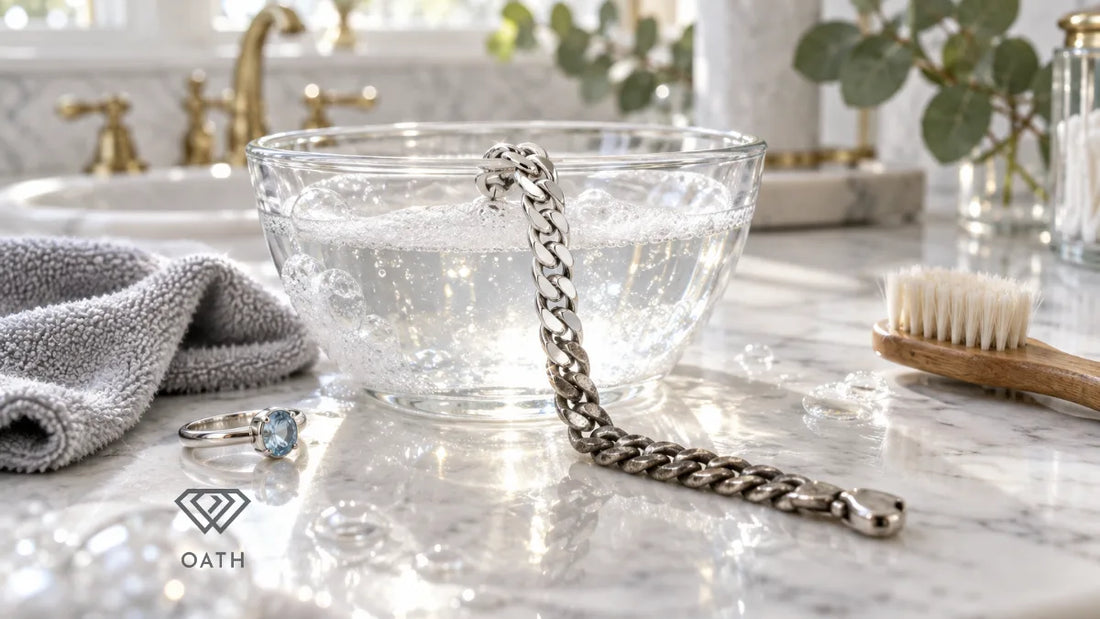
To clean silver jewelry, soak it for a few minutes in warm water with a few drops of mild dish soap, brush gently with a soft toothbrush, rinse, and dry it immediately with a soft cloth. Remove remaining tarnish with a silver polishing cloth. Avoid toothpaste, bleach and harsh dips, which scratch or damage silver.
Jump to a section
Why it tarnishesHow to cleanHeavy tarnishWhat to avoidPlated and stone-setPreventionFAQSilver is one of the easiest precious metals to keep looking new, as long as you use the right method. Most tarnish comes off with soap, water and a polishing cloth, and the methods that cause damage are usually the ones that promise the quickest results. This guide covers how to clean silver jewelry safely, how to remove heavy tarnish, and how to stop it coming back.
Why does silver jewelry tarnish?
Silver tarnishes because it reacts with sulfur compounds in the air. Hydrogen sulfide, present in small amounts almost everywhere, bonds with the surface of the metal and forms a thin film of silver sulfide. At first the film is barely visible and gives the piece a faint yellow cast. As it thickens, it turns brown and eventually blue-black.
Sterling silver tarnishes a little faster than pure silver because of what it is made of. To be sold as sterling in the United States, a piece must contain at least 92.5% silver, usually stamped 925, and the remaining 7.5% is most often copper, which adds strength but also reacts with sulfur and moisture. The guide to the 925 stamp explains how sterling is marked.
Humidity, sweat, perfume, lotion, chlorinated water, rubber bands and some fabrics all speed the reaction up. A ring worn every day often stays brighter than one kept in a drawer, because friction against skin and clothing gently polishes the surface before tarnish can build.
92.5%
Minimum silver in a piece sold as sterling
Sulfide
Tarnish is a surface film of silver sulfide
Airtight
Sealed storage is the most effective prevention
How do you clean silver jewelry at home?
Start with the gentlest method and only move on if it is not enough. Most silver jewelry needs nothing more than soap, water and a soft cloth.
1. Wash. Fill a small bowl with warm water and add a few drops of mild, phosphate-free dish soap. Let the piece soak for five to ten minutes to loosen skin oil and lotion.
2. Brush. Use a soft, clean toothbrush to work gently around clasps, links, engraving and the back of any setting, where residue collects.
3. Rinse and dry. Rinse under lukewarm running water with the drain closed, then dry immediately with a soft cotton or microfiber cloth. Water left on silver encourages new tarnish, so make sure links and crevices are fully dry before storing.
4. Polish. For any yellow or brown tarnish that remains, rub the piece with a silver polishing cloth using straight, back-and-forth strokes rather than circles. Most polishing cloths have a treated inner layer that lifts tarnish and a plain outer layer for a final buff. The cloth will turn black as it works; that is the tarnish coming off.
How do you remove heavy tarnish from silver?
Heavy, blue-black tarnish on a plain silver piece can be reversed with a baking soda and aluminum foil bath. Line a heat-safe bowl with foil, shiny side up, place the jewelry on the foil, sprinkle in about a tablespoon of baking soda, and pour in enough hot water to cover the piece. Leave it for a few minutes, then rinse, dry and buff with a polishing cloth.
The bath works by chemistry rather than scrubbing: the aluminum draws the sulfur away from the silver, converting the tarnish back into metal. Because nothing abrasive touches the surface, it removes no silver at all. It does, however, remove deliberate darkening, so it is the wrong choice for pieces with oxidized detail that the designer blackened to make a pattern stand out.
Commercial silver dips act faster but are harsher. If you use one, keep the piece in for only a few seconds, rinse thoroughly and dry at once. Never use a dip on pearls, opal, turquoise, coral, emerald or any glued setting, and never on gold-plated or rhodium-plated silver.
Before You Clean
If a piece has stones, check that every one is secure before soaking it. A loose stone can drop out in the bowl, and water trapped behind a stone can leave a cloudy film inside the setting.
Which cleaning methods should you avoid?
Several popular shortcuts do more harm than good. Toothpaste is the most common: it contains abrasives that remove tarnish by scratching the surface, and over time it dulls a polished finish. Paper towels and tissues are made from wood fiber and can leave fine scratches too, so use cotton or microfiber instead.
Chlorine bleach and pool water are worse. Chlorine attacks silver and the copper in sterling, causing pitting and dark staining that polishing cannot fully remove. Take silver off before swimming, using a hot tub or cleaning with household bleach.
| Method | Plain sterling silver | Silver with stones, pearls or plating |
|---|---|---|
| Mild soap and warm water | Safe for routine cleaning | Safe; dry stones and settings fully |
| Silver polishing cloth | Safe; the best tool for light tarnish | Avoid rubbing plated surfaces hard |
| Baking soda and foil bath | Safe for plain pieces | Avoid; it can strip oxidized detail and harm porous stones |
| Commercial silver dip | Use briefly, then rinse well | Avoid with pearls, opal, turquoise and plated pieces |
| Toothpaste | Avoid; it is abrasive and leaves fine scratches | Avoid |
| Bleach or chlorine | Never; it pits and discolors silver | Never |
| Ultrasonic cleaner | Usually safe on solid silver | Avoid with porous, fractured or glued stones |
The same principles apply to other metals, with small differences. Gold does not tarnish the way silver does, so it rarely needs polishing; the guide to cleaning gold jewelry safely covers its routine.
How do you clean plated or stone-set silver?
Much modern sterling is finished with a thin plating. Rhodium plating gives silver a bright white surface that resists tarnish, and gold plating gives it the color of yellow or rose gold. Both are very thin, so the rule is to clean gently and never polish hard. Soap, water and a soft brush are enough; skip dips, foil baths and abrasive cloths, which can wear through the plating and expose the silver underneath.
Silver set with gemstones needs the same care as the most delicate stone in it. Diamonds, sapphires and rubies tolerate warm soapy water well. Pearls, opal and turquoise are porous and should only be wiped with a soft, damp cloth, then dried. Pearls in particular should be put on last, after perfume and hairspray.
For pieces that need more than home care, such as deep tarnish in filigree, worn plating or a loose stone, a jeweler can clean, polish and replate silver professionally. The fine jewelry care guide explains when professional cleaning is worth it.
How do you keep silver from tarnishing?
Prevention is mostly about limiting air and moisture. Store each piece in a small airtight bag or a lined box with anti-tarnish strips, which absorb sulfur compounds before they reach the metal. A silica gel packet in the drawer helps in humid climates. Keep pieces separate so chains do not scratch one another.
Put silver on last, after lotion, perfume and hairspray, and take it off first. Remove it for swimming, exercise, cleaning and cooking with eggs or onions, both of which release sulfur. Wipe each piece with a soft cloth before putting it away to remove skin oil.
Above all, wear it. Regular wear keeps silver bright with very little effort, and a quick polish every few weeks keeps tarnish from ever reaching the brown stage. The complete guide to silver jewelry covers sterling, fine silver and how each wears.
"Hydrogen sulfide has a very strong affinity for silver."
David Thickett and Kathryn Hallett, "Managing silver tarnish", ICOM-CC 19th Triennial Conference, 2021 (English Heritage)
English Heritage conservation research
Further reading: FTC Jewelry Guides on silver content, 16 CFR 23.5. Conservators at English Heritage found that well-sealed storage stopped silver tarnish, the same principle behind airtight bags and anti-tarnish strips at home.
In Short
1Tarnish is a thin film of silver sulfide; it comes off completely with the right method.
2Clean with mild soap and warm water, dry at once, then polish with a silver cloth; use a foil bath only for heavy tarnish on plain pieces.
3Avoid toothpaste, bleach and harsh dips, and store silver airtight to slow tarnish.
Want the full care reference?
The Oath jewelry guide covers cleaning and storing silver, gold, platinum and gemstones in one place. We will email it to you.
Email Me the Guide →


Every order ships free with a 30-day return policy.
Clean silver gently and often, polish away tarnish before it darkens, and store it airtight. That routine keeps sterling bright for decades. Every order ships free with a 30-day return policy.
Frequently Asked Questions
01
How do I clean silver jewelry at home?
Silver jewelry cleans well at home with a few drops of mild dish soap in warm water. Soak it for five to ten minutes, brush gently with a soft toothbrush, rinse, and dry it immediately with a soft cloth. Finish with a silver polishing cloth if any tarnish remains.
02
How do I remove tarnish from silver?
Silver tarnish comes off light pieces with a silver polishing cloth, rubbed in straight strokes. For heavy, dark tarnish on plain silver, a bath of baking soda and hot water in a foil-lined bowl converts the tarnish back to metal without scrubbing. Avoid that bath on oxidized, plated or stone-set pieces.
03
How do I clean a silver necklace or chain?
A silver chain is cleaned by soaking it in warm soapy water, then working a soft brush gently along the links. Rinse it, lay it flat on a soft towel and pat it dry, making sure no water stays trapped in the links. A polishing cloth pulled gently along the chain removes remaining tarnish.
04
Is toothpaste safe for cleaning silver?
Toothpaste is not safe for silver jewelry. It contains abrasives that remove tarnish by scratching the metal, and repeated use leaves a dull, hazy finish. A polishing cloth or a soap and water wash does the same job without removing any silver.
05
Does sterling silver tarnish?
Sterling silver does tarnish, because both silver and the copper alloyed with it react with sulfur compounds in the air. Rhodium-plated sterling resists tarnish until the plating wears. Regular wear, airtight storage and a quick polish every few weeks keep it bright.
06
How do I keep silver from tarnishing?
Silver stays bright longest when it is stored airtight, in a sealed bag or a box with anti-tarnish strips, and kept dry. Put it on after lotion and perfume, take it off for swimming and cleaning, and wipe it with a soft cloth before putting it away.