
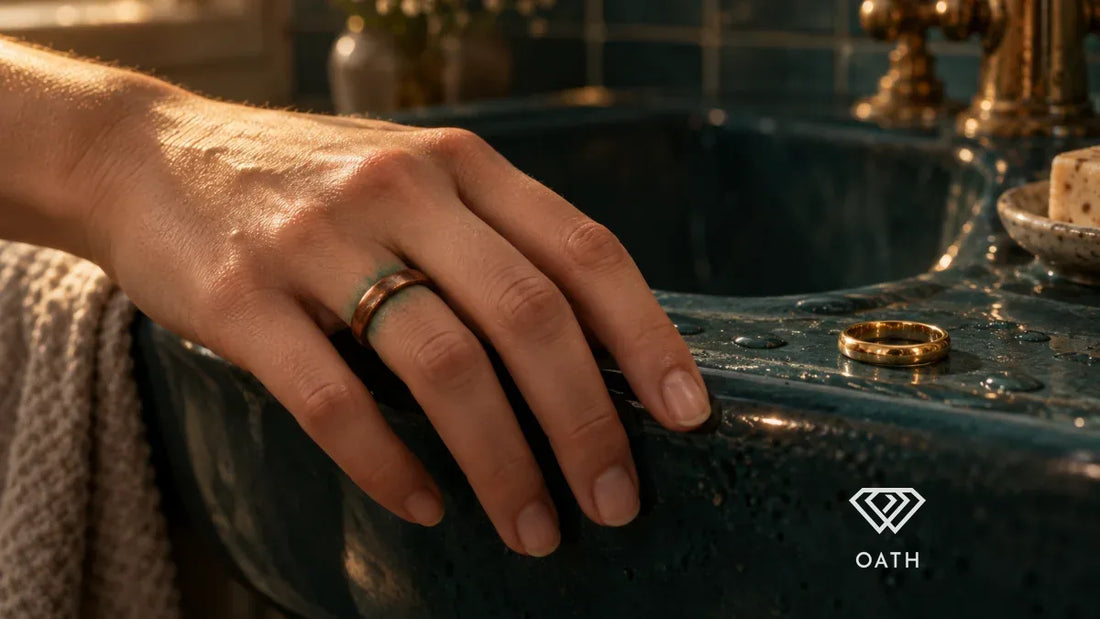
Jewelry turns skin green when copper in the metal reacts with sweat, lotion, soap and other chemicals, forming green copper salts that rub onto the skin. The mark is harmless and washes off. Brass, plated base metals, sterling silver and low-karat gold are most likely to cause it; platinum never does.
A green ring around your finger is one of the most common jewelry questions, and it has a simple chemical answer. The culprit is almost always copper, which is in brass, sterling silver and most karat gold. This guide explains why the mark appears, whether it is anything to worry about, and how to stop it for good.
Why does jewelry turn your skin green?
Jewelry turns skin green because copper in the metal reacts with moisture and chemicals on the skin. Sweat, lotion, soap and even hand sanitizer contain salts and acids that react with copper and form green copper compounds. Those compounds rub off onto the skin and leave the familiar green ring or line. The mark is harmless and washes away.
Copper is in far more jewelry than most people expect. It is the main ingredient in brass and bronze, it is the usual alloy metal in sterling silver, and it is part of most karat gold. How likely a piece is to leave a mark depends on how much copper it contains, how much of that copper is exposed, and how your skin and environment react with it.
Copper
The metal behind almost every green mark
7.5%
Copper content of standard sterling silver
0%
Copper in platinum, which never turns skin green
Which metals cause it?
Brass, copper and plated base metals cause the most green marks. Costume jewelry is often brass or copper with a thin layer of gold or silver plating on top. While the plating is intact the skin touches the plating, but as soon as it wears through at the edges or on the inside of a band, the copper underneath meets sweat and the green line appears.
Sterling silver is 92.5% silver, and the remaining 7.5% is usually copper. Most people wear sterling for years with no mark at all, but in humid weather or on skin that sweats a lot, a faint green tint can appear. The guide to what 925 means on jewelry explains the stamp and the alloy behind it.
Karat gold is gold mixed with other metals, usually silver and copper. Higher karat means more gold and less copper, so 18K rarely leaves a mark while 10K occasionally does. Rose gold uses extra copper for its color, so it is the karat gold most likely to tint the skin. The guide to 14K vs 18K gold covers how the alloys differ.
| Metal | Copper content | Green mark risk | Notes |
|---|---|---|---|
| Platinum (950) | None | Very low | No copper; the safest choice |
| 18K yellow gold | Low | Low | 75% gold, so little copper to react |
| 14K yellow gold | Moderate | Low to occasional | More alloy than 18K; body chemistry matters |
| 10K gold | Higher | Occasional | 41.7% gold, the most copper of the karat golds |
| Rose gold | High for its karat | Occasional | Copper gives rose gold its color |
| Sterling silver | 7.5% copper | Occasional | Silver tarnish can also leave a dark mark |
| Brass, copper, plated base metal | High | High | Shows once any plating wears through |
Platinum contains no copper, so it does not turn the skin green. Rhodium-plated white gold rarely does either while the plating is intact, because rhodium is one of the least reactive metals there is.
Is a green finger harmful?
A green mark on the skin is not harmful. It is a surface deposit of copper compounds that sits on top of the skin and comes off with soap and water. It does not mean the jewelry is poisoning you, and it does not mean you are allergic to the metal.
An allergy looks different. Nickel allergy, the most common metal allergy, causes an itchy red rash, small bumps or dry patches where the jewelry touches the skin, sometimes appearing a day or two after wearing the piece. If your skin is itchy or inflamed rather than simply tinted, the cause is more likely nickel than copper, and a dermatologist can confirm it with a patch test. The guide to the best metals for sensitive skin lists which metals contain nickel.
Green, Black or Red?
A green tint is copper and harmless. A black or gray smudge is usually silver tarnish or metal particles rubbed off by makeup. An itchy red rash is a possible allergy and worth a dermatologist's opinion.
Why do some rings leave a black mark instead?
A black or gray mark under a ring has two common causes. The first is tarnish: silver and the copper in gold alloys react with sulfur compounds in the air and on the skin, forming a dark film that can transfer to the skin. The second is abrasion. Makeup and sunscreen often contain hard mineral powders such as zinc oxide and titanium dioxide, and these can wear microscopic particles off the metal. Those fine particles look black against the skin.
The fix for both is the same as for green marks: keep the jewelry and the skin underneath it clean. Taking rings off while applying makeup, lotion or sunscreen and letting the products dry first prevents most black marks. If you also want to know whether solid gold itself can darken, the guide to cleaning gold jewelry covers how to remove film from karat gold.
How do you stop jewelry from turning your skin green?
Start with the habits that remove the chemistry. Take rings off before washing your hands, applying lotion or using hand sanitizer, and dry your hands fully before putting them back on. Remove jewelry before swimming, exercise and hot tubs, where sweat and chlorine speed up the reaction. Clean your jewelry regularly with warm water and a drop of mild dish soap so residue does not build up on the inside of a band.
Next, look at the piece. If a plated ring has started to mark your skin, the plating has worn through and will keep marking. A clear coat of nail polish on the inside of a band works as a temporary barrier, but it wears off within weeks and needs reapplying. Replating restores a barrier for longer. Neither changes the metal underneath, so they are short-term fixes for a piece you love rather than a solution.
The lasting fix is a metal with little or no exposed copper. Platinum, 18K gold and rhodium-plated white gold are the most reliable choices, and 14K yellow gold suits most people. The guide to gold-filled, gold-plated and vermeil explains why thicker gold layers last longer than standard plating.
Quick checklist
Remove rings for handwashing and lotion, dry skin before wearing, clean the inside of bands weekly, and avoid wearing jewelry to the pool or the gym.
Does it mean the jewelry is fake?
A green mark does not automatically mean a piece is fake. Solid 10K and 14K gold and genuine sterling silver can all leave a faint tint on some people, because they legitimately contain copper. What a green mark does tell you is that copper is touching your skin.
A strong, fast green mark from a piece sold as gold is a reason to check further, though. Look for a karat stamp such as 14K or 585, check whether the color has worn away at the edges to reveal a different metal underneath, and use the tests in the guide how to tell if your jewelry is real gold. A jeweler can confirm the metal with an acid test or an XRF reading if you are unsure.
"A green discoloration comes from a reaction between copper in jewelry and salts, acids, and other chemicals."
Anne Helmenstine, Science Notes
Science Notes, sciencenotes.org
Further reading: Mayo Clinic on nickel allergy symptoms. Science Notes adds that the copper compounds are not toxic or dangerous, and that black marks usually come from silver tarnish transferring onto the skin.
In Short
1Green marks come from copper reacting with sweat, lotion and soap; they are harmless and wash off.
2Brass, plated base metals, sterling silver, rose gold and 10K gold are most likely to cause them; platinum never does.
3Remove rings for handwashing and lotion, keep jewelry clean, and choose platinum, 18K or rhodium-plated white gold for a lasting fix.
Want the full jewelry care reference?
The Oath jewelry guide covers metals, care and what each stamp means in one place. We will email it to you.
Email Me the Guide →


Every order ships free with a 30-day return policy.
A green finger is a copper reaction, not a health problem. Keep skin and jewelry clean and dry, take rings off for lotion and handwashing, and for pieces you wear every day choose platinum, 18K gold or rhodium-plated white gold. Every order ships free with a 30-day return policy.
Frequently Asked Questions
01
Why does my gold ring turn my finger green?
A gold ring turns a finger green when the copper in its alloy reacts with sweat, soap or lotion. Lower karats such as 10K contain more copper and are more likely to do it, and rose gold uses extra copper for its color. 18K gold and platinum rarely or never leave a mark.
02
Does sterling silver turn your skin green?
Sterling silver can occasionally turn skin green, because it is 7.5% copper. Most people never see a mark, but humidity, heavy sweating and lotion make it more likely. Sterling more often leaves a dark mark from silver tarnish, which cleans off the jewelry and the skin easily.
03
Is a green finger dangerous?
A green finger is not dangerous. The mark is a deposit of copper compounds sitting on the skin, and it washes off with soap and water. An itchy red rash is different and may be a nickel allergy, which a dermatologist can confirm with a patch test.
04
Does clear nail polish stop rings turning your finger green?
Clear nail polish on the inside of a band works as a temporary barrier between the metal and your skin. It wears off within a few weeks and needs reapplying, so it is a short-term fix. A metal with little or no copper, such as platinum or 18K gold, is the lasting solution.
05
How do you remove a green mark from your skin?
A green mark comes off the skin with soap and warm water. For a stubborn mark, gently rub the area with a little makeup remover or rubbing alcohol on a cotton pad, then moisturize. Clean the inside of the ring too, or the mark will return.
06
Does real gold turn your skin black?
Real gold can leave a black mark, but the cause is usually makeup or sunscreen abrading tiny metal particles, or tarnish on the copper and silver in the alloy. Removing rings before applying cosmetics and cleaning both the ring and the skin prevents most black marks.